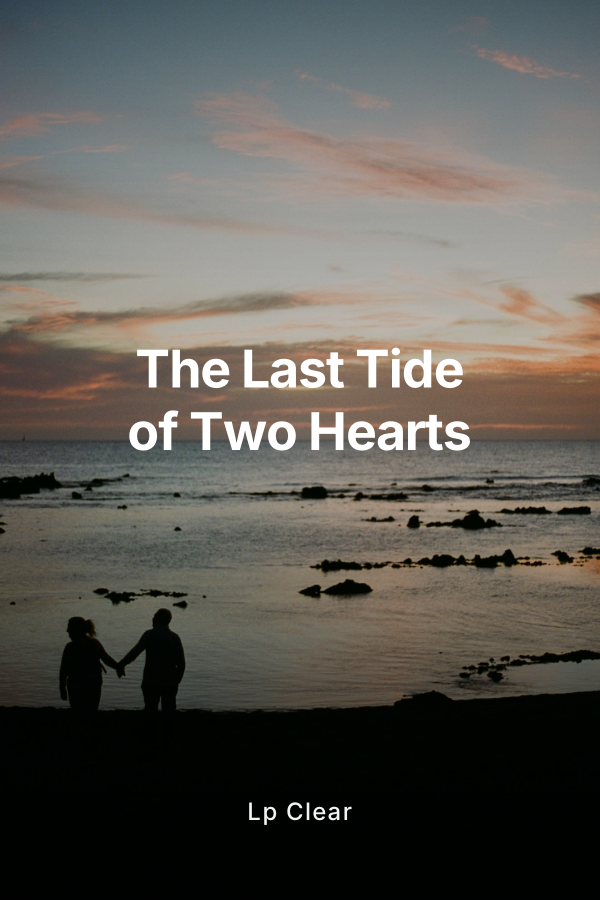
This book is an adult, dual point of view, slow burn queer romance set in a flooded post apocalyptic earth where collapsed universes have unleashed wild magic, ancient creatures, and strange new intelligences. The tone balances wonder and ruin, danger and tenderness, with explicit intimacy and a deeply emotional focus on consent, devotion, and the decision to keep living in a broken world.
Tello is a twenty something wanderer who spent his childhood in a cramped underground refuge, listening to stories about a sun he had never seen and an ocean that had swallowed entire cities before he was born. Newly free on the surface for only a few years, he sails a patched together boat across an endless sea, scavenging ruins and surviving on quick wit, stubborn optimism, and a refusal to give up on joy. Dark freckled skin, curly brown hair, and rich gold eyes make him look like a piece of sun caught in human form. He dresses in tans and earth tones, practical layers suited to salt and spray, and carries himself with a disarming warmth that hides the hard edge of someone who has clawed his way to survival more than once. Tello is kind, but not naive, funny without being flippant, honest without cruelty. He is lonely in a way he cannot even name, convinced he might be the last human alive, but still unable to stop wanting more than bare survival.
Casbian is the opposite of Tello in almost every visible way. Taller by nearly a head and a half, he stands at six foot three, with powerful muscle layered over a body that does not age, does not bruise, does not bleed. His long black hair is usually tied back or whipped loose by the wind. He wears blacks and deep blues that blend into midnight waves, and the most striking thing about him is the curling map of tattoos that starts at his left ring finger, winds up his arm, and ends in a dense swirl over his silent heart. Those markings are not art or vanity. They are the visible language of his curse. Caught in early adulthood by a spell that stole his mortality, Casbian has walked through centuries of catastrophe while everything and everyone around him decayed. His skin cannot be pierced, his nerves cannot feel pain, and his heart does not beat. He can die only one way: by falling in love. For decades he fought that fate with single minded fury. Over time, as he watched humanity crumble and the seas rise and monsters of other worlds stride through drowned cities, his refusal curdled into a quieter, more desperate thing. Now he wants death more than anything, and the only path toward it terrifies him.
When the story begins, the world is mostly ocean. What land remains is fractured and dangerous, lashed by storms tinged with raw magic. The collision of universes has left rifts in the sky, creatures that should belong in myth, and pockets of warping reality where time and gravity misbehave. Humanity has been extinct for decades as far as anyone knows. In this world Tello pilots his small, stubborn boat through wreckage and floating forests of crystal coral, never expecting to see another human face. That expectation shatters the day he finds the ribs of a beached ship, long dead on a half swallowed shoreline, and within its skeletal hull a man who looks almost carved from night. Casbian, thrown there by some recent violence and temporarily disoriented, awakens under Tello’s concerned gaze and responds with coldness, menace, and brittle warnings meant to drive the stranger away.
The attempt fails. Tello is instantly fascinated. It is not only the shock of seeing another human after years of isolation, but the particular gravity Casbian carries, an exhausted hatred of his own existence that Tello recognizes without fully understanding. Where others would flinch from the clear danger this man represents, Tello leans in. He jokes. He offers food. He offers passage. He refuses to be frightened away by threats he can see are more habit than conviction. Casbian wants to be alone, but he needs a boat and Tello has one. Tello wants company, but more than that he wants a purpose beyond wandering. He sees it in the tightness of Casbian’s mouth whenever he glances east, toward a horizon only he seems to be tracking.
Casbian is searching for a myth. Somewhere in the shifting archipelagos and half sunken mountain ranges lies a cave whispered of in old sailor’s tales, a place where curses can be severed at their roots. He intends to sail there, force the magic to lift his immortality, and finally die. He never plans to tell Tello the truth. To Tello he offers a fragment a vague goal, a rumor of something worth finding, nothing more. In exchange Tello insists on joining him. With nothing better to do and nowhere urgent to be, Tello chooses this stranger’s quest as his own, and together they set off into the unpredictable waters of a changed earth.
The middle of the book is a slow burn study in tension, survival, and the ways two opposite souls can twist gradually toward each other. Their journey spans months rather than days. They navigate magical storms that make the sky glow green and the ocean boil, negotiate iffy truces with new intelligent species that evolved or arrived after humanity’s fall, and explore ruins where the air hums with leftover spells. Each obstacle forces them to rely on one another. At first that reliance is purely practical Tello knows how to coax life from a leaky ship, Casbian knows how to fight creatures that should not exist. But shared danger turns into shared stories told late at night, then into shared jokes, unguarded glances, and the sort of inside references that feel like the beginning of a private language.
Internally, both men are a storm of want. They are intensely, almost painfully, attracted to one another. Casbian, used to distancing himself from all attachment, finds his gaze lingering on Tello’s mouth, his hands, the curve of his throat when he laughs. Tello, starved for touch and companionship, imagines in unflinching detail what it would be like to press Casbian against a cabin wall, to provoke reactions from the stoic immortal until his control cracks. Their inner monologues are explicit and kinky. They fantasize about power shifting between them in bed, about rope sliding over skin, about breath caught and given, about filthy words whispered against salt damp necks. Yet outwardly they maintain a taut restraint, circling each other with barbed banter and deceptively casual kindness instead of giving in. The slow burn is not from lack of desire but from too much of it, tangled with fear.
The pivotal external event that drags buried feelings closer to the surface is a magical storm that nearly kills Tello. During one crossing the sky fractures with unnatural lightning, and a wave charged with otherworldly power slams into the ship. Tello is swept overboard, dragged toward churning water that flashes with spectral shapes. Casbian dives after him instinctively, hauling him back through water thick with magic that sings against his cursed skin. The near loss sends a crack through Casbian’s practiced apathy. Only when Tello coughs up seawater and laughs weakly on the deck does Casbian realize how badly his hands are shaking, how hollow he feels at the idea of that laugh going silent forever. For Tello, the experience is a brutal confirmation of what he already suspects he could be content to stop wandering, to drop anchor in one place for the rest of his life, if that place were defined not by geography but by staying at Casbian’s side.
As they sail closer to the rumored cave, the emotional stakes rise. Casbian slowly reveals pieces of his history his agelessness, the curse that granted him invulnerable skin and an unbeating heart, the tattoos that grew with each century and each loss. He does not admit the final purpose of his quest. Tello fills in the gaps with more hopeful assumptions. Maybe Casbian wants to be free of the curse so he can actually live again, not so he can end himself. Maybe this journey is the start of a shared future, not an elaborate suicide. The truth, when it finally shatters that illusion, devastates him.
Tello uncovers Casbian’s real intent on the very brink of their destination, piecing it together from a half overheard conversation, old notes, and the haunted finality in Casbian’s voice. He realizes that the man he has grown to love intends to use the cave to kill himself, and that Tello’s company has been nothing but a convenient way to get there without admitting it. The betrayal is a knife. They fight at the mouth of the cave, words sharp with hurt and fear. Tello accuses Casbian of using him. Casbian, cornered, lashes out with truths designed to push Tello away, insisting that caring is a liability, that Tello’s feelings are meaningless against centuries of exhaustion. Both of them come heartbreakingly close to confessing that their anger is rooted in love, but pride and terror keep the words strangled behind their teeth. Finally Tello leaves, refusing to follow a man who is marching deliberately toward oblivion.
It is only in the echo of Tello’s absence that the quiet miracle happens. Deep within the cave, confronted with residual magic that resonates with his curse, Casbian hears something that should be impossible a faint, hesitant thud in the cage of his chest. His heart, dormant for hundreds of years, gives its first shaky beats. The realization is brutal and inescapable. Somewhere along this voyage, despite all his efforts to remain untouched, he has fallen in love with Tello. The one condition of his mortality has at last been met. The curse begins to unravel. Tattoos that once represented unbreakable protection now become vulnerable skin. The man who could once walk through fire without a mark suddenly can bleed, can bruise, can die.
Before he can fully process that change, danger crashes in. Creatures drawn to the cave’s magic attack, forcing Casbian into a battle for his life that he is no longer structurally designed to survive. Tello, walking away across the rocks with his heart in pieces, hears the sounds of that fight return to him on the wind. Instinct and love override his anger. He turns back and plunges into the chaos, flinging himself toward Casbian without thought for his own safety. In the struggle that follows Tello is nearly impaled by a blow meant for Casbian. Instead, Casbian moves faster, putting his own body between Tello and the strike. The weapon spears his chest, in the exact place where once nothing could pierce. This time blood blooms.
Tello freezes in horror. For years Casbian’s curse made his body impenetrable. The only way that protection could fail is if the condition of the spell had been met if he had fallen in love. As Casbian sags against him, bleeding and oddly unconcerned about his own injury, the truth slams into Tello. Casbian chose to take that blow, chose to risk his now fragile life, because losing Tello is more unthinkable to him than facing death. When Tello begs him to hold on, Casbian’s priorities have already reordered. Dying no longer feels like salvation. Living long enough to tell Tello the truth does. With the last of his strength, he breathes out the admission he has fought for so long. He tells Tello that he thinks he is in love with him. Then he blacks out, his body at the mercy of his newly returned mortality.
The final movement of the book revolves around the consequences of that choice and confession. Casbian survives, but only barely. He wakes three days later, bandaged and aching for the first time in centuries, in the familiar confines of his ship’s small bedroom. The weight in his chest is not just the echo of injury but the steady, rhythmic beating of a heart that has finally remembered how to move. He stumbles out to the deck and finds Tello at the bow of the ship, watching the water as if bracing for the world to take something else from him. Startled and relieved to see Casbian awake, Tello tries to shepherd him back to bed, all practical concern and shaking hands, but Casbian refuses to rest before he speaks the whole truth.
Under a sky rinsed clean by recent storms, he tells Tello everything. That he spent centuries despising the very idea of love because it was the condition of his death. That somewhere between shared meals, shared dangers, and the sight of Tello laughing in the sun, that refusal failed. That he is in love now, deeply and irreversibly, and because of that love his curse is broken. He can die. Yet now, astonishingly, he does not want to. Tello has given him something he never expected to claim again a reason to live, not out of obligation but out of desire. He tells Tello he wants forever, not an ending, if Tello will have him. Tello, who has already walked through the terror of almost losing him, responds with equally raw honesty. He confesses that he would gladly anchor himself to one person for the rest of his life if that person is Casbian. Their kiss at sunset is not tidy or restrained. It is the culmination of months of denied need, soaked in relief, apology, and a new promise.
The epilogue offers a quieter, more intimate glimpse into the life they build after choosing each other. Time has passed. They now live together on a larger ship with a balcony overlooking the ever changing ocean. One cold morning Tello stands outside, bare legs prickled by the chill, wearing only an oversized loose shirt that clearly belongs to Casbian and a leather cord hung with a single pearl at his throat, a gift worn like a claim. His skin is marked by Casbian’s mouth, a constellation of hickeys across his neck and inner thighs that speak to nights of enthusiastic, consensual, and often kinky exploration. Casbian joins him, shirtless and unguarded, slipping behind him to wrap warm arms around Tello’s waist. He teases him about stealing his clothes, about standing in the cold when the bed is still warm, about how the early light makes Tello’s freckles look like stars. Internal monologue reveals that their sex life is as explicit and playful as both men once only imagined in secret, filled with shared kinks they have discussed and chosen together rather than stumbled into.
Tello traces the ink that still curls over Casbian’s arm, lingering over the new scar carved across his chest where the fatal blow almost claimed him. Casbian covers Tello’s hand with his own, presses it over his now beating heart, and reminds him softly whose name it keeps time for. The scene closes on another kiss, another sunrise, and the steady motion of a ship that is no longer a vehicle for running from the world but a home carried from horizon to horizon. They are no longer the last humans clinging to life out of reflex. They are two men who have chosen each other and, through that choice, have transformed a death wish into a shared future.
Across its five chapters, the book traces intertwined arcs. Tello journeys from restless, half feral wanderer convinced he is fundamentally alone to a man who understands that choosing a person can be as wild and brave as choosing an ocean. His optimism matures into a fierce, deliberate hope. Casbian travels from cursed immortal who sees love only as a condition of his escape to a man willing to risk vulnerability, uncertainty, and pain in order to keep living beside one particular person. The romance is slow burn but eventually very explicit, framed always by mutual desire, verbal consent, and the contrast between Tello’s open hunger for connection and Casbian’s initial terror of it.
Thematically, the story asks what it means to live in a ruined world. It suggests that love does not fix broken landscapes or undo historical catastrophe, but it does answer the question of why survival might still matter. The magic and monsters, the flood and the cave, all circle the same quiet truth: that being truly seen and chosen by another person can feel like both the smallest and most revolutionary act in a universe that has already ended once.