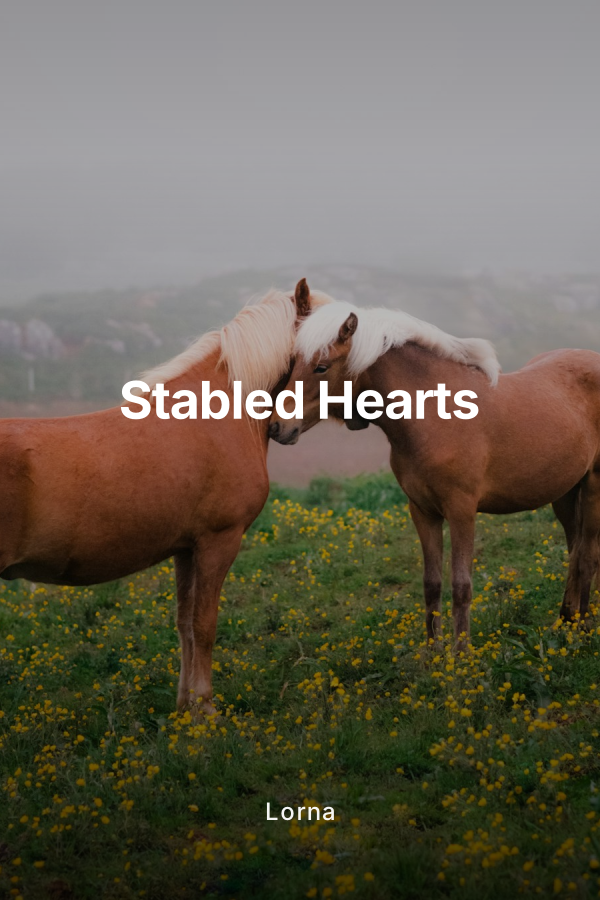
Elaine never planned to become a mistress of flesh and leather. At forty five, freshly bereaved and determined to honor her mother’s legacy, she inherits Southdowns Stables, a picturesque and profitable riding business that has anchored her family for decades. She believes she can expand it, modernize it, and finally step out from her mother’s shadow. Then a violent economic downturn tears through the countryside and empties her booking calendar almost overnight, turning her inheritance into a looming financial ruin.
Out of this collapse a new, disturbing market quietly rises. Across the region, desperate young women from struggling families begin to hire themselves out as “ponies” to specialty stables. They arrive willingly, often with little more than a backpack and a brittle smile, prepared to work for cash by surrendering their bodies to reins, bits, and harnesses, to be ridden or hitched to buggies for the pleasure of paying clients. Some take the work by the day, others by the week or month, and the rules are simple. They will be kept, used, and displayed as animals, in exchange for money they cannot earn anywhere else.
Elaine wants nothing to do with it. Southdowns has always been about horses, not human bodies. She tells herself that such places are beneath her, grotesque evolutions of an industry she loves. Yet every week the accounts grow redder, wages lag behind, and feed suppliers start hinting that credit will soon dry up. Clients vanish to the new specialty yards where novelty and scandal sell better than honest trail rides. When a quiet yet insistent agent suggests that she could save Southdowns almost overnight by opening her gates to this new trade, Elaine recoils. The idea feels obscene, a betrayal of her mother’s memory and everything she claims to value.
But survival has a voice of its own, and it is persistent. As utility bills stack up and staff look to her for pay she cannot provide, Elaine faces a brutal calculus. She can hold to her principles and watch Southdowns collapse, or she can let the world redefine what a stable is, and join a market that disgusts and tempts her in equal measure. In a moment of exhausted desperation she agrees to take on a small number of human “ponies” on a trial basis. The decision seems temporary, almost administrative. In reality, it marks the opening of an emotional and moral labyrinth from which there may be no graceful exit.
The first arrivals are not what Elaine expects. They are not hardened fetish performers or faceless victims, but poor unemployed women and anxious daughters trying to bring in extra money for their families. They sign their waivers slowly, listen carefully to the rules, and present their bodies with a hesitance that cuts through any abstract moral theory. Some cry in the tack room before their first fitting. Others stare straight ahead, already retreating somewhere deep inside themselves. Elaine tells herself that they are adults making a choice in hard times, that if she refuses them, they will simply go elsewhere for worse terms. This rationalization becomes the foundation of her new life.
As days turn into weeks, Elaine’s role mutates. She no longer merely runs a horse business. She selects, evaluates, and “fits out” women whose labor is their own submission. She learns where leather will chafe bare skin, how tightly a harness can sit before pain tips into injury, how to steady shaking hands while fastening a bit between nervous teeth. The process, at first, is clinical and awkward. Then it begins to fascinate her. The ritual of grooming, buckling, adjusting, and leading a woman out into the yard stirs a power she has never previously acknowledged in herself. The quiet click of a padlock on a stall ring at the end of the night starts to feel less like an administrative safeguard and more like an intimate claim.
Stabled Hearts follows Elaine through this transformation, tracing how external economic pressure and internal hunger entwine until she can no longer distinguish between what she is forced into and what she has grown to crave. The story presents a world where consent, coercion, and necessity blur in unsettling ways, and where respectability dresses itself in contracts and liability waivers that hide a far more primal exchange. As Southdowns’ new reputation spreads, clients return in droves, and the business not only recovers, it thrives. Horses once again share space with gleaming tack and polished buggies, but now the stables also echo with the faint sounds of human breath behind stall doors.
With prosperity comes scrutiny. Neighbors whisper. Former clients who once brought their children for pony rides avert their eyes as they drive past the high hedges, pretending not to notice the masked figures jogging in harness along the training tracks. Workers who stayed on through the lean months must decide how far they are willing to go to keep their jobs. Some embrace the change with enthusiastic pragmatism. Others grow uneasy as they watch Elaine lean into the role of owner and handler with increasing intensity. Behind closed doors, a few of the “ponies” begin to question what they have signed up for, especially when contracts renew and temporary measures start to look alarmingly permanent.
At the heart of the book lies a complex emotional triangle between Elaine, her growing stable of human ponies, and the shadow of her mother’s legacy. Elaine tells herself that she is still her mother’s daughter, a horsewoman who loves animals and land, yet she now channels that knowledge into new bodies instead of four legged ones. The same calm authority she once used to gentle skittish mares now subdues trembling girls. The grooming routines, the patient voice, the steady hand on a bridle all translate perfectly. What changes is not the technique but the ethical weight of every command.
Stabled Hearts asks readers to walk beside Elaine as she navigates her own shifting sense of self. Is she a victim of a brutal economy forced to commodify what she can to survive, or an opportunist who discovers that domination suits her far too well? Is she providing work to women who need it, or exploiting their lack of alternatives? The narrative does not offer comforting absolutes. Instead it presents layered scenes of negotiation, subtle rebellion, and quiet reliance, as some women find unexpected stability within Southdowns even as others begin to dream of escape.
Across three chapters, the book’s arc moves from crisis driven compromise to full fledged reinvention and finally to a reckoning with the costs of that reinvention. Chapter one grounds readers in the collapse of the traditional riding business and the uneasy birth of the human pony trade at Southdowns. We see Elaine’s fears, her rationalizations, and her first shaky steps into a world she pretends she is only borrowing. Chapter two explores the flourishing of the specialty stable model, as Elaine grows more skilled and more controlling, even while local resistance and personal doubts simmer just beneath the surface. Chapter three pushes all these tensions to a breaking point, forcing Elaine and the women she keeps to confront whether Southdowns is sanctuary, prison, or something more complicated than either word allows.
Throughout, the story uses sensual detail not simply for shock or arousal but to trace the psychological trajectories of its characters. A strap tightened one notch too far, a bit left in for a few minutes longer than necessary, a lingering glance in the mirror of the tack room, a hand that hesitates before locking a stall door for the night. These moments reveal fractures and attachments that dialogue alone cannot express. The intimacy shared between handler and pony is not limited to the body. It reaches into identity, shame, pride, and the human need to be seen, even while hidden behind leather and steel.
Stabled Hearts is written for adult readers comfortable with morally challenging themes and explicit power dynamics. It will appeal to those interested in dark character driven fiction that sits at the crossroads of erotic tension, psychological drama, and social commentary. It neither celebrates nor outright condemns Elaine’s choices, instead inviting readers to occupy the uncomfortable space between judgment and understanding. The book raises questions about autonomy, survival, and desire in a world where work itself can become a performance of submission.
By the end of the journey, Elaine must decide what kind of mistress she truly wants to be, and whether Southdowns is still the place her mother entrusted to her or an entirely new creation that belongs only to herself. Likewise, the women in her care must weigh the security they have found against the price they pay each night when they are tethered and left in the dark. The answers they choose shape not only their individual fates but the future of the stable, leaving readers to ponder how far anyone can travel from their own moral starting point before they no longer recognize the person holding the reins.