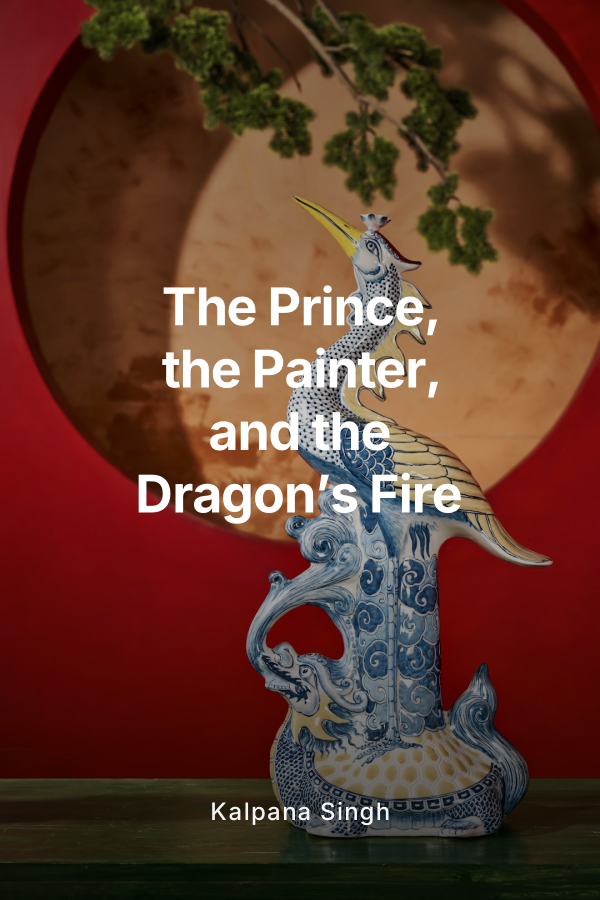
This book is a sensual, slow burn romance that follows Prince Baelor Targaryen, a solemn warrior with Dornish blood, and Tanselle, a gifted common-born artist and dancer whose beauty and talent capture every gaze yet bring her terrible danger. Loosely inspired by Targaryen lore but not bound to any canon, it tells a complete, emotionally rich love story that focuses on passion, healing, and a triumphant happy ending.
At the heart of the story is an act of violent cruelty that never becomes titillation. Baelor’s nephew, Prince Aerion, a vain and vicious young dragon of the court, sets his sights on Tanselle after seeing her perform and admiring her art. He believes that everything that dazzles him belongs to him. Tanselle, only twenty one, has long dark hair that falls to her waist, large almond shaped eyes, and warm honey colored skin. She is used to hungry stares, but not to princely obsession backed by power.
What Tanselle does not know at first is that the person she thinks she loves, her childhood sweetheart, has quietly sold her out to Aerion for coin and favor. Trusting in that old love, she walks into a trap. Aerion’s attempt to force himself on her is stopped only because Baelor intervenes. The prince finds her hurt and terrified, bearing marks on her body that shake him to the core. He carries her away and installs her in chambers under his protection, moved not only by pity but by an instinctive, overwhelming need to keep her safe from the world and from men like his nephew.
From that night, their lives are tied together. Yet their path to love is anything but simple. Tanselle awakens in royal chambers convinced she has been passed from one Targaryen to another like property. She hates the dragon sigil, the red and black banners, the whispers in the corridors. To her, Baelor is simply another man of power, another threat, no matter how gently he speaks or how carefully he knocks before entering. The more he offers protection and comfort, the more she aches with anger and humiliation.
Baelor, nearly forty, is a seasoned prince whose honor has always been his armor. Dark haired and striking, he carries the coloring and controlled fire of his Dornish mother. He has known war, duty, and the expectations of a court that watches his every move, yet he has never known a love that unsettles him as Tanselle does. He is fiercely protective, increasingly possessive, yet determined never to use his authority to push her. Her mistrust cuts him, but he refuses to withdraw his guard from around her.
The first chapters of the book follow the tense days and nights after the rescue. Tanselle struggles with fear and fury, confined in safety that feels like a different kind of cage. Baelor arranges for healers, warm baths, soft garments, and food, but he does so with almost painful restraint. He will not watch her undress. He will not cross a door she has not explicitly invited him through. He speaks to her as an equal, not a pet. Within this careful distance, a fragile familiarity grows. She begins to see that his protectiveness has nothing to do with ownership and everything to do with a deep, instinctive care.
As weeks turn into months, the story blossoms into a true slow burn romance. Forced proximity in the palace, shared secrets at night, and the intense public pressure of the court become the stage for their changing bond. Tanselle slowly reclaims her identity as an artist and dancer. Baelor commissions her work, not as charity but as recognition of her skill. She paints banners, murals, and private pieces for him, each revealing something of her inner world. Through these commissions, he gives her independence, coin, and pride, reshaping how she sees herself.
The age gap between them and the difference in station deepen the emotional conflict. She worries that he only desires her body, that he is trying to make her his hidden mistress. Court gossip feeds those fears, as courtiers whisper about the beautiful commoner tucked inside a prince’s wing. He, in turn, battles his own turmoil. Desire for her burns hot, especially in stolen moments when she dances for him in a guarded courtyard or leans too close over a sketch. Yet he fears becoming just another man who takes. His struggle between honor and obsession creates a powerful tension that runs through every chapter.
Aerion remains a constant threat. His pride cannot accept that his uncle stole his chosen toy, and his cruelty darkens as the story progresses. There are confrontations in halls and gardens, veiled threats delivered with courtly smiles, attempts to undermine Baelor’s standing, and sinister efforts to lure Tanselle back into danger through promises related to her art and her past. Aerion manipulates her former sweetheart, spreads lies about her, and tries to turn the court against her. Each move forces Baelor and Tanselle into shared defense, pulling them closer even when misunderstandings try to tear them apart.
One of the book’s central pivots is the shattering revelation of the childhood sweetheart’s betrayal. At first, Tanselle clings to the belief that her old love will come for her, that Baelor is a temporary storm and her real life waits outside the palace. When she learns, in cruel detail, that this man accepted gold and favor to deliver her to Aerion, it breaks something deep inside her. There is no quick recovery, only a slow, painful process of questioning every memory, every promise, every touch she once thought was safe.
Baelor becomes her ground during this heartbreak, not by replacing that old love as if it never mattered, but by giving her space to mourn it honestly. He listens when she is cruel to him, forgives her harsh words, and waits when she withdraws. He shows her, through action rather than declarations, what a different kind of devotion looks like. Through nights spent talking in his chambers, quiet gestures of comfort, and unwavering defense against Aerion’s schemes, his love becomes the healing force that rebuilds her capacity to trust.
The romantic and sensual arc is intentionally gradual, charting a clear journey from wary touches to intense, explicit passion. Their first physical contacts are small and charged. Baelor’s hand lingering a heartbeat too long on her wrist as he steadies her. Tanselle’s fingers brushing his when she passes him a brush or cup. A shared dance where formality melts into closeness, breath mingles, and silence says more than courtly phrases ever could. These scenes underline consent and emotional readiness at every step.
As her fear recedes and her trust in Baelor deepens, Tanselle begins to want him as fiercely as he wants her. One emotional turning point comes after a particularly vicious encounter with Aerion. Shaken and near breaking, Baelor nearly loses control and contemplates confronting his nephew in a way that would plunge the realm into scandal and blood. It is Tanselle who pulls him back from that edge, choosing him openly for the first time. In the quiet that follows, she initiates their first true, intentional intimacy.
Throughout the sensual chapters, the narrative keeps a strong focus on mutual desire, consent, and emotional reciprocity. Their first time together is slow and almost reverent, with Baelor constantly attuned to her responses, offering verbal reassurance, praising her, and making sure she feels cherished rather than used. The explicit scenes are passionate and detailed, celebrating their physical chemistry without cruelty, humiliation, or non consensual elements between them. As their relationship matures, playful jealousy, teasing, and deeply emotional lovemaking scenes explore how two people can be both lovers and partners, vulnerable and powerful together.
Misunderstandings, however, continue to test their bond. Court politics, half heard conversations, and Tanselle’s lingering scars from betrayal all play into moments where she doubts Baelor’s intentions or he questions her feelings. At times, she fears he will eventually bend to family pressure, marry another, and set her aside. At others, he worries that she cannot separate her gratitude and trauma from genuine love. These misunderstandings never exist just to fill pages; they grow organically from their histories and the world around them, and each one, once resolved, leaves their relationship stronger, more honest, and more resilient.
Aerion’s pursuit escalates as the story approaches its climax. Desperate to erase the insult of losing Tanselle to his uncle, he attempts to blackmail her with lies about Baelor, threatens to ruin her as an artist, and maneuvers to isolate her socially so that she appears as a corrupting influence on the prince. This leads to some of the book’s most gripping confrontations, where Baelor must choose between maintaining a careful political balance and openly defending the woman he loves. He chooses her. Repeatedly.
In the final movement of the book, the conflicts that have simmered for so long ignite fully. Aerion attempts one last, dangerous play to claim Tanselle, forcing a public reckoning that involves the whole court. Baelor answers with decisive action that strips his nephew of power and exposes his cruelty. While the details of the punishment remain within the realm of courtly justice rather than lurid spectacle, the outcome is clear. Aerion is finished. The threat that has haunted Tanselle since the first chapter is finally removed.
The resolution is triumphantly romantic. With Aerion defeated and the truth laid bare, Baelor makes a bold, public declaration of his love. Instead of hiding Tanselle as a secret mistress, he claims her openly, defying whispers of improper matches and age gaps. The exact form of their union respects the story’s looseness from strict canon, allowing for a heartfelt, socially risky choice that still lands in a joyful, non tragic ending. Their love, once a fragile flame in the dark, becomes a steady fire that no longer needs to hide.
The final chapters linger on their life together after the storm. Tanselle continues to create art that now openly bears the mark of a royal patron but also her own unmistakable signature. She walks through the court with her head high, no longer a frightened performer but a woman who survived betrayal, danger, and gossip to carve out her own fate. Baelor finds a new kind of peace, no longer torn solely between duty and honor, but able to weave love into both. Their intimacy grows richer with time, full of playful jealousy, teasing, and deep emotional connection.
Across its five chapters, this 10000 word book offers:
• A high tension, slow burn progression from rescue to undeniable love, driven by character growth rather than coincidence.
• A nuanced portrayal of trauma, healing, and trust, with special attention to how a survivor can reclaim desire on her own terms.
• Repeated, escalating confrontations with a dangerous antagonist whose threat highlights the stakes of their love without ever romanticizing violence.
• Explicit, sensual scenes that center consent, mutual worship, and emotional intimacy, framed by a strong “no humiliation, no non consensual intimacy between the main couple” ethic.
• A satisfying, fully happy ending where love is not only victorious in private but recognized and affirmed in the public, political world the characters inhabit.
“The Prince, the Painter, and the Dragon’s Fire” is designed for adult readers who enjoy intense, passionate romance with detailed sensuality, courtly intrigue, and complex emotional arcs. It invites readers into a world where a prince’s honor and a commoner’s talent remake each other, where betrayal gives way to a deeper, fiercer love, and where two people fight not only to be together, but to be better, braver versions of themselves in the light of that love.