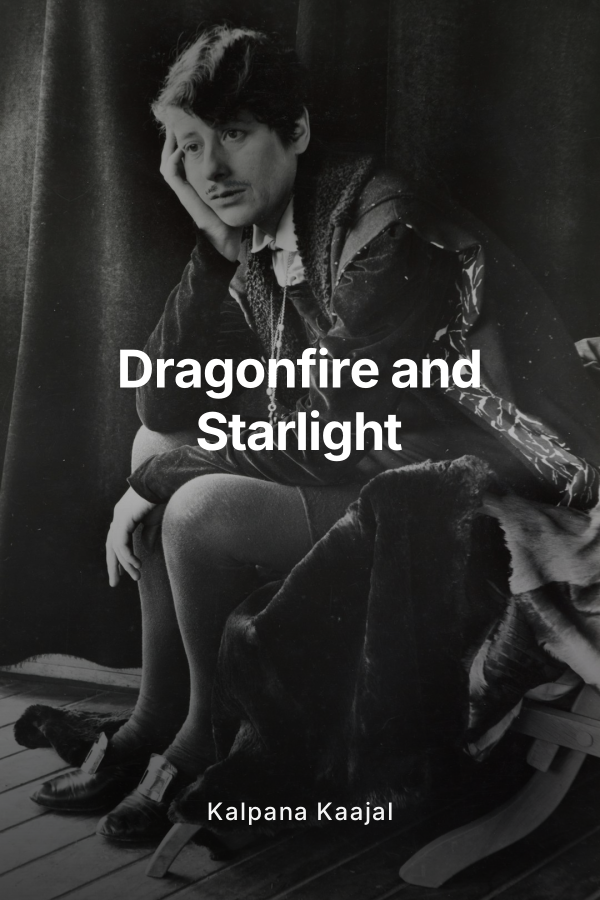
This book follows Tanselle, a gifted Dornish-born painter newly arrived at the Targaryen court, and Baelor Targaryen, the solemn, silver haired prince whose life has been defined by duty, piety, and a vow to live as a chaste exemplar of his faith. Their story unfolds in the familiar world of Targaryens and dragons, yet deliberately steps away from strict canon, reimagining relationships and events while keeping the tone, politics, and intensity of that universe intact .
The tone is mature and emotionally intense, with sensuality and passion treated as a natural outgrowth of character rather than a string of explicit scenes. Violence and trauma are present mostly in implication and aftermath, focusing on healing, agency, and the slow rebuilding of trust. There is no non consensual intimacy, no fetishized humiliation, and no graphic assault on the page. Instead, the emotional weight comes from threat, power imbalance, and the high political cost of every choice they make.
At the heart of the story is a secret, forbidden love. Tanselle and Baelor are drawn to one another from the moment they meet, but everything in their world conspires against them. Her low birth and Dornish blood mark her as unsuitable for a prince meant to embody purity and royal dignity. His family views marriage as a tool for power, not affection, and the Faith holds him up as a living symbol. For Baelor to choose Tanselle would mean scandal, broken alliances, and the loss of his carefully crafted saintly image.
Only a handful of people know or even suspect the truth. A loyal lady in waiting, perhaps a sworn sword who owes Tanselle a debt, and one or two of Baelor’s closest confidants become their reluctant accomplices. Everyone else sees only the mask: a quiet painter who should be beneath notice, and a distant prince too holy for earthly love. The tension of almost being discovered runs through the story, filling it with late night whispers, hidden gifts, and charged glances across crowded halls.
The great antagonist of their love is Aerion, a proud and volatile Targaryen prince who delights in cruelty and humiliation. He senses Baelor’s hypocrisy and is determined to expose it. What begins as malicious curiosity becomes a personal obsession. Aerion prowls after hints and half heard rumors, toys with Tanselle’s reputation, and seizes any chance to corner her in corridors, gardens, or empty galleries. He attempts to break her spirit not through physical violation on the page, but with threats, near misses, and the constant possibility of ruin. His looming presence gives the story an edge of danger without dwelling on graphic scenes.
Tanselle’s past adds another layer of complexity. Before coming to King’s Landing she loved a childhood sweetheart who promised her a future built on trust and safety. Over the course of the book Tanselle learns that this sweetheart betrayed her long before she reached the capital, selling secrets or aligning with those who would use her talent and proximity to power as a weapon. This revelation arrives in the middle of the narrative, around the fifth to seventh chapter of the full book, shattering her remaining illusions about simple, honest love and forcing her to see Baelor’s devotion in a new light .
Emotionally, the story unfolds as a steady tightening of the bond between Tanselle and Baelor. At first they only share quiet conversations in the secluded spaces where she paints, exchanging guarded remarks that hint at deeper wounds. Baelor tends to her after small injuries and moments of crisis, each touch of his hand a silent confession. Their tenderness grows through late night talks in the sept, shared prayers that slowly turn into shared doubts, and soft domestic scenes where he insists on caring for her in ways no prince should.
Jealousy flares more than once. Baelor struggles when he sees Tanselle forced to smile for other men, or when Aerion’s attention lingers too long. One of the key early confrontations comes when Baelor can no longer hide his anger after Aerion corners Tanselle during a feast. The prince’s normally controlled exterior cracks, exposing his possessiveness and terror that he cannot truly protect her while keeping their love secret. Tanselle, in turn, questions whether she is a sinful weakness pulling him from his faith, or a truth he has been denying all his life.
The romantic arc is a deliberate slow burn. Their first kiss comes only after a cascade of misunderstandings and near breakings. They lean close many times before their lips ever meet, interrupted by footsteps in the corridor, a knock at the door, or the sudden arrival of a member of the Kingsguard. These almost caught moments amplify both longing and fear. By the time they finally surrender to a fully mutual, passionate night together, the reader has witnessed the years of restraint and yearning that made it inevitable. The scene is sensual and explicit enough to feel real and cathartic, yet framed within a context of tenderness, consent, and shared choice.
Central to the book is Tanselle’s emotional breakdown and rebirth in Baelor’s arms. After the betrayal of her childhood love is revealed and Aerion’s schemes close in, she reaches a point of despair. She questions her worth, her safety, and whether any man can be trusted. It is in this moment that Baelor fully rejects the comfortable distance of sainthood. He holds her through her sobs, listens without defensiveness, and confesses his own terror of failure and hypocrisy. The scene marks a turning point where their relationship becomes a partnership. He is no longer the unreachable prince, and she is no longer the fragile commoner in need of protection. They stand together as equals in vulnerability, preparing to face the storm that awaits them.
The political stakes rise steadily through the chapters. If their love is exposed, Baelor risks being cast as a fraud by the Faith and disowned by his own blood. Tanselle faces exile, imprisonment, or even a quiet disappearance arranged by those who would rather erase the problem than confront it publicly. Aerion maneuvers to engineer a scandal that will not only destroy Baelor’s image but also grant him greater influence at court. Behind all of this, older Targaryens weigh alliances and groom Baelor for a pious marriage that would cement their power.
Despite the danger, neither Tanselle nor Baelor can walk away. They fight for their love in small and large ways: choosing to meet even when it risks discovery, standing up to slights against Dornish blood, refusing politically convenient lies, and ultimately confronting Aerion in a climactic clash of words and wills. The book gives equal weight to bruising arguments and to devotion. They misinterpret each other more than once, with hurtful silences and rash words that leave both wounded. Yet each misunderstanding becomes a lesson in clearer speech, deeper trust, and a braver kind of honesty.
By the end of the story, the transformation is clear. Baelor has learned that true piety cannot exist without truth and compassion, and that loving Tanselle does not make him weaker or less holy. It makes him human. Tanselle finds the strength to define herself outside of the roles men try to impose on her: muse, asset, whore, saint’s temptation. She claims her power as an artist, a lover, and a woman who survived betrayal without letting it calcify into bitterness. Their shared victory is not simply survival or escape, but the assertion that love is worth defying the expectations of blood, faith, and crown.
The full five chapter book will trace this journey from first charged meeting to final hard won commitment. Each chapter will deepen the emotional stakes and political risks, expanding on:
- The arrival of Tanselle at court, her early interactions with Baelor, and Aerion’s first hints of interest.
- The growth of secret affection, near discoveries, and the subtle web of allies and enemies forming around them.
- The midpoint revelation of Tanselle’s childhood sweetheart’s betrayal and the resulting fracture in her trust.
- The escalation of Aerion’s campaign to expose them, Baelor’s increasing defiance, and Tanselle’s breaking point and healing.
- The final choice that forces them to stand openly for their love, confront Aerion and the court, and accept the personal cost of choosing each other.
“Dragonfire and Starlight” is written for readers who enjoy morally complex characters, slow building intimacy, and a blend of court intrigue with private tenderness. It is a story where passion is inseparable from politics, where every kiss might be a crime, and where love’s greatest test is not whether it can ignite, but whether it can endure the cold judgment of a world built to crush it.