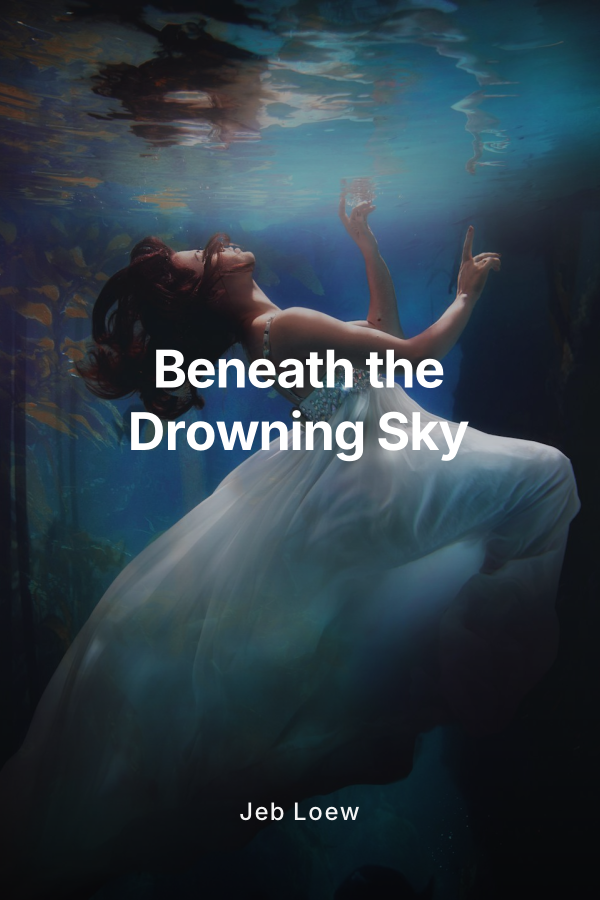
In a nameless coastal city that smells of salt, rust, and old rain, a man drifts through his days like wreckage.
His name is Eli Mercer. Once a quiet, meticulous library archivist, Eli’s life narrowed to a single point of focus when he fell in love with Jonah, a musician clawing his way out of addiction. Eli believed that if he loved hard enough, if he watched closely enough, he could keep Jonah alive. He measured time in chipped coffee mugs, late-night meetings outside rehab, and the precise intervals between Jonah’s relapses.
Then Jonah vanished.
No note. No body. No clear relapse to blame this time. One wet, gray morning, Jonah simply did not come home.
The police wrote it off as another addict gone missing. Friends shook their heads in grim, sorry understanding. But Eli felt something else. A pressure in the air. A silence too exact to be natural. And, worst of all, a sense that somewhere, somehow, Jonah was still close. Not safe. Not intact. But close.
Grief cracked Eli open. That was when the dreams started.
He woke at 3:03 a.m. night after night, mouth full of salt, lungs burning as if he had been screaming underwater. In every dream, an unmarked horizon of black ocean stretched before him. Behind him, a shape waited, tall and patient, its voice sliding into his ears without sound. He never remembered its words, only the echo of a promise he did not understand.
All he could retain was a single phrase, beating like a second heart inside his skull.
Give him back.
Eli did not know if he was the one pleading, or if the sea itself was speaking through him.
As the months pass, Eli’s loneliness turns feral. He haunts the bars Jonah once crawled through, searching for scraps of information, any rumor, any ghost story of men vanishing into the tide. On one such night, in a bar near the waterfront that always seems emptier than it should be, Eli meets a stranger.
The man sits alone, untouched by cigarette smoke and human noise. He is too composed for this place, too still, his eyes reflecting the bar’s dim lights like something from the ocean’s floor. He introduces himself as Cassian.
Cassian knows Jonah’s name.
He speaks it casually, as if testing the weight of it. He mentions details no outsider should know. The scar on Jonah’s left palm, the tremor in his fingers when he craved a fix, the stupid song he hummed when he tried to pretend he was fine. Cassian talks about Jonah as if remembering a favorite book, one he has read many times and never grown tired of.
Eli’s first instinct is rage. His second is hope.
Cassian does not claim to have seen Jonah recently. He does not offer simple lies. Instead, he speaks in half-truths and hints, painting a picture in which Jonah’s disappearance is not random or purely human. In Cassian’s telling, Jonah was chosen.
Chosen for what, he will not say.
Over a string of meetings, always in that same bar, always near closing time, Cassian draws Eli in. He listens without judgment to Eli’s frantic theories. He never laughs at the notion that something vast and ancient took Jonah away. In fact, he feeds it. Gently. Patiently. As if tending a fire.
Cassian’s presence begins to warp Eli’s world. Nightmares intensify. Waking hours fracture. People Eli barely knows mention odd dreams of the sea, of a knocking sound beneath their floors, of a cold voice murmuring in the pipes. Coincidences multiply. Strange symbols appear in Eli’s notebook margins when he does not remember writing them.
Cassian hints that there are gods older than language, older than any name man has carved into stone. They are not distant creators or moral judges. They are hunger and persistence, pressure and tide. They are what waits when every human connection fails and every fragile bond snaps. To such gods, people are not souls to save or damn. They are doors.
Cassian calls Eli a threshold.
According to Cassian, Jonah was not just taken. He was absorbed. Folded into something larger. In that drowning, he became part of a being that exists between worlds, one that has been pushing at the edges of human thought for centuries. Eli, with his obsessive attention, his desperate love, and his capacity to cling to another person even as they try to die in front of him, is the perfect counterweight.
A prophet, or something worse.
The more time Eli spends with Cassian, the more he senses that the line between man and god in this stranger is not merely thin. It is broken. Sometimes Cassian speaks like a tired bartender, familiar with heartbreak and human failure. Other times he speaks with a cold distance that feels less like cruelty and more like the weight of geological time poured into a human frame.
Eli’s first central bond was with Jonah, the addict he tried to save. His second is now with Cassian, the seductive stranger who might be god, monster, or both. The third will form in the cracks that open between them as Eli, frantic for answers, brushes against others who have lost someone to the sea and dares, briefly, to believe in human solidarity.
Whenever Eli reaches out, though, each connection he makes strains, frays, and finally fails.
A woman who lost her brother off a fishing trawler agrees to help Eli investigate local legends. For a moment, they seem like allies. She shares her research, the patterns she has gathered from obituaries, from drowned men whose bodies were never found, from maritime records that vanished from official archives but lingered in whispers. Together, they glimpse a thread of intention in what others call random tragedy.
Then she starts having the dreams.
The next time Eli goes to her apartment, the door stands open. Inside, there is no sign of a struggle. Just the lingering scent of saltwater and a small pile of neatly folded clothes by an open window. The books are gone from her shelves. The walls, once thick with notes and clippings, are bare.
Every time Eli dares to trust someone, the pattern repeats. A brief moment of recognition. The fragile warmth of not being alone. A promise made in a quiet room or a rainy street.
Then, absence.
Cassian explains it with a indifferent sort of tenderness. The connections are fragile. The god pressing through Eli, through all of them, is not malicious in any human sense. Its presence corrodes individual bonds, stretching them until they snap. In the end, every relationship fails. Every promise breaks. This is not a curse. It is a law, like gravity.
Eli refuses to accept that.
He clings harder. He stalks the tide-line, trying to reconstruct a path back to Jonah using scraps of myth and the erratic remarks Cassian lets slip whenever Eli lapses into desperate pleading. He starts to wonder whether his own memories of Jonah are accurate, or whether they have been re-edited by the thing that has its hands in both their lives now.
The more Eli fights for Jonah, the more the city around him warps.
Streetlights flicker at his approach. Strangers look at him with flinching recognition, as if they have seen his face in dreams. Water seeps into places it should not reach: a dark smear under his office door, a slow drip from the ceiling of the bar even when the sky is clear. Through it all, Cassian watches, a quiet center in the storm.
He never tells Eli what exactly he is.
He does not have to.
In the final act, as the tension builds toward breaking point, Eli corners Cassian in the empty bar. The rain outside hammers at the windows in steady, unnatural rhythm. Eli has pieced together enough to understand that Cassian is not separate from the god he serves. At some point, human and elder being fused. Jonah, too, is in there somewhere.
Eli confronts him with the raw, simple plea that has been building from the first moment he woke choking on imaginary seawater.
Give him back.
The words crack open the lie that has run beneath every conversation they have had. Eli demands Jonah’s return as if this is a kidnapping, a wrong that can be righted. He begs, his fury collapsing into grief, to at least see what Jonah has become.
Cassian’s response is the pivot on which the entire story turns.
He does not laugh. He does not rage. He answers with a cruel tenderness that is somehow worse than outright cruelty, explaining that Jonah cannot be given back because he is not, in any meaningful sense, separate anymore. Jonah is not trapped in a prison cell inside some divine skull. He is dissolved in it. Diffused. Freed from individuality, if such a thing can be called freedom.
He tells Eli that nothing anyone loves can stay only theirs.
The god inside Cassian offers Eli a choice. He can walk away, shattered but intact, his memories of Jonah slowly eroding into something he can fold like a faded photograph and bury. Or he can step through fully into the role that has been whispering at the edges of his thoughts.
He can become a doorway.
If Eli accepts, the walls between worlds will thin. Through his mind, his memories, his grief-soaked love for a lost addict, the elder god will seep into more lives. People will begin to dream as he does. Some will vanish into the sea, into their bathtubs, into puddles that should not be deep enough to drown a child. In exchange, Eli will meet Jonah again, not as a man, but as a fragment of a vast, alien consciousness that remembers him in a thousand overlapping ways.
For Eli, the choice is not between good and evil. It is between a solitary, slowly emptying life and a horrific kind of reunion.
Beneath the Drowning Sky is a fast, relentless psychological and cosmic thriller about obsession, grief, and the treacherous comfort of believing that love can save someone who is already sinking.
Across five taut chapters, the book:
• Establishes Eli and Jonah’s relationship as a pattern of rescue, relapse, and fragile hope, showing how Eli’s need to save Jonah binds him as tightly as any addiction.
• Unfolds Eli’s encounters with Cassian in the bar as a series of intimate interrogations, each conversation laced with seduction, menace, and hints of a truth too large for Eli to grasp all at once.
• Charts the spread of strange phenomena through the city, revealing Eli as not merely a victim but an emerging focal point, a living conduit through which the elder god’s influence flows to others.
• Explores Eli’s brief alliances with other bereaved and haunted people, then shatters each bond to underscore the central theme that every connection, no matter how intense, is temporary and breakable.
• Drives toward the final confrontation where Eli must accept that Jonah is gone in the way a wave is gone after it breaks, even if every future wave still carries its pattern.
The emotional through-line of the story is Eli’s dawning understanding that he has never truly been able to hold on to anyone. Not Jonah. Not his fleeting allies. Not even himself. All his life, he has tried to build permanence out of fragile human promises. The elder god’s philosophy is brutal but consistent: connection is always temporary. What endures is not the bond between separate beings, but the larger, impersonal tide that moves through them all.
Eli’s potential transformation into a prophet or doorway sits at the heart of the book’s horror. If he accepts, he gains intimacy with something vast enough to contain what is left of Jonah, yet he loses any claim to singularity. If he resists, he must live with a grief that has no metaphysical consolation, only the ordinary truth that people disappear and no reason is ever sufficient.
Throughout, the pacing never lets up. Each chapter raises the stakes: more disappearances, more dreams, more proof that the world is bending around Eli’s choices. Cassian alternates between an almost human gentleness and a chilling, godlike detachment, keeping readers off-balance. The bar scenes crackle with tension, as every casual line of dialogue might conceal a revelation about Jonah’s fate or Eli’s doomed role.
Beneath the Drowning Sky plays on the terror that the people we love most can be taken from us in ways we will never fully comprehend, and that our attempts to understand, to demand meaning, may open doors we are not equipped to walk through.
By the final page, readers are left with a haunting question. If there were a way to touch the person you lost again, to feel them as part of something endless, would you accept the cost?
Or would you cling to your fragile, failing connections, knowing that in the end they will all break, and you will stand alone on the shore, staring at a horizon that never answers when you plead:
Give him back.