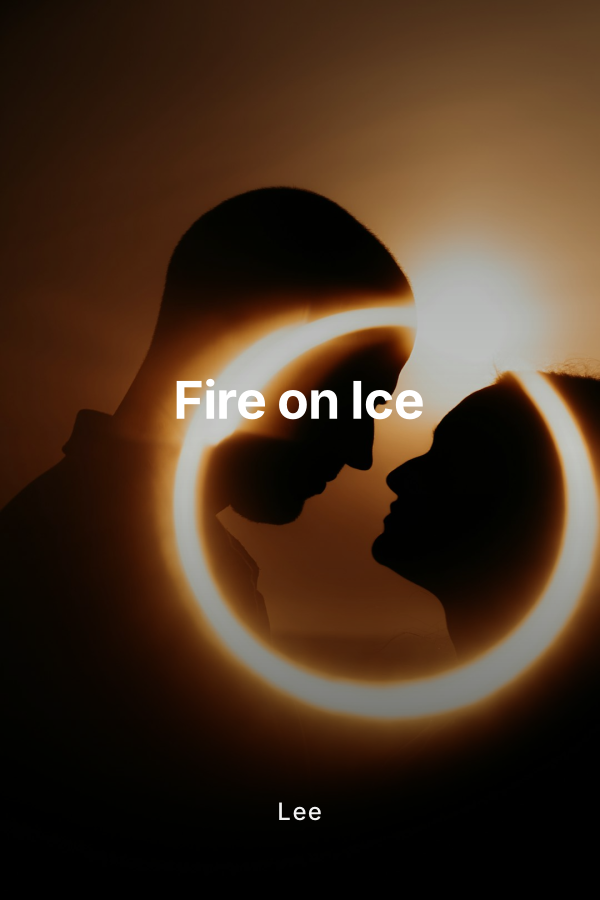
This book follows the fierce, fragile love story of Maxi, a brilliant but self-destructive Russian figure skater, and Will, the quietly intense partner who falls for every jagged, shimmering piece of him. Their romance burns through the cold world of competitive skating, illuminated by glittering performances, late night practices, and the terrifying intimacy of two people who see too much of each other.
Maxi is electric on the ice and chaotic everywhere else. Undiagnosed but clearly neurodivergent, he moves through life as if every sensation is too loud and every expectation a knife against his skin. Self harm has become “his thing,” a private ritual of pain and control that he defends with the same ferocity he gives to his programs. No one is allowed to interfere. Not his family, who have long since learned to walk the tightrope between worry and denial. Not Irena, the sharp eyed coach who has built champions out of broken boys.
Will is the one person who refuses to look away. Stoic, observant, and stubbornly gentle, he notices everything Maxi tries to hide. The weight fluctuations. The fresh burns. The way Maxi goes hollow before competitions. He does not speak Russian, cannot decode the muttered curses or the snapped defenses, but he understands the language of exhaustion and terror written in Maxi’s body.
At first, their connection forms in the practical spaces of training and performance. Will steadies Maxi’s landings, catches him in lifts and in quiet moments of near collapse. What begins as professional necessity grows into a wordless intimacy. Will starts working around Maxi’s defenses instead of confronting them directly. He brings snacks “for himself,” knowing Maxi will steal bites. He swaps out cigarettes, hides lighters, hovers close when Maxi is at his most volatile, all while pretending he is just another partner doing his job.
Maxi feels the intrusion and hates needing it as much as he craves it. He snarls at the suggestion of doctors, explodes when Irena and Will gently push the possibility of a diagnosis. He cannot bear the idea of being labeled, of having his chaos reduced to a word written in a file. He insists he is only “weird, not sick,” clinging to the idea that his edges are what give him his brilliance. Pulling away from help becomes another form of self punishment, one more line he refuses to let anyone cross.
Yet it is Will who becomes the exception Maxi never wanted. When the pressure of competition drives Maxi to hurt himself in more dangerous ways, the facade begins to crack. A burn in the wrong place before a skate nearly ruins a program and nearly destroys Maxi with shame. In the aftermath, with adrenaline still in their veins and the echo of the crowd fading, Maxi shakes apart in Will’s arms. For the first time, his desperation spills out unfiltered, in Russian he knows Will cannot understand. “I am so scared, I should stop this, but I want it so much,” he confesses, the words tumbling half in sobs, half in pleas.
Will hears only the tone, the broken rhythm of begging, yet he responds to what he feels rather than what he can translate. This becomes the heart of their bond. In intimate moments where dominance and surrender entwine with solace and release, Maxi begs in the language of his childhood, where shame and desire are tangled and raw. Will answers in touch, in murmured English, in the solid weight of his body and his refusal to let Maxi disappear into pain. Their sex becomes a battlefield and a sanctuary, a place where Maxi can say he is terrified of stopping and terrified of continuing, and Will can hold both truths without flinching.
The story traces how this dynamic evolves from something explosive and barely controlled into an uneasy, tender trust. Will must navigate the fine line between respecting Maxi’s autonomy and refusing to be complicit in his destruction. He learns to set boundaries without ultimatums, to say “I will not watch you do this to yourself” while still staying close enough to catch Maxi when he stumbles. Maxi, in turn, wrestles with the suffocating fear that accepting help will strip him of what makes him special. He flares with anger when Irena and Will push for evaluation, throwing their concern back at them as accusation, even as a small, quieter part of him begins to wonder if a name for his difference might be less a curse and more a shield.
As they move through a season of brutal competitions and even more brutal self discovery, the rink becomes the stage not only for their programs but for their emotional collisions. There are public triumphs that hide private catastrophes: a breathtaking performance shadowed by fresh scars, a medal ceremony followed by a fight in a locker room hallway, a shared hotel bed at a competition where neither sleeps, each listening to the other breathe like a lifeline.
Russian becomes Maxi’s refuge and his confession booth. He begs in it when he wants the pain to stop and also when he wants more, when he teeters on the edge of ecstasy and self annihilation. Will, at first, chooses not to ask for translations. He lets the incomprehension act as a buffer, a way to honor that there is a part of Maxi that is wild and uncontained. Over time, though, curiosity and love drive him to learn just a few phrases. Not enough to break the spell, only enough to offer comfort with deliberate weight. A whispered “good boy” in carefully practiced Russian, an “I have you” that makes Maxi shatter, not from pain this time, but from being seen.
The emotional core of the book lies in the moments between the big events. In quiet scenes where Will finds a clinic number saved but unsent in Maxi’s phone. In arguments where Maxi screams that Will must see him as broken to want him to get help, and Will answers that wanting him alive and less afraid is not the same as wanting him perfect. In the exhausted truce that follows, with Maxi curled tight against Will’s chest, whispering in Russian that he does not know how to exist without the edge of hurt, and Will replying in English that they can learn together.
Throughout five chapters, the narrative explores:
-
The spark
How Maxi and Will’s partnership begins on the ice, establishing the tension between professional necessity and personal attraction. The early clues of Maxi’s self harm, his undiagnosed neurodivergence, and Will’s decision to interfere indirectly rather than risk losing him. -
The fracture
The growing conflicts as Maxi’s rituals escalate, Irena and Will push for a diagnosis, and Maxi clings harder to his right to suffer on his own terms. The near catastrophic competition that forces his terror into the open and leads to the first raw scene of Russian begging that neither of them can ever fully forget. -
The surrender
Their first explicitly dominant and submissive encounter where fear, desire, and the need to let go collide. Will’s response to words he does not understand but deeply feels, and the way Maxi experiences, maybe for the first time, being guided instead of abandoned when he is at his most vulnerable. -
The choice
A season of negotiations. Will trying to balance love and responsibility, Maxi tentatively hovering at the edge of seeking formal help. The arguments that lay bare their deepest insecurities, and the incremental, imperfect steps Maxi takes toward acknowledging that his pain is not the price of his talent or his love. -
The promise
A final competition that is no longer about medals but about showing up for each other without hiding. Maxi making a choice that is small from the outside yet life altering from within saying aloud, perhaps only to Will, that he might want a different way to live. Will meeting that fragile admission not with triumph but with humility, understanding that this is a beginning, not a cure. Their future remains uncertain, but they commit to walking it side by side, with Russian whispers and English reassurances weaving a shared language of care.
“Fire on Ice” is a deeply intimate romance about how love can be both a risk and a refuge. It does not offer neat resolutions or miraculous recoveries. Instead, it honors the messy, nonlinear reality of healing, especially for someone who does not yet know who he is without his own hurt. At its heart is a simple, devastating question. How far can you go in loving someone who is determined to burn, and what happens when the person on fire finally reaches for the hand that has been held out to him all along?
In the glow of the rink lights and the darkness of hotel rooms, Maxi and Will find that the bravest act is not the perfect landing but the choice, again and again, to stay.