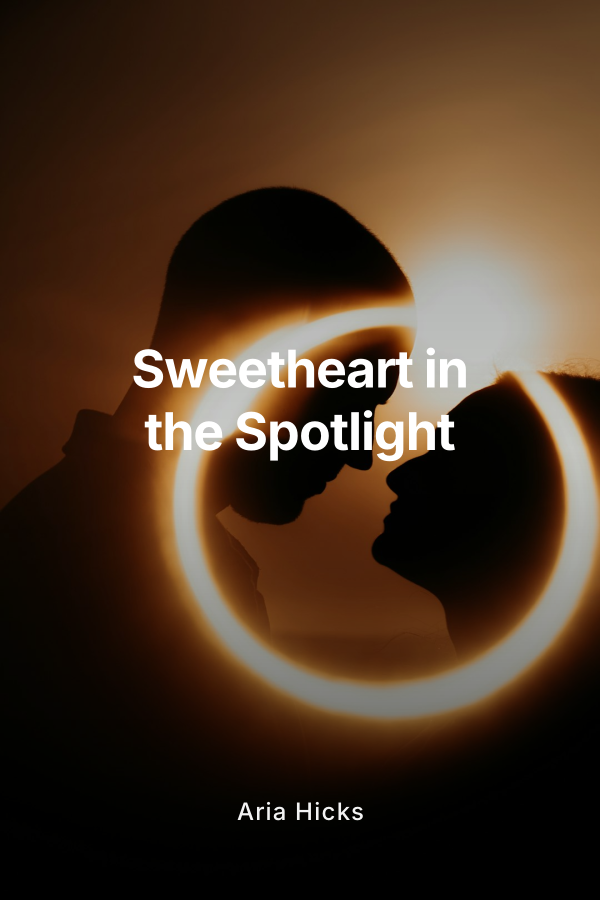
This book follows Aria, Eddie, and Steve through a multi chapter, character driven love story that moves back and forth between their points of view as they stumble from secret friendship into undeniable love. The story begins in the familiar, creaking halls and neon washed streets of Hawkins, where Aria and Eddie have already built the kind of friendship everyone else envies: late night phone calls, shared rides, scribbled notes in the margins of song lyrics and scripts, and a constant presence in each other’s lives as she rehearses for school plays and he chases music with his band. Steve, steady and quietly protective, orbits them both, close enough to see what they cannot yet admit, and far enough away to pretend it does not hurt.
At the heart of the book is Aria, a theater kid with a stubborn streak and a voice that will not stay small. She spends afternoons under stage lights and evenings memorizing lines while Eddie sits hidden in the dark of the auditorium, watching every rehearsal as if it is his own private concert. He teases her about blown cues and dramatic flourishes, calls her “sweetheart” and “honey,” and uses an inside joke nickname that never fails to make her dissolve into laughter, but he never quite says what is really there. Their closeness is physical and easy, full of hand holding, shared jackets, linked arms in crowded hallways, and sleepovers that still pretend to be strictly friendly even as the air between them grows charged.
Eddie’s chapters bring readers into the messy, tender chaos of his mind. The book explores his fear of ruining the safest, brightest thing in his life by reaching for more. At rehearsals he watches Aria become other people on stage and falls harder for the real girl who emerges afterward, smudged eyeliner and hoarse voice, leaning into his shoulder. With his band, he pours all the words he cannot say straight into riffs and lyrics, crafting a song that quietly becomes “theirs” long before Aria understands what it means. Each Eddie POV chapter deepens the tension, tracing how jokes, shared beds, and casual touches evolve into something that keeps him awake at night.
Aria’s perspective reveals the other side of the same story. To her, Eddie is comfort and rebellion at once, the boy who waits outside rehearsals with warm drinks, the one who shows up when her home becomes suffocating. She knows his hands better than her own, knows his moods by the tilt of his smile, yet keeps insisting that they are “just friends” even as she memorizes the shape of his mouth when he laughs. When Eddie attends her shows and she turns toward the darkness beyond the stage lights, she feels him before she ever sees him. Her internal battle unfolds chapter by chapter, as she navigates the ache of wanting more, the terror of losing him, and the weight of her father Hopper’s expectations pressing against every decision she makes.
Steve’s chapters offer a grounded outside lens. Once the self centered king of Hawkins High, he now finds himself strangely invested in these two idiots who refuse to see what is obvious to everyone else. In his eyes, Aria and Eddie are already a couple in everything but name, sharing rides, splitting snacks, leaning into one another as if their bodies have made an unspoken agreement. Steve’s POV gives readers quiet heartbreak and wry humor as he grapples with his own complicated feelings, the echoes of his past, and the reluctant understanding that his role in their story is to protect, to listen, and eventually, to push them toward their truth even if it changes everything.
The early chapters live in that slow burn: shared headphones, back row seats in theaters and dim gymnasiums, nights in Eddie’s room with music too loud and the lights too low, afternoons at Family Video where Aria sprawls behind the counter while Eddie fiddles with tapes and Steve pretends he is not watching them softening around each other. Tiny shifts accumulate: a lingering glance, a hand that does not drop fast enough, a long hug after a bad rehearsal, a half asleep confession that almost becomes a first kiss.
The midpoint of the book is built around the day everything finally tips. A play’s after party, a drive home under a sky full of cold Hawkins stars, a moment in Eddie’s van that starts as another joke and ends with them kissing for real, no laughter, no deflection. In the days that follow, sleepovers become charged with new meaning, their pet names sharpen into intimacy, and they begin to test what it means to move from “my best friend” to something much more dangerous. Their POVs capture the exhilaration and terror of that shift, the giddy secrecy and clumsy attempts at boundaries that keep dissolving every time their fingers find each other.
The quiet happiness they build is fragile, and the story does not shy away from the collision waiting at home. Hopper, used to being the line Aria will not cross, finally discovers just how far she has already stepped. One of the central, devastating scenes of the book is Aria’s confrontation with him, shown through her eyes so that her anger, fear, and aching love for her father all land at once. Years of rules, trauma, and unspoken worry explode into a brutal argument where Hopper’s desire to keep her safe clashes with Aria’s need to live a life that is hers, with the boy she chose. The monologue she delivers in that scene becomes a defining moment for her character, marking her shift from “Hopper’s kid” to a young woman who will not apologize for who she loves.
In the aftermath, the book’s tone grows raw and introspective. Aria walks out, throwing herself into rehearsals and late nights with Eddie, though even that safe harbor begins to feel unsteady under the weight of her guilt and fear. Eddie, torn between fury at how she has been treated and his own understanding of what it means to be scared of losing someone, struggles with how to show up for her without burning every bridge she has left. Steve’s chapters become crucial here, as he witnesses Aria’s slow unraveling at Family Video, where she finally breaks down in front of him. That breakdown, with Eddie also present, becomes a second emotional pivot: a moment where their makeshift little family chooses each other in a new, more deliberate way.
From there, the book broadens its scope. Time skips begin to appear, showing glimpses of concerts where Eddie’s band plays to growing crowds, with Aria cheering from the front row, and plays where Aria commands the stage while Eddie sits in the dark, mouthing her lines along with her. Their relationship is no longer a question but a constant, even when life pulls them in different directions. Arguments, miscommunications, and the ongoing tension with Hopper never vanish, yet the story insists on hope, on the slow work of healing rather than neat resolutions.
The final chapters offer a tapestry of these moments. We see Aria and Eddie as an established but still learning couple, living in the messy space between youthful fantasy and adult reality. Their private language of pet names and inside jokes remains, deepened by the history they now share. Steve finds a quieter peace, accepting his place as the one who helped them get here and discovering his own path forward beyond their orbit. Hopper’s presence softens from looming threat to gruff, wary father slowly trying to understand the young adults his little girl and her musician boyfriend have become.
Throughout the book, the shifting POVs are used to show how differently love can be seen from the inside and the outside. Aria feels reckless and fragile. Eddie feels unworthy and overwhelmed by how much space she occupies in his life. Steve sees two kids who have already chosen each other, stumbling, yes, but always reaching back to hold on. Each chapter reveals new layers of the same events, inviting readers to piece together the emotional truths that the characters themselves struggle to articulate.
Ultimately, “Sweetheart in the Spotlight” is a story about friendship that grows too big to stay only friendship, about the families we are born into and the ones we build in video stores and backstage corridors and cramped vans filled with music. It is a love story, but not a simple one. It traces the fragile line between staying safe and risking everything, showing how two people who have always belonged to each other learn to say it out loud, hand in hand, under harsh stage lights and humming amplifiers, with the people who love them watching from the dark.