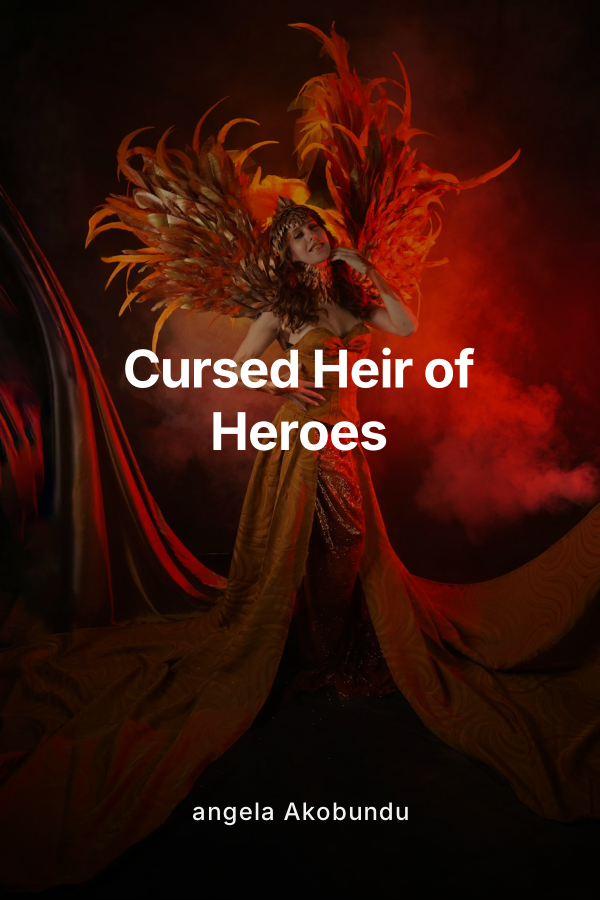
This book follows Izuku Ryomen, a boy born into the world of My Hero Academia with the appearance, talents, and dreaded legacy of the ancient tyrant Ryomen Sukuna. Two centuries earlier, Sukuna wielded a terrifying, otherworldly force known as cursed energy and carved his name into history as “the Strongest in History,” a man who ruled through fear, slaughter, and overwhelming might. His techniques, such as Black Flash, Cleave, and Dismantle, along with his open‑air domain Malevolent Shrine, allowed him to annihilate armies, erase cities, and even betray and maim the infamous All For One himself, leaving the villain permanently scarred and humiliated .
Over the generations, cursed energy was suppressed, buried, and forgotten. The age of Quirks dawned, and humanity rewrote its history, reducing Sukuna to a distorted legend. Yet the terror he inspired never truly vanished. Governments quietly erased records, hero institutions refused to touch the topic, and every surviving trace of cursed techniques disappeared into shadow. Publicly, no one speaks of cursed energy. Privately, villains and secret societies whisper the name “Sukuna” like a bad omen, a symbol of a power that can slice through any defense and ignore the normal rules that govern Quirks.
In this tense world, Izuku Ryomen is born.
From childhood, Izuku is marked as different. He has nearly limitless reserves of cursed energy, a body that perfectly mirrors Sukuna’s fearsome physicality, and an instinctive affinity for the same lethal techniques once used to dominate the globe. Where other children learn to channel their Quirks with pride, Izuku battles an invisible current of raw, predatory energy that constantly urges him toward destruction. His Black Flash strikes shatter training equipment. His stray slashes with Cleave and Dismantle cut through steel and concrete as if they were paper. Even when he tries to hold back, his power turns every mistake into a potential catastrophe.
To the world, Izuku does not look like a hopeful hero. He looks like the second coming of its worst nightmare.
The core of the story lies in this contradiction. Izuku desperately dreams of becoming a hero, yet every part of his heredity and history insists he is destined to become a monster. Teachers fear him. Classmates avoid him. Rumors spread that he is possessed or cursed. The mere mention of his family name “Ryomen” draws wary glances from those who still know the old tales. Rather than cheering for his power, people question whether someone like him should even be allowed to live freely, much less train as a protector.
This tension escalates when the modern hero society finally witnesses what cursed energy can do. During pivotal incidents, Izuku’s attempts to save people result in overwhelming displays of force. Robots are not just destroyed but sliced into dust. Terrain is remade in a single breath. Enemies who threaten his loved ones are cut down in ways that haunt onlookers long after the fight ends. What heroes see is not a boy struggling to protect others, but the horrifying echo of Ryomen Sukuna’s dominion revived in living form.
As Izuku’s power grows, so does interest in him from both heroes and villains. The hero establishment is torn. Some argue that he represents a dangerous, uncontrolled anomaly tied to an unregulated, forgotten power system. Others argue that precisely because his abilities frighten them, hero society has a responsibility to guide and contain him before he slips beyond their reach entirely. Meanwhile, in the shadows, All For One and like‑minded schemers remember the betrayal he once suffered at Sukuna’s hands and recognize the potential in Sukuna’s descendant. Where others see a looming disaster, the underworld sees a weapon, a chance to reclaim a power that surpasses almost all known Quirks.
At its heart, the book is a character‑driven exploration of identity, legacy, and choice. Izuku Ryomen’s journey forces him to confront several central questions:
- Is he obligated to atone for the sins of his ancestor, or does he have the right to define himself apart from that bloody legacy?
- Can a power created for destruction be reshaped into a tool for rescue and defense?
- When institutions are built to fear what they cannot classify or control, how does someone like Izuku carve out a place within them?
Each chapter traces a different phase of Izuku’s growth and the shifting dynamics around cursed energy in the hero world.
The early chapters immerse readers in Izuku’s childhood and adolescence, where the first manifestations of cursed energy create small but deeply scarring incidents. A toy sliced in half during a tantrum. A bully injured by an uncontrolled Dismantle. Parents and teachers caught between concern and terror as they realize standard Quirk counseling and training cannot contain this force. Izuku learns quickly that any loss of control on his part carries consequences no one else his age has to face. Where others can experiment, he must calculate. Where others can be impulsive, he must be precise.
As he approaches the age where aspiring heroes apply to schools like U.A., Izuku faces structural rejection as well as social hostility. Application processes are not designed for someone whose power is classified as neither Quirk nor mutation but as a forgotten, taboo energy source that once almost ended civilization. Bureaucrats quietly move to limit his options or redirect him toward anonymous containment. Hero course instructors debate whether training him would be an act of responsibility or a reckless gamble with the safety of every other student.
Yet beneath the fear and stigma, a smaller, braver group of individuals chooses to see Izuku as a person rather than a threat. Friends and mentors emerge who challenge the assumptions around cursed energy. They question whether history’s narrative about Sukuna was complete or whether it was shaped by the victors who survived him. These allies push Izuku to claim ownership of his power, to analyze it, refine it, and sculpt it into something that reflects his values instead of his bloodline.
Later chapters broaden the scope. As Izuku’s presence forces hero society to revisit ancient records, the truth about cursed energy begins to surface. Old reports describe how Sukuna’s techniques ignore many of the conventional defenses heroes rely on. Malevolent Shrine, in particular, reveals a frightening implication. By manifesting directly in reality rather than within a closed barrier, Sukuna had once created a battlefield on his own terms, where his slashes automatically targeted anything within a vast radius. If Izuku ever awakened a similar domain, entire districts could be changed in an instant .
Villains attempt to exploit this possibility. Some factions want to manipulate Izuku into duplicating Sukuna’s greatest feats and turning them against modern heroes. Others simply want to dissect and study him, reverse engineering cursed energy for mass production. All For One, still bearing the memory of the day Sukuna betrayed him and carved his body to pieces, views Izuku as both a reminder of past humiliation and a chance at revenge. He contemplates whether to destroy the boy out of spite or break him and bend cursed energy to his own will.
This external pressure creates a crucible for Izuku’s internal arc. Every confrontation forces him to choose between the easy path of overwhelming violence and the far more difficult path of restraint. Each time he refuses to fully unleash his destructive potential, he risks defeat and criticism from those who argue that power like his should be used decisively. Each time he grants himself leeway and taps more deeply into Sukuna’s techniques, he edges closer to the image of the tyrant that the world already believes he is.
The thematic spine of the story is that true heroism is not the absence of darkness but the steadfast decision not to let that darkness define your actions. Izuku’s struggle is not about suppressing cursed energy entirely. It is about learning to understand every aspect of it, from the elegant precision of Cleave to the raw devastation of Malevolent Shrine, and then deliberately choosing how to use those capabilities in ways that align with his conscience. Where Sukuna saw power as a ladder to domination and self‑indulgence, Izuku seeks to transform that same force into a shield for the innocent.
Alongside its character focus, the book also examines systemic themes. It asks how a society built on regulated, categorized Quirks reacts when confronted with a power that exists outside its rules, one that calls into question long‑held assumptions about where abilities come from and how they should be controlled. It explores the tension between security and compassion, between locking away what frightens us and engaging with it to understand and possibly redeem it. Through the reactions of pro heroes, government officials, and ordinary citizens, readers see a range of responses from instinctive fear to cautious curiosity to opportunistic greed.
The personal and political threads converge in climactic moments where Izuku’s choices redefine the meaning of being a hero in a world that has always equated heroism with publicly acceptable, easily categorized powers. By daring to stand as a symbol of both fear and hope, Izuku Ryomen challenges not just villains and monsters, but the comfortable illusions of the very society he wants to protect.
“Cursed Heir of Heroes” is aimed at readers who enjoy character‑driven, morally complex stories set within familiar hero frameworks. It blends high‑intensity action with psychological depth, focusing less on flashy spectacle for its own sake and more on the emotional and ethical weight that comes with wielding a power others consider inherently evil. The book respects the established structure of the My Hero Academia world while introducing a parallel power system rooted in cursed energy, forming a rich backdrop for questions about legacy, stigma, and the right to self‑definition.
Across five chapters, the full book will trace Izuku Ryomen’s evolution from a boy suffocated by a terrifying inheritance into a young hero candidate who not only learns to master cursed energy, but also forces an entire world to confront what it truly fears. Is it power itself, or the possibility that someone born from darkness could choose, again and again, to stand in the light?