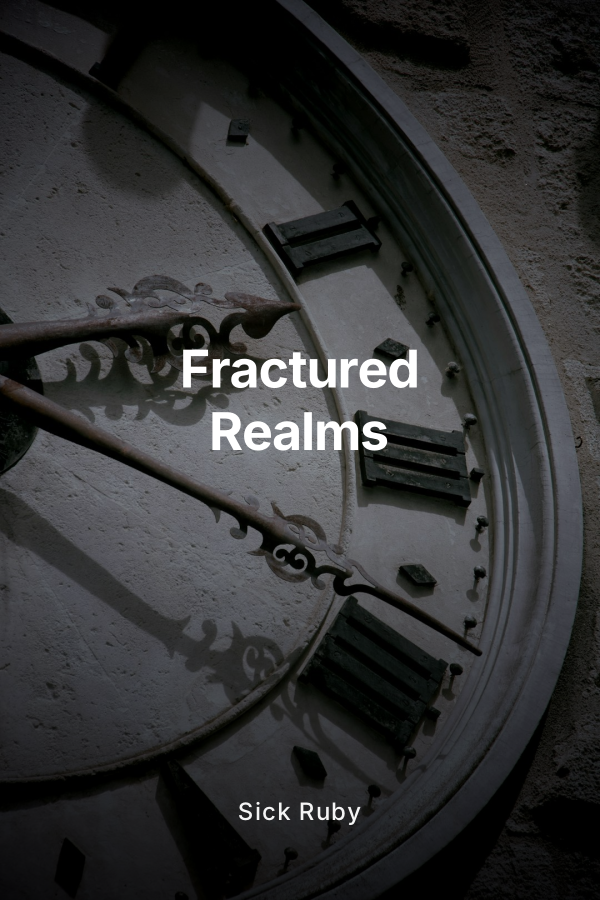
This book follows a small circle of ordinary people who stumble into an extraordinary conflict between two intertwined realities. In one world, life moves forward in familiar ways: cities grow, friendships strain under the weight of adulthood, and time appears to be a simple, one-way path. In the other, history has splintered into overlapping versions of itself, and memory is no longer a reliable guide to what is real.
At the center of the story is a quiet, analytical protagonist who has always trusted patterns more than feelings. A glitch in an everyday routine exposes fissures in their world: events misalign, strangers remember conversations that never happened, and physical places shift in subtle but undeniable ways. This is not a single miraculous event but a slow, unnerving drift that chips away at the comfort of certainty.
The protagonist discovers that their world is one of two parallel realms, each incomplete on its own. One realm has preserved continuity and stability but at the cost of deep, unacknowledged losses that have been edited out of collective memory. The other realm has kept every possibility alive, but now suffers from the weight of too many unresolved paths. A rare group of people can sense both realities at once, and our protagonist is one of them.
Guided by a small, conflicted group who have lived with this knowledge longer, the protagonist learns that every decision, every forgotten moment, and every avoided conversation has an echo on the other side. Where one world chooses safety, the other preserves consequence. Where one world hides its scars, the other exposes them. These differences are not abstract: they show up as changes in relationships, altered personal histories, and a haunting mismatch between what people feel and what they can prove.
As the two realms drift further out of alignment, ordinary people begin to experience time slippage, emotional déjà vu, and sudden grief over events they cannot name. The protagonist realizes that what affects one world ripples into the other, intensifying conflict in subtle, intimate ways. Friendships fray under contradictory memories. Families argue over past events that cannot be reconciled. Institutions cling to a single official version of reality while individuals grow more certain that something is deeply wrong.
At the heart of the narrative is a difficult moral problem: Should the fracture between realms be sealed, preserving a single clean timeline at the cost of erasing entire strands of lived experience, or should the worlds be brought closer together, forcing everyone to confront the painful truths that were so carefully avoided? There is no solution that does not harm someone. Every possible outcome asks the characters to sacrifice comfort, certainty, or identity itself.
The story explores how people respond when the foundations of cause and effect begin to crumble. Some characters turn to control, believing that strict rules and rigid stories can hold reality in place. Others seek escape, longing to disappear into the realm that matches their memories best. A few choose honesty, doing the hard work of admitting what they have lost, even if they cannot fully prove that loss ever happened.
Throughout both chapters, the narrative remains grounded in the personal rather than the purely cosmic. Instead of focusing on abstract theories, it tracks the impact of this fractured reality on small, everyday decisions. The protagonist must decide who to trust, which memories to believe, and how much of their former life they are willing to let go. Relationships become the true battleground where the fate of the realms is decided.
The tension builds toward a final choice that cannot be undone. To restore balance, someone must willingly accept being misremembered, misunderstood, or even forgotten, preserving coherence for everyone else at a personal cost. The protagonist stands at the crossroads between two imperfect worlds, tasked with deciding what kind of future people deserve: one where the past is clear but incomplete, or one where nothing important is ever truly lost, even when it hurts to face it.
Throughout the book, themes of identity, memory, responsibility, and quiet courage are woven into a story that is part speculative mystery and part intimate character study. The tone is reflective and emotionally grounded, crafted for readers who enjoy thoughtful science fiction and fantasy that stays close to human experience.
Ultimately, Fractured Realms is about more than parallel worlds. It is about the invisible gaps in our shared stories, the pieces of ourselves we hide to keep moving forward, and the quiet heroism required to look directly at the truth. It suggests that reality is not just a collection of events, but a fragile agreement we make with one another about what we are willing to remember, forgive, and protect.