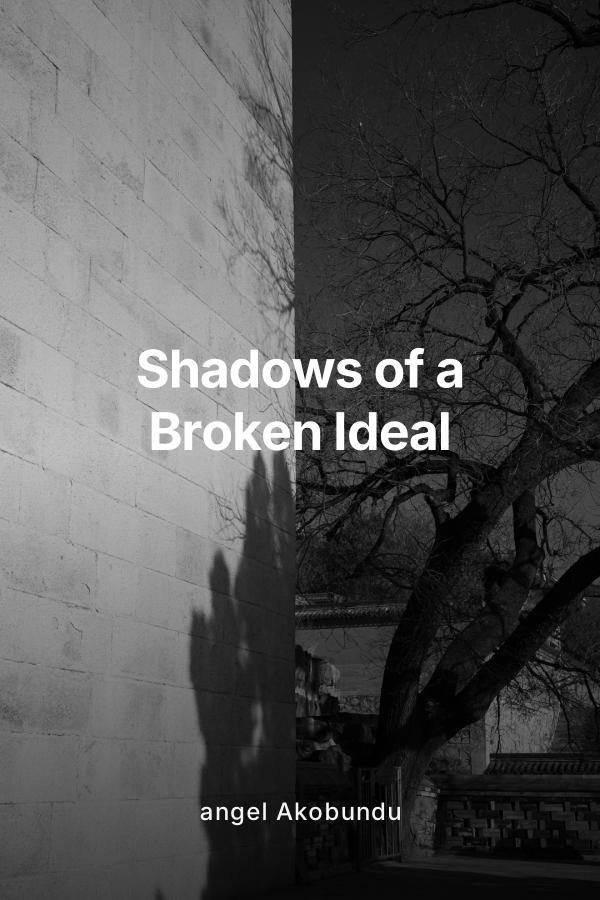
This book follows a bullied, quirkless boy in the My Hero Academia universe who rejects the dream of becoming a traditional hero and instead chooses the ruthless path of a professional mercenary. He lives by a single line he will not cross: no children. Everything else is negotiable. Through his eyes, readers witness a hero society that prides itself on justice yet leaves the weak to suffer in the cracks, and they watch as he turns that injustice into fuel for a bloody career that runs parallel to canon events.
The story begins with a child who once idolized heroes and worshipped All Might, only to grow up in a system that branded him worthless. As bullying intensifies and every adult figure fails him, his faith in heroism curdles into cynical pragmatism. He discovers that power in this world does not belong to the righteous but to the effective. From that realization, a harsh philosophy takes root: people only respect what they fear or what they need. He will become both. This emotional core focuses on the loneliness bred by years of abuse and neglect, then traces how that loneliness hardens into a cold, meticulous hunger for control.
His first kills are not grand or theatrical; they are ugly, desperate, and transactional. He stumbles into the criminal underworld as a disposable errand boy, but his lack of a quirk becomes an advantage. No flashy signature, no recognizable power set, just a ghost that plans, watches, and strikes. He studies heroes and villains the way others study for exams, cataloging their habits, blind spots, and public personas. His rule about children, formed in the ashes of his own lost childhood, is the only moral boundary he refuses to negotiate. This single restriction gives him a strange, unsettling code in a world of extremes. He will guard this line violently, even against his own employers.
As his reputation grows, urban legends begin to circulate. Underground brokers whisper about a nameless contractor who never shows his face and always finishes the job. Sometimes he is described as a failed hero course applicant, sometimes as a vigilante gone rogue. He encourages the myths and hides behind them. The more distorted the stories become, the safer his anonymity stays. In this phase of the narrative, the focus is on the craft of his work: surveillance, planning, psychological warfare, and surgical violence. He does not throw himself into chaotic brawls; he engineers outcomes, exploiting the arrogance of heroes and the overconfidence of villains alike.
Canon events unfold in the background: UA’s entrance exams, the emergence of the League of Villains, All Might’s declining strength. Rather than stepping into the spotlight, the protagonist brushes against these events from the shadows. He sabotages minor operations, rescues targeted kids who would have been collateral damage, or accepts contracts that intersect with larger conspiracies. Sometimes his efforts protect the status quo by accident. Other times they destabilize it in ways no one can trace. Readers see a different angle on familiar moments, realizing how many invisible players shape the world while the cameras focus on heroic battles.
Morally, the book never lets the reader fully relax into admiring him. He does kill people. He accepts blood money. There are jobs he should have refused. While he clings to his “no children” rule, he is fully willing to traumatize, manipulate, and destroy adults who stand in his way. Yet the narrative also forces readers to confront the complicity of a hero society that looked away while a child was broken. Much of the tension arises from his internal war: a part of him still aches for the simple dream of being a hero, even as he sharpens himself into a weapon that no hero agency could publicly endorse.
The emotional center of the book is the collision between three forces inside him. The first is the hurt, isolated child who wanted to be saved. The second is the cold strategist who thrives in the clarity of combat and contract work, even feeling a dark thrill in outsmarting and outlasting stronger foes. The third is the young man who cannot stop asking whether there is any place for him in the light. When he watches students his age laughing in UA’s corridors or sees news footage of bright hero trainees hailed as the future, he feels the gap between what he could have been and what he is becoming.
Supporting characters appear mostly in the underworld: fixers who arrange jobs, informants who trade secrets, and occasional collaborators who never learn his real name. Among them, a few become recurring mirrors. A disillusioned ex-hero shows him what happens when someone tries to walk back from the edge and fails. A bright eyed vigilante forces him to confront the difference between killing for pay and fighting for principle. A civilian child he saves by breaking a contract embodies the cost of his one unshakable rule. Through these encounters, the book explores themes of identity, choice, and the thin line between justification and excuse.
As hero society strains under the pressure of escalating villain activity, demand for invisible solutions rises. Shadow actors like the protagonist become more valuable. He receives offers from powerful factions that want to formalize his work, to put his methods to use on a larger scale. Accepting could give him more resources and information, but it would also chain him to an agenda much darker than simple survival. Rejecting these offers keeps him nominally “independent” yet forever hunted. His decisions at these crossroads drive the overarching plot of the later chapters.
The mercenary’s relationship to canon figures remains indirect yet charged. He studies All Might as an abstract ideal, a symbol that failed to reach him in time. The appearance of Stain fascinates him because Stain is what hero worship looks like when it mutates into holy war. The League of Villains represents the chaos he avoids, proof that reckless ideology without discipline gets people killed. He moves around these giants like a shark in deep water, careful never to draw their full attention, but the reader always feels the possibility that a single miscalculation could drag him into the center of the larger conflict.
By the end of the planned arc, the protagonist stands at a precipice. The boy who once dreamed of wearing a hero’s costume has become a rumour that even pro heroes fear to confirm. He has carved out power in his own way, but the cost is a trail of bodies and a soul that does not know what it believes in anymore, beyond that first rule about children. The final movement of the book pushes him into a situation where his code and his profession collide head on, forcing him to choose whether he will remain a weapon for hire or risk everything to act on a conviction he cannot deny.
Overall, this book is a dark, character driven exploration of power, trauma, and the hypocrisy woven into a world that divides people neatly into heroes and villains while abandoning those who never fit either role. It speaks to readers who are fascinated by morally complex protagonists and who want to see the My Hero Academia universe examined from its hidden corners instead of its shining stages. The tone is intense, introspective, and ruthless, yet anchored by an underlying question that never fully goes away: if the world had given this boy a single genuine chance, would he have taken it, and could he have become something else?