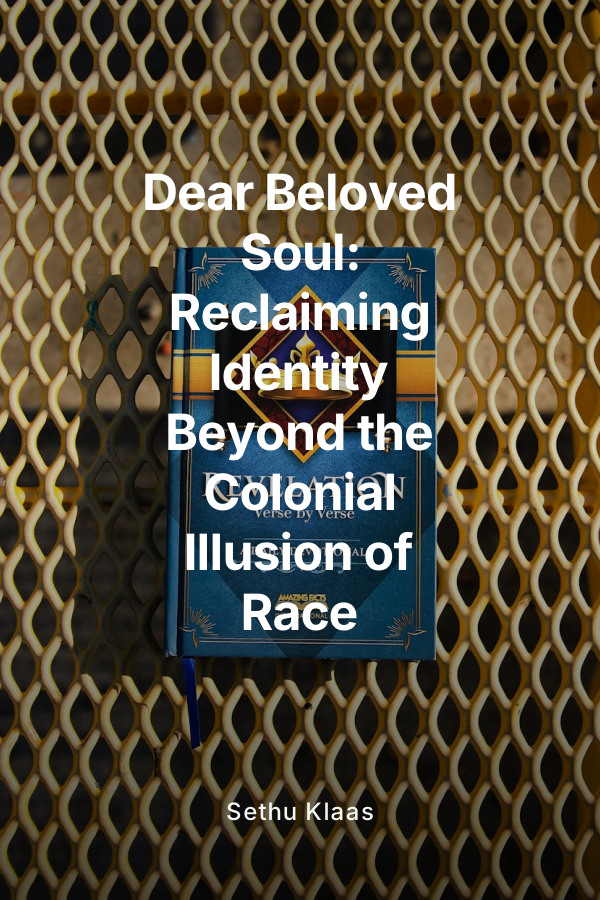
This book is a lyrical manifesto and a practical companion for anyone who feels both held and hemmed in by racial identity, and who is ready to remember themselves beyond the borders that colonial history drew across their life. Written as an intimate series of letters from a narrator to a “Beloved Soul,” it braids memoir, historical reflection, political analysis, and ritual guidance into a single, persuasive invitation: to understand how race was made, to grieve what it has stolen, and to reclaim a deeper belonging that no census form can name.
At its core, the book argues that race is not a natural truth about human beings but a modern technology of power designed to justify land theft, labor exploitation, and social hierarchy. It shows how European empires, in Southern Africa and in what became the United States, turned casual observations of difference into rigid racial categories through law, commerce, pseudo‑science, and bureaucratic systems of classification. These systems made race feel inevitable while remaining, in fact, historically contingent and politically motivated. The book insists that seeing race as manufactured does not erase the reality of racialized harm; instead it offers a more honest starting point for both healing and structural change.
Yet this is not primarily a work of detached history. It begins in the interior, with the feeling of living inside a “cage” of inherited labels and the faint but persistent “whisper” that asks whether the cage was ever truly yours. Through vignettes of family conversations, school experiences, spiritual awakenings, and encounters with archival traces of ancestors, the narrator shows how racial categories seep into self‑image, constrict beauty, and fracture memory. The early chapters linger tenderly on the moment of awakening when one realizes that the voice narrating their worth is not their own, and that beneath shame and performance something older and freer is waiting to be named.
From there, the book moves outward, tracing the “business of classification” that turned race into infrastructure. It explains how plantation economies, settler colonial land grabs, and emerging nation‑states needed categories to organize labor and justify dispossession. Law hardened those categories, transforming them from social perceptions into binding realities that governed mobility, property, marriage, and citizenship. Science, religion, and pedagogy then lent their authority to the arrangement, codifying hierarchies that elevated “whiteness” as a property and reduced others to exploitable or expendable status. Throughout, the narrative interweaves Southern African and American histories to show both parallels and divergences while refusing to flatten them into a single story.
One of the book’s threads is the theft of stories and the stubborn survival of memory. It shows how colonial power tried to erase precolonial languages, spiritualities, beauty practices, and household rituals, replacing them with imported standards that made Indigenous and African lineages seem backward or shameful. Yet it also uncovers how stories traveled underground: in lullabies, folktales, foodways, hairstyles, and syncretic rituals that blended ancestral and imposed forms. Rather than romanticizing any “pure” past, the book honors this tenacious creativity, insisting that even fragmentary memories can be stitched into a living sense of self.
A crucial contribution of the book is its attention to interior archives. One chapter explores the “archive of shame” built from small, repeated corrections of voice, hair, posture, laughter, and language; it shows how survival strategies like code‑switching and respectability politics protect against danger yet can generate a painful split between public and private self. The text names internalized racism and colorism as manifestations of colonial logic turned inward, then offers practices for repair: witnessing circles, mirror work, gentle conversations across generations, and spaces where people can show up unpolished and un‑switched.
From inner work, the book turns to lineage and ancestors. For readers whose family histories are riddled with gaps and forced migrations, it proposes that fragmentation is not the end of the story but an invitation to creative reclamation. Through research, oral interviews, visits to old homelands or symbolic sites, and the revival of small rituals, readers are guided to rebuild a sense of belonging grounded in specific lineages rather than generic racial labels. Ancestors become not only spiritual companions but also political resources whose remembered names and claims can support struggles for land restitution, cultural rights, and reparations.
The book is not content to remain at the level of understanding or emotion; it insists on practice. An extended section gathers concrete disciplines that readers can adopt: daily invocations naming grandparents or villages, breathwork that nurtures gratitude for the body, language reclamation practices, household story nights, hair and food ceremonies, grief altars, and community story circles. Each practice is modest and accessible, designed to be woven into ordinary life rather than reserved for special occasions. These ritual forms become bridges between private healing and public transformation.
Later chapters widen the frame to reimagine solidarity beyond colonial racial scripts. Instead of unity based solely on shared injury, the book advocates solidarity rooted in shared flourishing and structural change. It offers principles for building durable alliances across communities and borders; revisits historical models such as global anti‑apartheid campaigns and transnational labor movements; and emphasizes that true solidarity must be material, not only symbolic, engaging questions of reparations, redistribution, and institutional reform.
As the narrative approaches its close, it returns to the language of vows and love letters. One chapter provides templates for “declarations” at three concentric levels: private letters addressed to oneself as “Beloved Soul,” family rituals where names are restored and remembered, and public civic vows that anchor community demands in shared memory. By pairing spoken commitments with simple rituals of water, earth, thread, and archival preservation, the book underscores that words gain power when tied to embodied action.
The Epilogue gathers the book’s themes into a brief Invocation of Remembering that readers can adapt and recite in their own contexts, reaffirming a refusal to be measured by imposed categories and a commitment to live as “a beloved soul.” In its final pages, the book gestures toward futures in which institutions, economies, and public memories are redesigned to align with this reclaimed sense of human worth, while acknowledging that such work is slow, incomplete, and necessarily intergenerational.
Across its five large movements in the forthcoming expansion, the book will:
- Chart the awakening from racialized self‑understanding to a deeper, lineage‑rooted identity, weaving intimate testimony with a sharp critique of the “cage” of race.
- Unmask the historical manufacture of racial categories in Southern Africa and the United States, showing how law, science, religion, and bureaucracy collaborated to make race appear natural while serving specific regimes of profit and control.
- Illuminate the theft and survival of stories, languages, spiritualities, and aesthetics, and guide readers through practical memory work that restores these to everyday life.
- Lead readers through inner and familial reclamation, including shame work, code‑switching, body and beauty rituals, lineage research, and ancestor practices that reanchor identity beyond external labels.
- Move from personal and communal practice to structural transformation, offering a vision of solidarity, reparations, and civic remembering that can outlast any single generation.
The overall tone is both tender and unsparing: it names harm without turning people into nothing more than their wounds, and it imagines freedom not as a forgetting of race, but as a long, shared labor of remembering more than race has ever allowed. Minutely attentive to everyday experience while rigorously aware of historical structures, the book equips readers to do both the inner excavation and the outward organizing required to dismantle the colonial illusion of race and to live, finally, as beloved souls among other beloved souls.