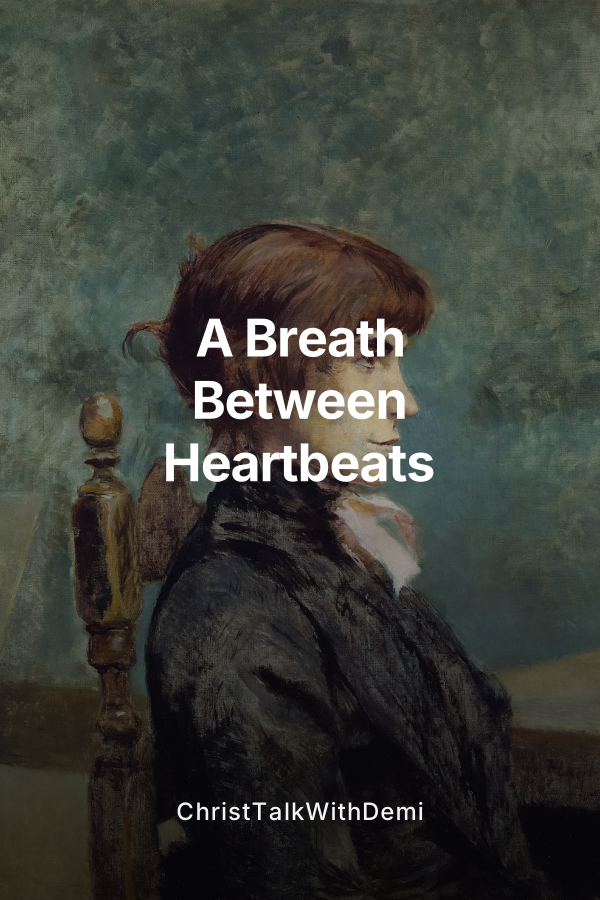
This book is an emotionally focused, character driven exploration of a single frightening incident that cracks open the careful composure of a world class spy and reshapes the bond within his unconventional family. Drawing from the request for a detailed hurt and comfort scenario where Loid experiences a panic attack and closing throat reaction to a hidden strawberry allergy, the story follows the event itself and the ripples it sends through his relationship with Yor and their shared life in Ostania .
Across five chapters, the book traces a tight, intimate arc. It begins with Loid’s confident routine and illusion of control, then plunges him into sudden physical crisis when an ordinary dessert hides the one ingredient his body cannot tolerate. What starts as mild discomfort escalates into a terrifying constriction of his throat, dizziness, and the unfamiliar sensation of his own body betraying him. For a man trained to manage pain, injury, and fear with clinical detachment, this specific loss of breath and voice becomes uniquely destabilizing.
The core of the story lies in the clash between Loid’s perfected mask and the raw helplessness of a panic laced allergic reaction. His instincts tell him to minimize, to stay lucid, to calculate the odds and solutions. Yet as his airway feels tighter and his vision blurs, the techniques that once made him unshakeable falter. Internal monologue reveals an intense, almost clinical analysis of symptoms colliding with intrusive flashes of past missions, failures, and the child he once was, swallowed by war and fear. The psychological realism of the panic response is foregrounded without resorting to medical jargon, focusing instead on sensations, fractured thoughts, and the incremental erosion of his composure.
Yor becomes the vital counterpoint. The incident forces her to confront both her fear of hurting others and her determination to protect the family she has chosen. At first she is baffled by Loid’s symptoms, unsure whether this is poisoning, a delayed injury from a mission, or something she inadvertently triggered. Her distress is not portrayed as incompetence but as the urgent, messy humanity of someone who loves deeply yet believes herself dangerous. When she realizes the reaction is likely to a strawberry hidden in the food, she pivots from confusion to purposeful action. The narrative lingers on her sensory and emotional experience: the sound of Loid’s ragged breathing, the shock of seeing such a controlled man shaking, the desperate focus required to ground herself so she can ground him.
The middle chapters narrow the lens to the vivid immediacy of the episode and its aftermath. Readers witness Yor guiding Loid through basic yet powerful forms of support during the panic spiral. She reassures him, keeps his attention anchored with voice, touch, and simple, repeatable cues, and supports the emergency response needed for his allergic reaction while battling her own urge to fall apart. The story resists melodrama in favor of a steady build of emotional stakes, showing how small choices in a crisis silently redefine trust. Loid, for his part, is forced against every trained instinct to lean on someone else, to accept help rather than provide it.
Once the immediate danger passes, the book does not simply snap back to normalcy. The latter half explores the quiet, often overlooked territory of recovery. Loid is left confronting a vulnerable truth: for all his training as Twilight, he is still subject to fragile, human limits. A simple fruit nearly silenced him more effectively than any enemy agent. This realization shakes his self image and exposes deeper anxieties about failing Operation Strix and failing the people depending on him. Nighttime reflections, restless half sleep, and subtle changes in his behavior around food and risk give shape to a nuanced portrait of lingering fear and hypervigilance.
Yor’s perspective in these chapters deepens the emotional resonance. She struggles with guilt at not noticing the ingredient earlier, with an almost superstitious fear that her presence invites harm to those she loves, and with the question of how to support someone who is so skilled at pretending nothing is wrong. Her journey is about learning that care does not always mean grand gestures or physical protection. Sometimes it means watching for the smallest flinch, gently insisting on rest, or quietly ensuring that no strawberry enters their home again. Her growth is marked by new confidence in her ability to nurture rather than endanger.
The climax of the emotional arc is not a battle, but a conversation. Loid, finally unable to maintain the façade, opens up to Yor about what it felt like to lose his breath and control at once. The book treats this as a pivotal moment in their relationship, not simply because of the content of his confession, but because Loid chooses to be seen in his weakness. He admits to being afraid, not of death itself, but of disappearing without making the world safer for children like the one he once was, and without truly having lived as a husband and father, even in a constructed family arrangement. Yor responds not with perfect words, but with steadfast presence and a promise that he is not alone in the work of protection and care.
By the closing chapter, the incident has become a subtle but enduring turning point. Their domestic routines shift in small, meaningful ways. Shared meals now carry a new layer of attentiveness and unspoken gratitude. Loid becomes marginally more willing to voice discomfort instead of shouldering it in silence. Yor, bolstered by having navigated the crisis, grows more secure in her role and less afraid of breaking what they have. While the external mission driven context of their lives remains unchanged, the internal architecture of their partnership is transformed. They move forward with a stronger, more mutual trust, one that includes their fears as well as their strengths.
Designed for readers who appreciate emotionally intense character studies, realistic depictions of panic and vulnerability, and intimate relationship growth, this book offers a focused, immersive experience built around a single, life altering incident. It provides an exploration of physical crisis as a catalyst for emotional honesty, showing how a choking throat and racing heart can open a path toward deeper connection. The narrative treats anxiety, allergic reaction, and trauma responses with sensitivity, aiming to validate real world experiences of panic while still honoring the distinct personalities and dynamics of Loid and Yor in their unique, high stakes world .