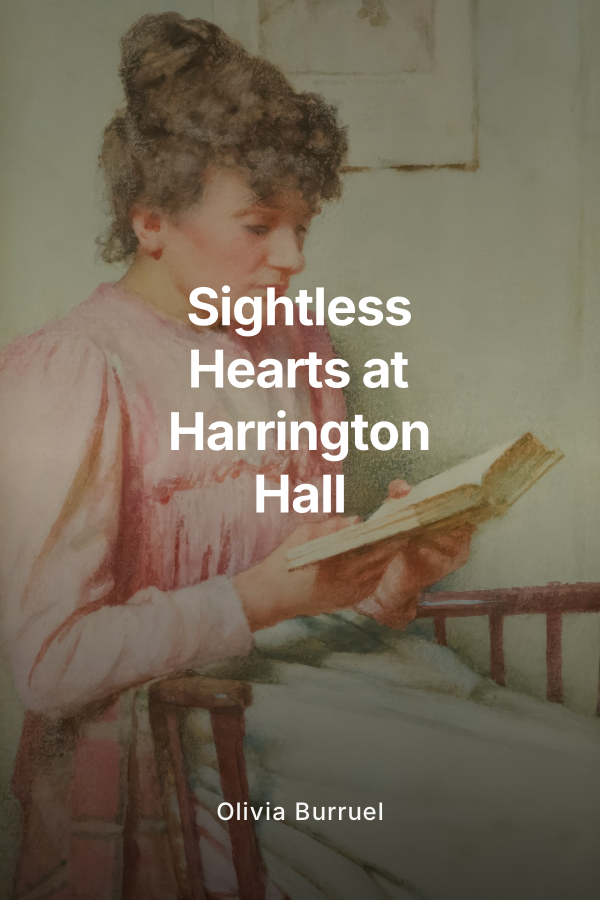
At Harrington Hall, the most prestigious boarding school in the world, the walls gleam with old money and quiet cruelty. Every marble corridor whispers legacy, every pressed uniform signals power. It is a sanctuary built for heirs to empires and future CEOs, a place where names matter more than hearts and where those without wealth are reminded of their place at every turn. In this ruthless ecosystem, two lives collide in a way no one expects and no rule can quite contain.
She has everything that is supposed to matter.
Evelyn Ashbourne is Harrington royalty. Daughter of a billionaire family whose influence reaches far beyond the wrought iron gates, she is the kind of girl everyone notices and no one truly sees. On paper, her life is perfection. A last name that opens doors. A wardrobe curated by stylists. A future that has been plotted out since the moment she could walk.
Yet beneath the immaculate blazer and controlled smile, Evelyn is suffocating. The obscene wealth that dazzles her classmates makes her feel sick. The charity galas, the brutal expectations, the hollow conversations about mergers and private islands leave her empty. She doesn’t brag, she doesn’t bully, and she doesn’t play the games that define Harrington’s social hierarchy. Instead, she hides her rebellion behind kindness and quiet excellence. She is known as the gentle Ashbourne girl, brilliant and good, the one staff members secretly favor and fellow students underestimate.
She belongs to this world, yet every day it feels less like a life and more like a sentence.
He has nothing but what truly counts.
Liam Hart arrives at Harrington Hall with no driver, no monogrammed luggage, and no safety net. He is there on a full scholarship, one of the rare “charity cases” the school parades for good publicity. But beneath the administration’s polished speeches and the students’ thinly veiled contempt lies a simple truth: Liam is brilliant. His mind is sharper than any gilded crest, his insights more precise than any legacy’s entitlement.
He also cannot see.
Once, Liam’s world was full of color and shape and light. An accident took his sight and with it, the future everyone assumed he would have. Instead of collapsing beneath the weight of loss, he clawed his way back through sheer force of will and ruthless discipline. Getting into Harrington on merit alone is his triumph, his proof that he will not be defined by pity.
But Harrington Hall is not built for someone like him. Its maze of corridors, unwritten social rules, and quiet humiliations are designed to break anyone who does not fit the mold. Liam arrives guarded and cold, his dark glasses and measured posture a shield. He is determined to survive without needing anyone. Above all, he refuses to be anyone’s burden.
An unexpected assignment. A life altering connection.
When Evelyn is called to the principal’s office, she expects yet another tedious conversation about leadership opportunities or alumni functions. Instead, she is met with something far stranger. The principal tells her there is a new student who will share all her classes and that he will need her assistance. She assumes she is being asked to tutor some underprepared rich kid whose parents bought his way in. Even she, with all her patience, resents the thought.
Then she meets Liam.
He is waiting just outside the office. Tall, composed, with dark hair and facial features so sharp they almost look carved, he fits in visually with the Harrington elite. Only the subtle tension in his shoulders and the black glasses over his eyes betray the truth. When she learns he is blind, the word catches in her throat. She was ready to resent him. Instead, what she feels is an unfamiliar mixture of curiosity and tenderness.
The principal explains that Liam will be given all the same classes as Evelyn to simplify accommodations. Her role is not to tutor him, but to guide him through the unforgiving architecture of the school and the even crueller arena of its social life. She has been chosen, he says, because she is the kindest, one of the most intelligent, and someone they trust. Evelyn nods, outwardly calm, while inside something shifts. For the first time in a long time, she is being asked to do something that is not about reputation or optics, but about a person who might actually need her.
Two worlds that should never mix.
On paper, Evelyn and Liam could not be more different. She is old money, poised to inherit corporations and expectations. He lives with the memory of hospital disinfectant and late night study sessions, clawing at a future no one handed him. At Harrington, money is the only language that matters. People like Evelyn belong. People like Liam are either invisible or targeted.
Their arrangement does not go unnoticed. When she walks the halls with her hand lightly guiding him, whispers bloom like mold in the corners. Why is the Ashbourne girl wasting her time on him? Is this some new charity project? Does he think he is special because the administration is indulging him? Harrington’s golden students, accustomed to using their wealth as a shield and a weapon, resent any disruption to their carefully curated dominance. The scholarship kids watch with wary eyes, knowing that closeness to someone like Evelyn can paint a target on your back as much as it can open doors.
Evelyn is caught between two worlds. She has one foot in the glittering circle of privilege that raised her, and another inching toward someone who has no armor beyond his pride. Liam, for his part, trusts no one. To him, needing help is a humiliation he barely tolerates. Every time Evelyn slows her step for him, every time she describes the classroom or the expressions he cannot see, he hears the quiet scrape of dependence. He hates it. He hates himself for needing it.
A slow burn lit in stolen moments.
Their connection does not ignite in some instant blaze. It flickers, then retreats. At first, they are painfully awkward. Evelyn speaks too carefully, afraid of saying the wrong thing, while Liam responds with clipped answers, his voice a shield. She is warm, he is icy. She is used to being liked, he is used to preemptive disappointment.
Yet day after day, circumstance forces them into each other’s orbit. Shared classes become shared walks. Shared walks become shared silences that aren’t entirely uncomfortable. Slowly, against Liam’s best intentions and Evelyn’s cautious heart, something begins to shift.
Evelyn learns that Liam was not born blind and that the loss of his sight carved scars far deeper than the physical reality of darkness. He confides, haltingly, about the life he thought he would have, the person he used to be, and the rage that still flares when he reaches for something that is not where he left it. Beneath his hardened exterior, she finds a breathtaking intellect, devastating honesty, and a tenderness he is terrified to show.
Liam, in turn, begins to see Evelyn even more clearly than those with sight. He hears the way her voice tightens when she mentions her parents. He notices how she goes quiet when her friends talk carelessly about money, or how she flinches at the word empire. He realizes that while she moves through marble hallways as if she owns them, she is, in her own way, just as trapped as he is.
No shared trauma bonds them. No dramatic rescue throws them into each other’s arms. Instead, intimacy grows in the shadowed spaces of ordinary days. In the way she describes the light through the stained glass windows to him, not as some vague “it’s pretty,” but as shifting rivers of color that spill across the floor. In the way he pushes her to answer why she still lets her parents dictate every choice when her mind is clearly her own. In sarcastic comments traded under their breath during assemblies, in the comfort of knowing that someone else in this world of calculated surfaces is quietly rebelling too.
Barriers no amount of money can fix.
Their feelings do not bloom in a vacuum. Three major forces stand between them and anything that looks like a future.
First is the raw gap between their worlds. Evelyn’s life is polished and suffocating; Liam’s is precarious and hard won. People from her circle would never understand why a girl like her would choose a boy who cannot attend galas with ease, cannot pose in perfect photographs, cannot glide through their world without it costing him effort and dignity. Her parents speak in the currency of alliances and appearances. To them, Liam is not a person, but a problem.
Second is his blindness itself, not as a flaw in him, but as something he believes makes him fundamentally unworthy. Liam is consumed by the fear that he is anchoring her to a smaller life. He tells himself that loving her would mean stealing experiences from her, tethering her to his limitations. Each time she chooses to sit with him instead of attending some exclusive gathering, guilt claws at him. Rather than believing her when she says he is enough, he imagines her future self resenting him for everything she missed.
Third is Harrington Hall itself, with its unspoken rules and quiet punishments. Bullying of scholarship students is subtle but brutal, more about social isolation and targeted rumors than overt violence. For Evelyn, defending Liam means openly rejecting the system that has always protected her. For Liam, allowing her to stand beside him means watching her become a target too. The more their bond deepens, the more dangerous it becomes for both of them.
Intimacy in defiance of expectation.
The novel traces their slow evolution from reluctant partners in an unfair arrangement to something far more profound. Each chapter deepens their emotional landscape, weaving late night conversations, near broken promises, and raw confessions into a tapestry of intimacy.
There are moments so small they almost seem trivial yet carry the weight of entire lifetimes. Evelyn guiding his hand across the grooves of an old stone pillar so he can know the building the way she does. Liam teaching her how to navigate by sound and touch so she can understand, in the smallest way, what movement means to him now. A near argument when she tries too hard to help, and his pride lashes out. An equally fierce apology when he realizes she is not pitying him, but fighting for him.
Their relationship never becomes a story of one saving the other. Instead, it is a story of mutual unmaking and rebuilding. Evelyn begins to question whether the future her parents planned is something she wants at all. Liam starts to consider that accepting help is not equivalent to surrendering his worth. Together, they confront the idea that love is not about perfection or convenience, but about choosing each other in full knowledge of their fractures.
Risking everything for something real.
As they grow closer, the cost of their connection rises. Whispers turn to confrontations. Evelyn’s parents receive subtle complaints about her “inappropriate attachment” and the way her priorities have shifted. Liam feels the hostility from both the wealthy students who see him as an interloper and the scholarship kids who fear his closeness to her will bring trouble on all of them.
He pulls back, telling himself it is for her own good. She pushes forward, refusing to let him make that choice for her. Their fights are not about petty misunderstandings, but about deep rooted fears and clashing definitions of love and sacrifice. He believes protecting her means staying away. She believes loving him means staying, even when it hurts.
The pressure culminates in a series of choices that will define not just their relationship, but who they become as individuals. Will Evelyn finally speak a truth that risks everything her family has planned for her? Will Liam allow himself to be loved without apology, accepting that his blindness does not make him a burden, but simply human?
A love that rewrites the rules.
“Sightless Hearts at Harrington Hall” is more than a school romance. It is a slow burning exploration of privilege, identity, and the quiet courage it takes to walk away from a life that looks perfect but feels unbearably wrong. It is a story of a boy who thought his value ended the day the world went dark, and a girl who thought she had no right to want anything different from what her last name demanded.
Through their eyes and their silences, readers are invited into a world where emotional intimacy is more electric than scandal, where the most powerful scenes are not the grand gestures, but the whispered choices made in the shadows of marble halls. The novel does not trivialize Liam’s blindness or treat it as a trope to be cured, nor does it frame Evelyn’s wealth as a fantasy without cost. Instead, it allows both characters to exist in full complexity, challenging each other and the world that shaped them.
Ultimately, this is a story about learning to see.
Evelyn must learn to see herself not as an accessory to her family’s empire, but as a person with desires, fears, and a future she can shape. Liam must learn to see that letting someone in does not make him weaker, that his worth is not measured by what he can offer in return for love.
Together, they discover that the most radical act in a world built on appearances and power is to love someone for who they are when no one is watching. Their romance is not about fixing each other, but about standing side by side as they dismantle the cages they were born and thrown into.
“Sightless Hearts at Harrington Hall” promises a deeply emotional journey filled with aching vulnerability, charged quiet moments, and the kind of slow burn intimacy that lingers long after the last page. It is for readers who crave romance rooted in character and feeling, a story where every touch, every argument, and every hard won confession feels earned.
In the end, Evelyn and Liam do not simply fall in love. They learn to choose it. Over fear. Over expectation. Over the rigid, glittering world of Harrington Hall. And in choosing each other, they begin to finally, truly, see.