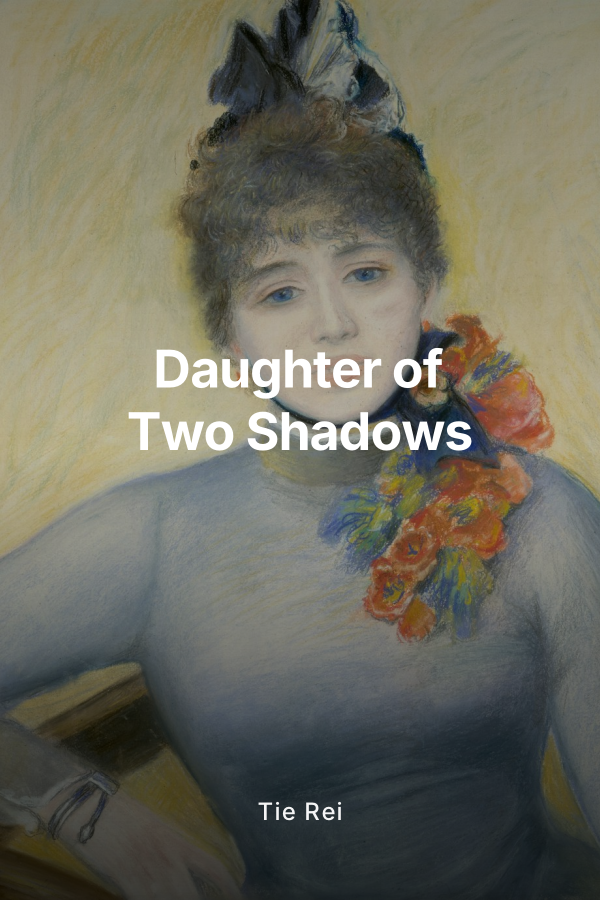
This novel follows Sarah, a young biracial woman enslaved on a Southern plantation in the tense years before the Civil War, as she struggles to claim an inner freedom long before the law will ever acknowledge her humanity. Caught between the worlds that created her yet refuse to claim her, Sarah moves through a landscape of constant surveillance, unspoken hierarchies, and generational wounds that live in every glance, every order, every silence. Her very existence is a living reminder of the violence of the slave system and the forbidden intimacies that sustain it, and this precarious position becomes both her greatest vulnerability and the source of a fragile, stubborn strength.
Across from her stands William, the white heir to the plantation, whose outward power masks a gnawing, festering insecurity. He is heir not only to land and people but also to a legacy of cruelty and dominance that he has never learned to question, only to inhabit. William’s jealousy and need for control turn Sarah into a focal point for all he cannot name in himself: his fear of failure, his resentment of his forebears, his confused fascination with the woman whose bloodline crosses the boundaries he has been raised to defend. His cruelty is both personal and systemic, and the novel traces how each of his choices tightens the net around Sarah while also revealing the deep fractures within his own soul.
The story unfolds in five movements, each one deepening both the historical pressures of the pre Civil War South and the intimate, psychological war between Sarah and William. In the opening chapters, readers meet Sarah as a young woman who has long learned to survive by moving carefully around white eyes and white tempers. She moderates her speech, conceals the quickness of her mind, and lives with the constant awareness that she belongs nowhere: not fully among the enslaved community, who both love and resent the privileges and punishments attached to her mixed heritage, and not even in the secret corners of the big house where she sometimes walks. The reader is drawn into her inner life, where small acts of quiet defiance, such as holding on to a forbidden memory or sheltering someone weaker from a whipping, become the only spaces in which she can choose herself.
As the narrative progresses, the plantation’s routine is shown as a brittle arrangement built on fear, humiliation, and constant threat. William steps into his role as overseer in waiting, and his first encounters with Sarah establish a precarious pattern. To the outside world, he remains rigid and unyielding, taking every opportunity to remind Sarah of her place. Yet the text lingers on his hesitation, his peculiar attentiveness, the way his gaze narrows when she does not break as quickly as he expects. Early scenes of punishment and public reprimand are choreographed as performances of power that both of them understand: he cannot afford to show softness, and she cannot afford to show anger. Beneath the ritual of cruelty, however, another dynamic is beginning to form, one in which Sarah discovers small, hidden ways to retain her dignity even as William fights to prove his dominance.
The second movement of the book explores the intricate social order of the enslaved quarters and the big house, showing how Sarah’s mixed heritage shapes every relationship she has. To some of the enslaved, she appears stained by her proximity to the master’s family, even as she shares their hunger, pain, and fear. To the white family, she is both useful and suspect, receiving certain tasks and minor comforts that only underline how easily they could be stripped away. This duality leaves her haunted by the question of where she truly belongs. The narrative delves into her memories of childhood, fragments of stories about her mother, and the echoes of whispered gossip that follow her wherever she walks. These chapters emphasize her greatest fear that she will die as nothing more than property and her secret hope that there is some world beyond the river, beyond the tree line, where a woman like her might simply be a person.
In contrast, the third movement turns inward toward William’s psyche, illuminating the history that formed him. Readers see glimmers of his childhood, the stern paternal expectations, the silent mother, the lessons in ownership and masculinity delivered not as ideas but as practices enacted on Black bodies. The book explores the one line he tells himself he will not cross, the boundary that lets him believe he is somehow more honorable than the men before him. Yet as economic pressures grow and political tensions rise around the country, his need to prove himself erodes even this fragile self image. Each time he approaches a moment of possible mercy, something in him recoils, and he instead chooses punishment, humiliation, or calculated indifference. The tension lies in those near misses, those seconds in which another William might have drawn back and another future might have opened.
The fourth movement charts an escalating series of confrontations between Sarah and William as the balance of visible and invisible power begins to shift. What begins as a pattern of one sided domination slowly turns into a charged, dangerous dialogue that neither of them can fully control. Sarah learns to read the legal and social limits constraining William just as sharply as the laws constraining herself. She understands that his inheritance is not only land but also expectation, and that there are forms of disobedience that risk his reputation as much as her life. With deliberate subtlety, she starts to assert small refusals and bargains, timing them precisely to the moments when William is most desperate to display authority. Each encounter raises the stakes, as rumors begin to circulate among the enslaved and white communities alike, and the plantation itself feels increasingly like a tinderbox waiting for a spark.
Throughout this section, the narrative also foregrounds the solidarity, conflict, and quiet heroism that fill the lives of the enslaved. Friends, elders, and children in the quarters are given rich interiority, showing how they navigate a world in which hope itself can be dangerous. Sarah’s relationships with them deepen her sense of responsibility and complicate any simple notion of escape. Her choices are never simply her own. Every possible path out of bondage risks drawing others into retribution. The novel underscores the slow birth of a different kind of power, one rooted in shared stories, small risks taken for one another, and the fierce commitment to remember every injustice instead of letting it sink unmarked into the soil.
In the final movement, external events in the wider country begin to intrude more directly on the plantation’s insulated world. Rumors of uprisings, new laws, and political upheavals swirl among both the enslaved and the white owners, though interpreted through vastly different lenses. For Sarah, these rumors are distant lightning, flashes of possibility that may never reach her. For William, they are threats to everything he has been promised. Under this gathering storm, the personal war between them reaches a breaking point. An early scene of public punishment that once defined their roles is mirrored by a later, pivotal confrontation in which Sarah refuses a humiliation that once would have gone unquestioned. The legal order still stands against her, yet the emotional and moral landscape has subtly altered. The momentary crack in the ritual of submission exposes William’s profound fear and the hollowness of his supposed mastery.
The climax does not arrive as a single grand rebellion but as a series of layered reckonings. Sarah must decide what form of freedom she can realistically claim: a physical escape that endangers those she loves, a spiritual and psychological liberation that allows her to hold on to herself within chains, or some uncertain combination of both. The book resists easy resolutions, acknowledging the brutality of the system while honoring the quiet, indomitable force of Sarah’s inner life. William, confronted with the consequences of his choices, faces a final moment in which the path of mercy is once again available to him. The tension lies in whether he will finally step across his own line or retreat once more into the armor of cruelty that has shaped his every adult decision.
Across its five chapters, the novel blends intimate character study with the stark realities of the pre Civil War South. It does not flinch from depicting the violence, exploitation, and psychological terror of slavery, yet its deepest focus remains on the textures of thought, feeling, and memory that constitute Sarah’s experience. Her transformation from a young woman who survives primarily by erasure of self to one who dares to claim her own interiority as a form of resistance forms the book’s central arc. Each chapter adds new layers to her identity as a daughter of two shadows, born from a union of domination and despair, yet capable of imagining a future in which her bloodline is neither a curse nor a secret, but simply her own.
Ultimately, Daughter of Two Shadows is a story about power, belonging, and the fragile, insistent emergence of freedom in a world built to extinguish it. Through elegant prose and deep introspection, the book invites readers to dwell within the conflicted hearts of both Sarah and William, to witness the daily choreography of oppression and endurance, and to consider how a single human soul, held in bondage, can still find room to grow, to choose, and to imagine.