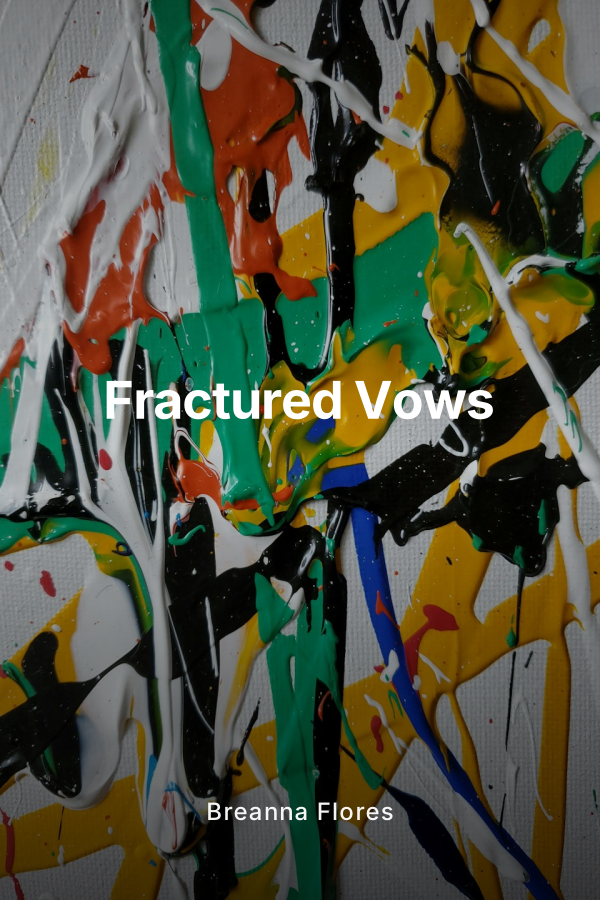
This book is a tense, emotionally charged family drama centered on a stepfather and adult stepdaughter, both consenting adults, whose complicated bond becomes the fault line that cracks an already unstable household. Their relationship never exists in a vacuum. It is tangled in decades of secrets, loyalties, betrayals, and the quiet resentments that grow inside a family that looks functional from the outside but is quietly unraveling within .
At its core, the story follows an adult stepdaughter in her mid twenties and a stepfather who is noticeably older. The age gap amplifies their history and power dynamics. She has spent years feeling like an outsider in her own home, overshadowed by her mother’s needs and her stepfather’s unspoken judgments. He, in turn, has built his identity around being the reliable one, the provider, the man who stepped in to repair what her biological father broke. Their family roles are rigid, but beneath them lies a shared loneliness that neither of them can admit to anyone else.
The central conflict revolves around a buried family secret that implicates both of them. When the stepdaughter stumbles on evidence that the narrative she has been told about her childhood and her father’s disappearance from her life is not the full truth, she is forced into an uneasy alliance with the one man she has always resented most. Together, they must confront what her mother has hidden, what he has enabled through silence, and what it has cost all of them. As they dig deeper, anger and mistrust flare, but so do flashes of understanding that neither of them anticipated.
The book traces their journey from brittle distance to a raw, uncomfortable honesty. At the beginning, every interaction is laced with tension. They clash over house rules, money, loyalty to the mother, and unresolved grief. She sees him as a gatekeeper, a symbol of all the choices that were made for her without her consent. He sees her as a constant reminder of everything he has failed to fix. Their skirmishes during late nights in the kitchen, terse car rides, and awkward family dinners set the tone for a home where words are weapons and silence is a shield.
When the truth begins to surface, the stepdaughter becomes the catalyst for the family’s unraveling. She refuses to swallow convenient explanations and easy lies, even when doing so would preserve the fragile peace in the household. The stepfather, whose loyalty has always been to his wife first, now finds himself torn. Does he continue to protect the woman he promised to care for, or does he finally acknowledge the harm that his compliance has caused her daughter? This moral crossroads forces him to examine his identity as a husband, a provider, and a parental figure who never quite fit the role of “father.”
The story’s emotional engine is the evolving relationship between the two leads. As they confront their shared past, private moments of vulnerability break through the hostility. A late night argument that begins with accusations ends in mutual confessions of fear, guilt, and longing for something like family, even if neither of them knows what that should look like anymore. A volatile blowup at a family gathering exposes hidden alliances and fractures. A quiet, almost tentative conversation in a parked car, away from the eyes of the mother and extended family, becomes the space where they finally begin to tell each other the truth.
Their bond edges into forbidden territory, not primarily in a physical sense but in the emotional intensity that defies conventional labels. They are not parent and child, not quite friends, and not simply adversaries. They exist in a liminal space where they understand each other in ways no one else in the family does. That intimacy carries its own danger. The book does not romanticize exploitation or blurred boundaries; instead, it interrogates how unmet emotional needs, bad communication, and fractured loyalties can distort the lines between protection, attachment, and desire.
Family drama is the broader frame surrounding this intimate core. The mother’s fragility and partial culpability, simmering conflicts with extended relatives, money disputes over inheritance or debts, and unspoken comparisons to the absent biological father all tighten the narrative tension. Each chapter peels back another layer of how this family has survived by avoiding certain truths and assigning rigid roles. The stepdaughter has always been the problem, the rebel, or the disappointment. The stepfather has always been the stabilizer, the adult in the room. The story challenges those labels and reveals who actually holds power and who has been silently sacrificed.
Crucially, the book’s trajectory is not about glamorizing a taboo connection but about forcing its characters to grow up emotionally. The stepdaughter learns to articulate her boundaries, her anger, and her grief, rather than acting them out in self destructive ways. The stepfather learns that loyalty without integrity is just fear wearing a moral mask. Their fraught alliance ultimately pushes the entire family through a painful reckoning.
The climax hinges on a series of confrontations. A late night showdown between stepfather and stepdaughter brings their years of resentment to a head. A charged family gathering explodes when long buried truths are dragged into the open, forcing every character to choose a side. Finally, a private conversation of apology and acknowledgment redefines the central relationship in terms that respect both of their adulthood while finally accepting that some bonds, no matter how emotionally intense, must be held at a careful distance to avoid further harm.
By the end, their relationship has changed from antagonistic and confused to something clearer, though not simple. There is no easy, fairy tale resolution. Instead the book offers a fragile but genuine form of peace. The stepdaughter gains a sense of agency and self trust. The stepfather steps out of the shadow of his own self justification and faces the consequences of both his actions and his inaction. They arrive at a mutual understanding that honors their shared history without denying the damage that has been done.
For readers, this family drama offers a gripping, intimate look at how complicated adult relationships inside blended families can become, especially when layered over secrets, power imbalances, and unresolved grief. It speaks to anyone who has ever felt out of place inside their own home, or who has been cast in a family role that does not fit who they truly are. Through uncomfortable conflicts and hard won moments of honesty, the book explores how people can both wound and save each other inside the same set of walls.
Fractured Vows is not a story about a tidy moral lesson. It is about the messy, contradictory reality of love, obligation, resentment, and forgiveness inside a family structure that was already fragile long before one stepfather and one stepdaughter were forced to look each other in the eye and finally speak the truth.