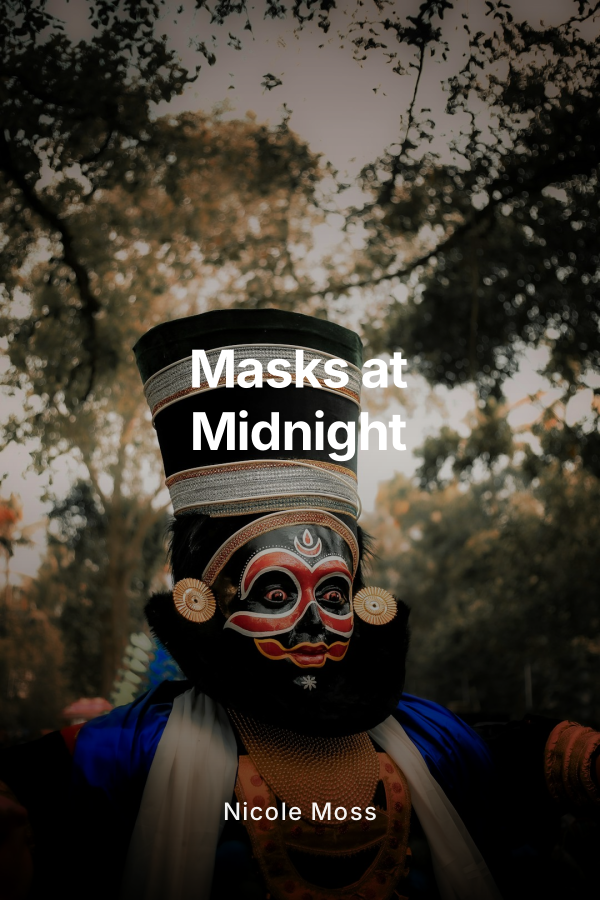
This book is a concentrated, two chapter sapphic historical romance that compresses an entire emotional awakening into a single glittering night. At its heart lies the reluctant heroine Eloise, who dreads everything the ballroom represents, and Cressida, the dazzling woman she has taught herself never to want. Across roughly four thousand words, the narrative traces Eloise’s journey from suffocating resentment through secret, shame soaked longing, to an urgent embrace of desire that risks her reputation and sense of self. The tone is lush, intimate, and psychologically driven, written for adult readers who crave intense, character centered romance where every glance and touch carries real weight.
The story unfolds over one ball that feels like a lifetime. From the moment Eloise arrives, the setting is painted as both opulent and oppressive. Chandeliers, polished floors, expensive fabrics, and an orchestra’s relentless music form a kind of golden cage that keeps everyone moving in rehearsed patterns. To the outside world, this is a place of courtship and celebration. To Eloise, it is a marketplace where she must present herself as a prize she has no interest in being. She is expected to smile, flirt, and circulate as though the future husbands and family alliances being bartered around her are exciting instead of exhausting. This tension between the room’s beauty and her inner resistance defines the book’s atmosphere from the first page.
Eloise’s dissatisfaction is not vague boredom. It is rooted in a lifelong sense of misfit. The rules of womanhood in her world have always felt tailored for someone else. Marriage is spoken of as destiny, modesty as virtue, obedience as safety. She understands these expectations with almost clinical clarity and can mimic them well enough to satisfy her family, yet she experiences each curtsy and polite smile as a small betrayal of something unnamed inside her. Masks at Midnight makes this dissonance visceral. The crush of bodies on the dance floor is too close, the music too loud, the attention on her appearance too unrelenting. Eloise’s thoughts circle around escape as much as they circle around endurance. That she keeps participating at all shows how deeply the social script has settled into her bones.
Into this stifling routine steps Cressida, or rather, Eloise’s awareness of her. The book frames their initial connection not as love at first sight but as a jarring interruption. A flash of fabric, a laugh too sharp to ignore, a profile turned in candlelight that hooks Eloise’s gaze despite herself. The moment she notices Cressida, the crowd recedes. The text leans on the strange clarity of sudden fixation, the way one person can become the only point of focus in a crowded room. At first, Eloise names this sensation as annoyance. Cressida is everything she resents the ball for celebrating: poised, witty, envied, apparently at ease with the rituals Eloise loathes. The summary emphasizes that this irritation is the surface expression of something more dangerous, an early tremor of desire that Eloise is not prepared to recognize.
From that point forward, Chapter 1 maps how resentment sours into craving. Each conventional interaction Eloise endures throws Cressida into sharper relief. A tedious conversation with a suitor becomes more unbearable because she knows that across the room Cressida is laughing with someone else. A dance she must accept out of politeness feels like wasted time when she can feel Cressida’s eyes on her or imagines that she can. The book lingers on the micro moments that accumulate into obsession. Fingers almost touch when they exchange pleasantries. Their sleeves brush as they pass. They share a look that is gone before anyone else can register it, yet sears itself into Eloise’s memory. She tells herself she is irritated by Cressida’s confidence, by her effortless grace, but her attention keeps returning to the shape of Cressida’s mouth, the scent of perfume as she walks by, the lower register of her voice when the two of them stand closer than propriety recommends.
The ballroom itself becomes a character, functioning as a glittering prison that tightens around Eloise the more her interest in Cressida grows. The story’s descriptive choices emphasize surveillance and judgment. Every pair of eyes feels like a threat, every polite smile like a test she is always in danger of failing. The dance figures, the etiquette of conversation, and the carefully arranged chaperonage are presented as mechanisms designed to funnel desire into acceptable channels and to punish any deviation. In this environment, Eloise’s burgeoning attraction takes on a specifically transgressive charge. It is not simply that she wants another woman. It is that she wants the one person who seems born to thrive within the system Eloise herself cannot tolerate. Her glances at Cressida have to be disguised as idle observation. Any softening in her tone must be buried under practiced coolness. The energy that might have gone into flirting is spent instead on suppressing evidence of longing.
The first chapter builds toward a sharp emotional wound. After a sequence of glances and brief exchanges that hint at mutual interest, Eloise experiences what feels like a personal dismissal or rejection. The book leaves room for variations in how this takes shape, but the impact is constant. A remark from Cressida lands with surgical precision, delivered in front of others who laugh. A cool look replaces a previously warm one. Or Eloise sees Cressida seemingly choose a safer, more conventional partner over her. Whatever the exact trigger, the effect is devastating. In a space where Eloise already feels wrong for wanting anything outside the script, this perceived rejection confirms her worst fears. She feels foolish for imagining any shared spark, ashamed for having allowed herself to hope, and exposed in a way that makes the crowded ballroom suddenly unbearable.
Eloise’s emotional defenses surge back with a vengeance. What had slowly softened into secret longing hardens into brittle indifference. She becomes sharper, more sarcastic, more determined not to let anyone see the depth of her hurt. Yet the book is clear that this posture is a last ditch attempt at self protection rather than a return to true detachment. The wound has already altered the landscape of her feelings. Her escape from the ballroom at the end of Chapter 1 is driven as much by that inner chaos as by the need for air. The night outside offers cold, dark, and quiet, a stark counterpoint to the overheated, over lit confines she has fled. In stepping through the doors, Eloise is entering a liminal space where rules relax, where secrecy is still necessary but honesty becomes possible. The chapter closes on this threshold, with Eloise’s anger, confusion, and still smoldering desire all unresolved, and the sense that some decisive confrontation lies ahead.
Chapter 2 narrows the focus to the intense, private encounter that follows. It opens with Eloise alone outside, replaying the entire evening in her mind. The relative stillness of the night allows her thoughts to grow louder. She vacillates between a desire to erase Cressida from her life and an awareness that she cannot stop thinking about her. The calm air, the muted strains of music drifting from inside, the distant glow of the ballroom’s windows all create a suspended atmosphere that mirrors her internal state. This is not peace but a charged pause before something breaks.
Cressida’s arrival interrupts that fragile solitude. The book treats her appearance as inevitable, as if both women have been pulled to the same borderland by forces they have spent years denying. The initial silence between them hums with unsaid words and misread signals. Their conversation begins in a defensive mode, fueled by pride, hurt, and a shared terror of naming what has been simmering all night. Eloise wields brittle humor and sharp remarks as armor, determined not to show how deeply she has been wounded. Cressida answers with polished composure and quick deflections, the same traits that made her seem untouchable in the ballroom. Yet here, in the shadows, those masks begin to slip. The summary highlights this gradual stripping away of pretense as the emotional core of the second chapter.
Through barbed exchanges and half confessions, both women reveal that their experiences of the ballroom have been more similar than either guessed. Cressida too has felt the weight of expectation, the suffocation of always performing charm. She admits, haltingly or through implication, that she has been watching Eloise throughout the night, frustrated by her distance and drawn to her defiance. The earlier sense of rejection turns out to be rooted in misunderstanding and fear rather than actual disdain. This reframing does not erase Eloise’s hurt, but it does undermine her conviction that she is fundamentally alone in her desire. As each layer of politeness falls away, the space between them fills with something rawer and more honest.
Physical proximity begins to tell a parallel story. A step closer to hear one another’s words, a shared breath in the cool night air, the accidental brush of fingers as one reaches for the balustrade or a nearby branch. These seemingly small moments carry the weight of the entire evening’s restraint. The narration sharpens around sensory detail at this stage. Eloise feels the heat of Cressida’s body against the chill, registers the exact cadence of her breathing, notices how the world seems to contract until all that exists is the space between their mouths. Her internal conflict reaches a breaking point. On one side stand dread and shame, ingrained over a lifetime by a society that has never made room for women like her. On the other stands the immediate, undeniable pull of Cressida’s presence, the visceral rightness of wanting her.
The central turning point of the book comes when Cressida finally makes an unambiguous move. It might be a hand that lingers at Eloise’s wrist, eyes that hold hers without flinching, or a whispered confession that can only be read as desire. Whatever its form, this act removes the last possible deniability between them. Eloise is pushed past the edge of indecision. The kiss that follows is described as both tentative and overwhelming, gentle in its physical movement yet seismic in emotional impact. Years of suppression collapse into that one point of contact. The language dwells on the rush of sensation: the pressure of lips, the grasp of hands seeking anchor, the shock of knowing that the longing Eloise barely dared to name is not only real but reciprocated. In that moment, the ballroom and its rules fall away. The distant music becomes irrelevant, the social universe they have always navigated shrinks to nothing against the immediacy of this singular choice.
The aftermath of the kiss is not a neat resolution but a surge of complicated feeling. Eloise is elated, flooded with relief, and also terrified. If this is real, what does it mean for her future, for the life mapped out for her since childhood, for the fragile safety of propriety she has relied on even while resenting it? The book chooses to explore these questions not through philosophical debate but through continued physical and verbal intimacy. Touch becomes a language of reassurance, with Cressida’s hands on Eloise’s skin conveying a steadiness that words struggle to match. The way Cressida looks at her now, as though seeing and accepting all that Eloise has tried so hard to hide, begins to heal some of the shame that has haunted her. At the same time, the looming presence of the ballroom presses at the edges of their stolen moment, reminding them that nothing about this connection can be simple or safe.
The outside scene ultimately functions as a crucible. For Eloise, allowing herself to be kissed and to respond with unrestrained hunger is the first time she refuses to treat her own desire as an aberration. She does not arrive at a tidy reconciliation between who she is and the role her world demands she play. Instead, she accepts that such reconciliation might be impossible, yet still chooses not to erase this part of herself. The book underscores this as a shift from secret, solitary yearning to mutual, embodied passion. Cressida, too, is transformed. By seeking Eloise out and risking both rejection and discovery, she steps beyond the safety of her carefully curated social persona. Their shared vulnerability becomes a fragile foundation for whatever future they might manage to build under hostile conditions.
The story closes on a note of precarious hope rather than guaranteed happiness. Perhaps they must eventually smooth their dresses, steady their breathing, and walk back into the ballroom with new masks hastily arranged. Perhaps they choose to linger in the shadows a little longer, stealing time before dawn and its consequences. In either case, the emotional reality has shifted irrevocably. Eloise has moved from dread and resentment, through humiliation and despair, into a dangerous yet liberating honesty. Cressida has shed her role as distant idol or apparent antagonist and emerged as a co conspirator in a love that defies every visible rule. The external world remains unchanged and unforgiving, yet something private between them has become undeniable.
Throughout Masks at Midnight, the core themes intertwine: desire blooming under repression, the corrosive power of shame, and the radical courage required to admit what we want when the world insists we should want something else. Sensuality is never decorative here. Each touch, each glance, each kiss bears the weight of years spent pretending. By confining the narrative to a single night and two concentrated chapters, the book magnifies the stakes of every choice. A look across a ballroom becomes as significant as a declaration, a step into the night as momentous as a life decision. Readers are left not with the comfort of certainty but with the thrill of possibility. Eloise and Cressida cannot unlearn what they have discovered in each other. However their lives unfold beyond the final page, they have already crossed the line between performance and truth, and that knowledge will not easily be forgotten.