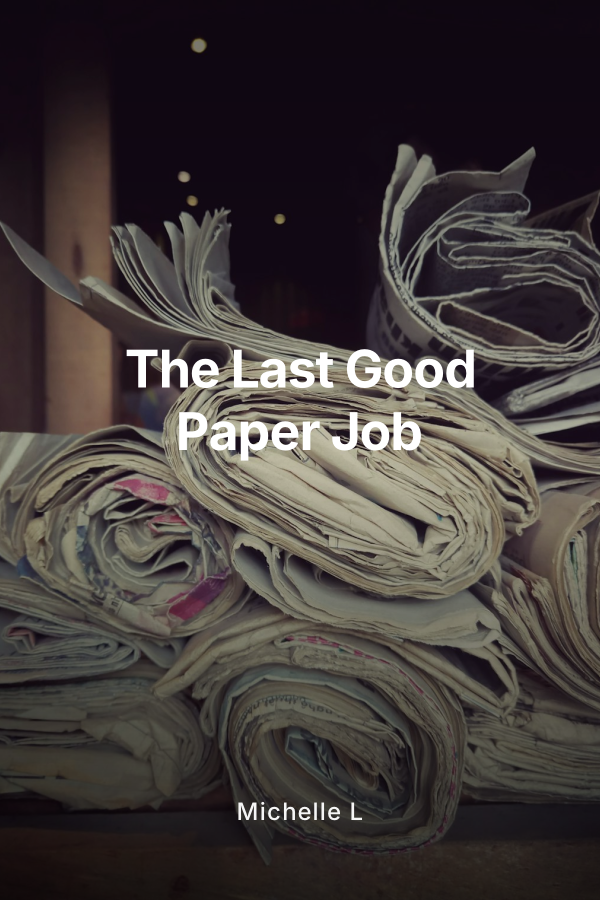
In the late 1990s, when classified ads still paid the rent and no one outside a niche message board used the word “blog,” Beverly Hart believes she has landed the one thing she has always wanted: a real reporting job at a mid‑sized city newspaper that still calls itself a paper of record. Ambitious, sharp tongued, and just naïve enough to think that truth will be rewarded on merit, Bev walks into the newsroom expecting a calling and finds instead a decaying institution held together by habit, bad coffee, and the pettier instincts of frightened people.
The book follows Bev through the brief, formative stretch between what she thinks is the start of her career and what will become its first brutal redefinition. At the city paper she is both useful and suspect. Her talent is obvious, her instincts good, but her inability to keep her commentary to herself makes her a quiet threat to a culture built on unspoken compromises. Her copy sings; her side remarks scorch. Around her, older reporters cling to their desks like life rafts while managers translate their own career terror into punitive small‑mindedness.
Three figures crystallize the moral weather of this place. Benny, a jaded but fundamentally kind veteran reporter, recognizes in Bev the same stubborn fire he used to carry and cannot quite extinguish in himself. He becomes her unofficial guide: part mentor, part warning, part accomplice in cynical humor that lets them survive the worst days. Susie, a high‑functioning newsroom operator with better political instincts than anyone in management, understands that survival here depends less on truth and more on how softly it is spoken. She admires Bev’s courage while knowing exactly how dangerous it is.
Then there is John, a small tyrant in an ill fitting blazer who has failed upward through a mixture of shamelessness and timing. For John, journalism is not a calling but a ladder with missing rungs, and he guards the ones beneath him by stomping on any hand that reaches too high. Bev’s unwillingness to flatter, to pretend idiocy is competence, or to look the other way when facts are bent for comfort sets her on a collision course with him.
The core of the book is this slow motion office war, waged not with dramatic firings or screaming matches but with performance reviews, assignment reassignments, and insinuations about “fit.” Bev’s greatest strength as a reporter is her clarity; her greatest liability as an employee is that she applies the same clarity to the people she works for. The narrative moves between her public work and her private thoughts, showing how the same sharp perception that helps her see through political spin also reveals the soft corruption of her own workplace.
As Bev covers small city scandals, zoning meetings, and local human interest stories, she keeps tripping over the quieter scandal inside her own building. Sloppy editing justified as “voice,” favoritism dressed up as “strategic priorities,” an HR department more concerned with keeping the publisher undisturbed than with keeping the staff protected. Bev cannot stop pointing out contradictions whether they occur in a mayoral press conference or an internal memo reminding reporters to “maintain objectivity” while pushing them to write advertiser friendly fluff.
Her refusal to play along earns her a reputation for being “difficult.” What begins as eye rolling behind her back hardens into a tactical project: John’s determination to have her removed before her defiance spreads. Where Bev sees herself as merely being honest, he sees a threat to a precarious power structure. The campaign to discredit her is small in scale but chilling in design: rewriting her evaluations, reinterpreting normal mistakes as evidence of temperament, hinting that she is “not a team player.”
The tone of the book is darkly comic, catching the absurdity in every earnest memo and contrived strategy meeting. The humor comes from the mismatch between how the paper talks about itself and what it actually is. Management speaks in grand terms about “serving democracy” while fretting about the size of the lifestyle section. A sales rep assures anyone who will listen that classified ads will be the paper’s “forever money,” even as a few younger staffers mention something they have seen called “online listings” and are waved away.
No one, not even Bev, really understands how close they are to a cliff. The newsroom culture is still organized around print deadlines and the daily ritual of bundling a physical product, as if that ritual has the solidity of a natural law. When the word “internet” appears at all, it is in joke form, a passing curiosity. The coming upheaval in media hangs over the narrative as a silent future cloud. The reader, armed with hindsight, sees these people not just as flawed colleagues but as citizens of a vanishing world who do not know they are living in its last years.
When Bev finally decides to leave, it is less a triumphant escape than a bruised recalibration. She applies to a smaller, respected regional newspaper in a sleepy beach town a few hours away, half convinced they will not want her and half hoping they will. The offer comes from an editor who has quietly followed her reporting and values the unvarnished clarity that made her so troublesome in her current shop. Accepting means stepping down in prestige yet stepping up in sanity.
Her plan is simple: leave on her own terms. John’s plan is simpler still: make sure she does not. When he learns she is preparing to resign, he accelerates his campaign to push her out, eager to blacken her record before she can depart with a clean reference. The book tightens around this final stretch. Bev’s last weeks in the city newsroom become a chess game she does not initially realize she is playing. Casual interactions acquire new weight. Offhand comments are recast as “evidence.” HR, who previously waved off concerns as misunderstandings, now appears willing to believe the worst if it means avoiding conflict with management.
In this fraught moment, Benny and Susie reveal who they are. Benny, who has long armored himself in cynicism, risks what remains of his own standing to back Bev, not out of heroism exactly but from a late blooming refusal to watch another talented reporter be quietly erased. Susie, whose survival has always depended on reading the room better than anyone, chooses to disrupt the script rather than adapt to it. When John attempts a final maneuver to have Bev fired before she can submit her resignation, Susie bypasses him entirely and appeals to Harvey, a senior figure with enough institutional gravity to interrupt the farce.
Harvey’s intervention is not some shining moment of corporate justice. He does not expose John, overhaul the culture, or promise reform. What he does is smaller and more human: he listens, he recognizes a pattern he has perhaps ignored too many times, and he quietly insists that Bev be allowed to leave on the terms she has already set. The victory is narrow, almost procedural, yet it carries disproportionate emotional weight precisely because everyone understands how rare such interventions are.
Bev’s last day in the newsroom is rendered as a collage of small scenes rather than a single cathartic goodbye. There is an absurd HR exit meeting where religion cannot be mentioned, gratitude must be scripted, and everyone pretends that nothing truly contentious ever occurred. There is an almost tender farewell with Benny, who slips her a joint along with his rough edged pep talk. There is Susie’s quieter gift: an old reporter’s notebook, corners softened by years of use, with a warning scrawled inside the front cover that manages to be affectionate and bleak at once.
The move to the beach town is both literal and psychic. The second half of the book relocates Bev to a smaller newsroom that is, by comparison, functional. The staff is leaner, the pay modest, the town’s dramas more miniature, but there is less toxicity in the air. Her new editor respects her brain without being intimidated by it, and her colleagues are quirky yet fundamentally decent. Here the dark comedy shifts flavor. Instead of the corrosive absurdity of institutional decay, the humor grows out of the mismatch between the tiny scale of their stories and the seriousness with which they approach their craft.
Her first assignment in the beach town, a trivial local spectacle involving perhaps a minor festival or an oddly contentious council vote about seaside decor, feels at once beneath her and oddly perfect. She approaches it with professional thoroughness, initially out of habit, then with a rediscovered sense of curiosity. The small stakes allow her to reconnect with the original pleasure that drove her into journalism in the first place: the close attention to lives she does not yet understand.
Yet the move does not magically cure her. The inner habits that caused trouble in the city newsroom travel with her. Bev is still too quick to speak, too ready to slice through pretension aloud instead of just on the page. Part of the book’s emotional arc is her gradual recognition that “saying what is on her mind” is not a virtue or a vice in itself but a power that requires discernment. In a setting where people are not posturing constantly for status, where the stakes of every internal meeting are not existential, she begins to experiment with restraint.
She learns, slowly and not without backsliding, that withholding a remark is not the same as lying and that letting someone else’s foolishness stand uncorrected in the moment can sometimes protect the work that matters more. Rather than turning her into a blander version of herself, this developing filter makes her sharper where it counts. She fights fewer ego battles and spends more energy on stories, on the people whose lives are changed by policies and accidents and longstanding local feuds.
Throughout, the specter of the coming digital revolution grows in the margins. In the beach town office there is one computer that connects, intermittently, to this thing called the web. A few younger staffers experiment with posting short updates there, more as a novelty than a strategy. The publisher, proud of the loyal subscriber base, insists that people will always want the feel of a paper in their hands. The reader sees the irony plainly. These are the years before social media and smartphones, before endless comments sections, before the economics of news are ripped apart and reassembled around clicks.
The novel traces the quiet tragedy that the characters cannot see: all of their frantic politics, their betrayals and loyalties, are happening on a ship already taking on water. Bev believes that her move to the beach town is a retreat, a concession, a step away from the “real” big city journalism she once romanticized. In reality, she is stepping sideways into the last relatively stable pocket of a profession that is about to be hollowed out. The beach newspaper’s future is no more secure than the city’s, but for a moment in time it offers room for her to practice her craft without being devoured by internal rot.
Stylistically, the book stays close to Bev’s consciousness, layering wry observation over raw vulnerability. Her interior life is rich with second guesses, imagined retorts, and speculative futures. She is often funniest when she is most frightened, building jokes as small shelters against the accumulating evidence that institutions do not love the truth as much as they claim. The prose dwells on the textures of newsroom life: the smear of ink on fingertips, the fluorescent glare over worn carpet, the clatter of keyboards, the way a phone that never rings can be more unnerving than one that will not stop.
At its heart, The Last Good Paper Job is a character study of a woman learning to distinguish between the part of herself she must protect at all costs and the parts she can allow to soften. The early chapters chart the shattering of her illusions, not about the world she covers, but about the workplace she thought would house her talent. The middle sections follow her difficult choice to walk away from a place that still carries prestige yet corrodes her from the inside. The final chapters witness the slow, humble reconstruction of a professional life in a setting that is smaller in scope but truer in spirit.
The dark comedy never entirely lifts. Even in the beach town, administrators hand down baffling edicts, and there are still meetings where jargon overtakes sense. But the cruelty is less systemic, the stakes less personally annihilating. That shift in scale allows Bev to experiment not only with new ways of working but with new ways of being with other people, ones that do not rely on either submission or scorched earth honesty.
While the book is steeped in a specific historical moment, it avoids nostalgia. It does not pretend that the pre internet newspaper world was a golden age. Instead, it presents that world as crowded with human contradictions, some of which will survive any technological shift. Managers will still fear being revealed as incompetent. Talented people will still be punished for the wrong kinds of courage. Friendships will still be forged in the shared trenches of underfunded, overworked institutions.
The looming media upheaval works as a kind of offstage inevitability, shaping the reader’s perception of events more than the characters’. The comedy of people boasting that “newspapers will never die” is undercut by an almost tender awareness that they are building their adult identities atop an industry already beginning to crack. Bev herself occasionally hears someone mention “online news” and dismisses it with a shrug, too busy with the politics of her current desk to imagine that the very concept of a “desk” could soon be obsolete.
By ending before the full force of the digital transformation hits, the book captures a threshold time. Bev’s story closes with her in the beach town, beginning to find a fragile equilibrium, her sense of vocation battered but not extinguished. She is still opinionated, still caustically funny, but her harshest judgments are increasingly reserved for her own unquestioned impulses rather than for everyone around her. As she walks the shoreline after filing a story that, in earlier years, she might have dismissed as too small to matter, she feels the faintest stirring of something like peace.
The reader knows more than she does about what lies ahead for her profession. That knowledge lends poignancy to her relative calm. The Last Good Paper Job leaves Bev on the cusp of a future that will demand yet another reinvention. The book does not follow her into that next upheaval. Instead, it lingers on the hard won lesson that will serve her no matter what form journalism takes: the understanding that telling the truth outwardly also requires learning which inner truths to voice, which to temper, and which to keep quietly intact so that she can go on doing the work she still, for all her disillusionment, believes in.
In capturing this narrow slice of time, the novel becomes more than a workplace story. It is a meditation on compromise, loyalty, and the cost of maintaining integrity within failing systems. It invites readers to laugh at the ridiculousness of institutional life even as they recognize the stakes beneath the jokes. And it offers, through Bev’s imperfect persistence, a quietly defiant answer to the question of how one lives meaningfully inside a structure that may not deserve one’s best self.