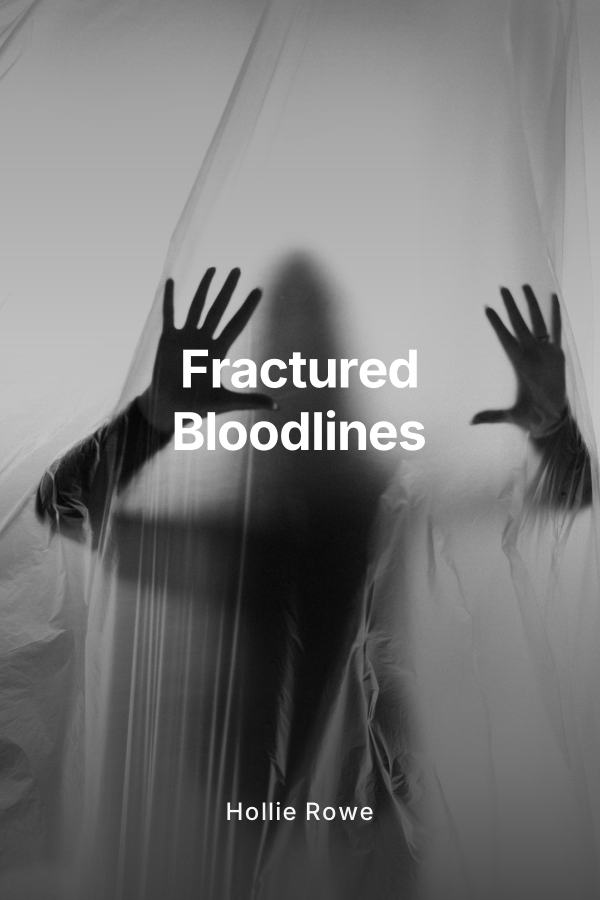
Fractured Bloodlines is an adult paranormal romance and urban fantasy hybrid that reframes the world of Mystic Falls through the eyes of the lost Salvatore brother, Silas, and the werewolf sheriff determined to save him, Cassian Forbes. It weaves supernatural politics, psychological horror, and slow burn enemies to lovers into a single, charged narrative about what it costs to be loved when you are certain you are a monster.
At its core, the book asks a deceptively simple question: what if the “villain” of the story never lost his humanity at all, but carried it intact through a century and a half of torture, guilt, and an intrusive, violent alter ego that wants to wear his body like a weapon? Silas Salvatore is the brother history erased, the ghost story vampires tell each other about what happens when you go too far. In truth, he is a man with Dissociative Identity Disorder whose psyche was fractured on the night he died, when Katherine Pierce used an ancient artifact called the Sanguis Stone during his turning. The result is the Shadow, a separate, predatory self that seizes control whenever Silas draws too deeply on his vampiric power.
The book opens with a sharp, cinematic prologue that rewrites Salvatore history. Damon is the charming sociopath, Stefan the brooding penitent, but Silas is the footnote, the brother presumed dead and gone. In reality he survived the fire that destroyed the family estate, completed his transition with Katherine’s blood in his veins, and walked out of the flames alone. He never flipped his humanity switch; he simply learned to live with the constant screaming of the Shadow that Katherine’s experiments awakened inside him. For one hundred and fifty years he stayed ahead of the people who wanted to use that Shadow, including Katherine herself and the ancient Vampire High Council that would rather execute him than risk what he might become.
By 2010, Silas has cultivated a reputation as a ruthless, amoral vampire who thrives on chaos, a persona he wears like armor to keep everyone at a safe distance. Returning to Mystic Falls is the one promise he swore never to break. Yet the book’s first chapter finds him at the Mystic Grill on a Tuesday night, bourbon in hand, staring down the familiar bones of the town he left behind and wondering how every bad choice he has ever made led him home.
It is there that Cassian Forbes walks back into his life. Cassian, the “Sheriff Junior” Silas has spent fifty‑three years sparring with across state lines, territory disputes, and failed truces, is a disciplined werewolf whose life revolves around control, duty, and the thin line between justice and execution. He runs hot where Silas runs cold. He trains, plans, and follows rules while Silas performs recklessness to hide how carefully he manages every movement, every use of speed or compulsion, anything that might feed the Shadow in his head. The heat between them has always been edged with the intent to kill. In Mystic Falls, it shifts into something even more dangerous: the intent to save.
The plot’s inciting engine is Katherine Pierce and the Sanguis Stone. Katherine steps out of the tomb shadows every bit as glamorous and lethal as she was in 1864, and tells Silas precisely what she wants. The Stone is an ancient relic that amplifies vampire abilities to near godlike levels while shredding the user’s psyche, splitting it along its deepest fault lines. Long ago she tested it on Silas without his consent, and the Shadow was the result. Now, with rumors of the Vampire High Council tightening its hold on the supernatural world, she wants the Stone back so she can become untouchable. Silas is her proof of concept and her preferred weapon.
Katherine knows exactly where to strike. She threatens an innocent girl named Emma, already tangled in her orbit, and later reveals an even more devastating hostage: Celeste, the vampire who sired Silas, whose life is bound to his through a lethal sire bond. If Katherine kills Celeste, Silas dies with her, and she makes sure he understands that he will feel every second of Celeste’s death. The ultimatum is simple and impossibly cruel. Bring her the real Sanguis Stone, not the decoy she waves in his face, or lose the woman who turned him and his own life in the same breath.
Facing this trap alone is exactly what Silas has always done. The book’s emotional pivot comes when Cassian refuses to let him keep doing it. Katherine abducts Silas, chains him to a basement wall, and suffuses his system with vervain so his healing is slow and agonizing. When she tries to blackmail Cassian into abandoning the search for the Stone, showing him live footage of Silas’s torture, Cassian plays obedient “puppy” to her face but immediately reaches out to the last allies he ever wanted: Damon and Stefan Salvatore. That choice shifts the narrative from solitary survival to fragile found family.
Fractured Bloodlines thrives on layered confrontations. At the boarding house, decades of resentment and grief detonate when Silas finally stands in front of his brothers again. Damon’s first reflex is fury at the secrets Silas kept and the Sanguis Stone he has been unknowingly carrying. Stefan’s is hurt that their youngest brother chose exile over trust. Silas, too exhausted and terrified to perform the devil‑may‑care act flawlessly, finally tells them the truth. The Shadow is not a metaphor. Every time he uses his powers aggressively he risks blacking out while another self drives his body like a weapon, with no regard for brothers, bystanders, or anyone else in the path. This is not described in clinical detail, but grounded in the book as an internal reality Silas lives with, shaped by Katherine’s experiments and decades of coping.
The answers he expects are horror and rejection. What he receives instead is messy, furious, unwavering love. Stefan refuses to let him define himself as a monster. Damon, for all his anger, refuses to entertain the Council’s solution of execution. When Cassian reveals the Council has already considered putting Silas down as a public safety measure, Damon’s response is simple: they can try. The brothers start talking not about how to contain Silas, but how to protect him. Cassian, standing between them and the Council as both an enforcer and an advocate, offers to take formal responsibility for Silas’s control. If Silas loses control completely, the Council expects Cassian to be the one who kills him. Cassian agrees to the condition knowing exactly what it means, and knowing he has no intention of letting the Council pull that trigger.
This promise shapes Cassian’s arc. He begins as the wolf who has spent half a century tracking Silas as a problem to solve, a threat to contain. Through late night research sessions, tense strategy briefings, and shared beds in safe houses where neither of them truly sleeps, he becomes the one person Silas allows close enough to see his terror. Cassian digs into dusty Council records and founding family archives and finds the original research on the Sanguis Stone, piecing together the true origin of the Shadow and offering Silas a new narrative. Maybe he is not inherently broken. Maybe he was hurt. Maybe the thing in his head is a wound, not his essence. Where others might try to exorcise, Cassian quietly, insistently argues for integration and healing.
Romantically, the book is a slow shift from enemies locked in a fifty‑three‑year stalemate to partners whose every plan, every risk, is taken with the other’s heart in mind. Their intimacy builds in quiet domestic scenes alongside violent supernatural ones. There is the cramped bed they “just sleep” in after the worst of the Council’s threats, where Cassian’s arm ends up draped over Silas’s chest and their fingers tangle in the dark as Silas admits how much he fears the day he never wakes up himself again. There are the morning‑after moments, stolen in thin light, when Silas lets himself simply look at Cassian’s sleeping face, trace an old scar, and taste the kind of safety he has denied himself for a century and a half. These scenes do not erase the danger of Silas’s condition or the Shadow’s hunger, but they give him a reason to keep fighting it.
Parallel to the romance is a high‑stakes supernatural thriller. Katherine’s plan unfolds in escalating set pieces: abductions, Council ambushes, and the final ritual where she uses the Stone’s power to pry open Silas’s mind completely. The boarding house becomes a war room where Silas, Cassian, Damon, and Stefan map entry routes, assign roles, and argue over who gets to risk what in the rescue mission for Celeste. Cassian insists on taking point for Silas’s protection. Damon volunteers for any distraction that lets him set things on fire. Stefan, as always, builds the quiet, meticulous extraction plan. Looming over all of it is the sire bond between Silas and Celeste. If she dies, he dies, and Katherine intends to use that fact to force every hand at the table.
The book’s climactic confrontation crystallizes its central themes. Under the Stone’s amplified power Silas finally loses his grip and the Shadow steps fully into the driver’s seat. Katherine expects a controllable monster. What she gets is something she cannot direct at all. The Shadow tears through her vampires with merciless efficiency, its voice in Silas’s mouth cold and exultant. It mocks Stefan’s pleas, taunts Damon’s threats, and turns predatory eyes on Cassian, the “pet” whose presence has become a destabilizing variable. Inside his own skull, Silas can only watch and beg it to stop.
Where most of the supernatural world sees only a weapon gone rogue, Cassian sees the man still fighting underneath. He steps between the Shadow and Stefan, offering himself as the target. He names what he is to Silas, not a pet but a partner, and challenges the Shadow to understand that killing him will not free it of Silas, only destroy the one tether still keeping Silas tethered to himself. His belief, spoken simply and without arrogance, becomes the line Silas can wrap his mind around. It is not a magic cure, but it is enough for him to claw back temporary control, long enough to prevent the Shadow from doing the one thing he could never forgive himself for.
The aftermath of that battle is where the book earns its title. Bloodlines are fractured everywhere you look. Between Silas and Katherine, whose perverse, almost maternal obsession with the monster she helped create leads her to underestimate his will to remain himself. Between Silas and the Council, who still see him as an existential risk regardless of how many lives he saves. Between Silas and his brothers, whose relief at his survival comes with the knowledge that the Shadow has not been exorcised or destroyed. It is still there. The Stone’s destruction, when it comes, may weaken its hold or may tear Silas apart entirely. No one knows which it will be.
Most crucially, there is the bond between Silas and Cassian. Long before the book’s end, they make a brutal private pact. If the Shadow ever takes over completely and does not let Silas back, Cassian is the one who must end him. Silas asks for this promise because he cannot bear the idea of Damon or Stefan having to make that choice. Cassian agrees because he loves him enough to consider an act of mercy worse than murder. Yet in the same breath he vows to do everything in his power to ensure that day never comes. That core paradox fuels the next stage of their story and gives this first volume its bittersweet emotional closure.
Tonally, Fractured Bloodlines blends sharp, self‑aware humor with genuine horror and aching tenderness. Silas weaponizes sarcasm as much as compulsion; Katherine wields affection like a knife; Damon and Stefan’s arguments over how best to save their brother crackle with sibling banter even at their bleakest. At the same time, the book treats Silas’s fractured psyche and ongoing trauma with weight, not as a gimmick but as the axis around which his inner life turns. The Shadow is never glamorized. Power is seductive, but the narrative stays anchored in the costs: blackouts, lost time, the dread of waking up as someone you do not recognize. The romantic arc does not fix that, but it does give Silas a reason to seek a future in which he is more than his damage.
The final pages look forward to that future. Katherine, beaten but not gone, escapes with enough knowledge to remain a threat. The Vampire High Council backs away from immediate execution but places Silas formally under Cassian’s supervision, an arrangement as fraught as it is intimate. Damon and Stefan re‑learn how to be brothers with a man who carries a century and a half of secrets on his back. Celeste’s rescue resets the lethal clock of the sire bond, but it also raises new questions about what it means to belong to someone by blood and choice at once.
For readers, this book offers a complete, emotionally satisfying arc while clearly opening the door to more. It delivers a self‑contained narrative about a haunted vampire who finally comes home, a wolf who chooses to stake his career and life on the belief that no one is beyond saving, and a family that decides to fight a nightmare together instead of letting one of their own be devoured by it alone. It ends not with the Shadow vanquished, but with Silas choosing, again and again, to stay present, to trust, and to believe that he can be loved as he is while working toward something better.
Fractured Bloodlines is for readers who want their paranormal romance with teeth, their found family complicated and fiercely loyal, and their protagonists powerful but not invulnerable. It promises a story in which love does not erase darkness but stands beside it, hand in hand, and dares it to swallow them whole.