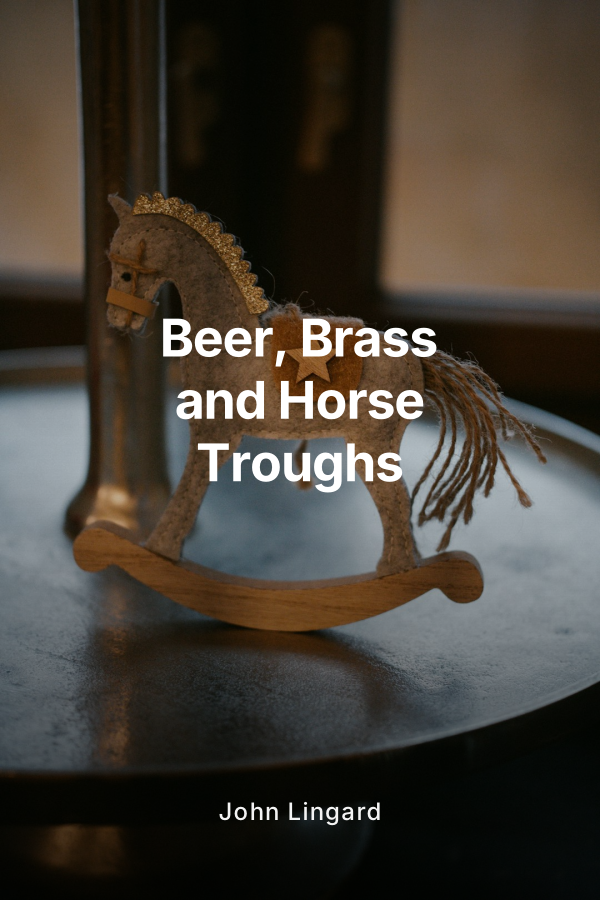
This book is a nostalgic comic tale told in retrospect by Henry, once a bright apprentice at Grindleys engineering works in the late 1940s, now an elderly gentleman settled comfortably in the bosom of his family. At last he confesses to the reader the full extent of the scrapes he fell into with Fred, Bert and the rest of the Skeldersley crowd, escapades he never dared reveal to his fearsome, chapel‑going mam. Set in a small Yorkshire town still shaking off the war, the story captures a vanished world of brewery strikes, brass bands, black market beer and stubborn dray horses, all with a gentle, affectionate humour reminiscent of cosy Sunday‑evening television comedies.
At the heart of the tale lies a scandalous little enterprise born out of a beer shortage. Amberleys Brewery, proud pillar of Skeldersley, is brought to a halt by a long and bitter strike. Denise, the young and capable landlady of the Boilermakers Arms, watches her customers disappear as the pumps run dry, and the town discovers that principled industrial action comes with a very unprincipled thirst. Lord Amberley himself boasts that he can outlast the men and the union, but in practice his stand-off leaves race days at Skeldersley course facing the unthinkable: no beer in the tents.
Enter Bert Ramsden, a hulking, bowler‑hatted wheeler‑dealer with the morals of a market stall and the charm of a born survivor. During the war he kept Grindleys supplied with scarce parts by courting the black market. To Bert, business has no colour, only opportunity. When he learns from the seedy brewery sales manager Arkwright that the strikers are blocking all beer entering town, he spies a loophole. There might be no brewery beer, but there is nothing to stop “a bit of brewing” inside Grindleys itself, behind the respectable façade of furnaces, boilers and machine tools.
With the help of Jim and his well‑meaning but simple brother Gordon, Bert persuades the works to install tanks in the boiler house and starts turning out rough but drinkable beer in an “industrial environment” that smells more of oil and steam than hops. Henry, still a youth eager not to get on the wrong side of his foreman, is drawn in as a junior accomplice, equal parts horrified and thrilled. A quiet sideline selling pints to workmates begins to swell into something much bolder when Arkwright offers cash if Bert can supply the racecourse refreshment tent during the strike.
Skeldersley itself forms a bustling backdrop. Old Josiah Grindley, owner of the works, relies heavily on Gladys Greenhalgh, his tiny but terrifying secretary, who guards his in‑tray like a dragon, and on Hilda Stainswick, the towering canteen manageress whose subsidised dinners arrive hot, heavy and best faced under a dim forty‑watt bulb. Hilda’s rock cakes have the hardness and trajectory of artillery shells and will later play an unexpected part in events on the racecourse. The gossip, grudges and small kindnesses of these women, together with Denise’s bar and the ever‑hopeful workers, give the book its sense of a whole community muddling through post‑war austerity with grim stoicism and raucous laughter.
The race‑day scheme, which forms the central caper of the book, seems straightforward enough: brew a few hundred pints of “foundry beer” in cleaned oil drums at the works, load them on Grindleys lorry and dray, declare the racecourse beer tent a “tea tent” in name only, and sell to thirsty punters while keeping Lord Amberley and Mr Grindley discreetly supplied. Hilda’s canteen staff are dragooned into providing all the food for the meeting after regular caterers refuse to cross the picket line, adding a further layer of divided loyalties for women whose husbands are among the strikers.
Naturally, nothing goes smoothly. Gordon, entrusted with steam‑cleaning the “empty” oil drums before they receive the precious brew, manages instead to polish the Grindley Works Brass Band’s kettle‑drums, leaving the beer resting in drums still filmed with diesel oil. By the time anyone notices, several hundred pints are already contaminated. Bert turns purple, threatens to introduce Gordon to casualty, and is only just stopped from murdering the man he calls a daft ha’porth. Henry, however, remembers a wartime cinema reel about clearing oil from submarine drinking water and proposes a solution: pour the beer into Lord Amberley’s racecourse stable trough and pack it with hay to soak up the oil.
The sight of Bert and Henry ankle‑deep in beer, shovelling hay into a horse trough, sets the tone for the farce that follows. Oily straw is burned in Hilda’s kitchen boiler, sending suspicious smoke belching from the chimney, while the remaining beer‑soaked hay is left in the stable to dry. Against all odds, the beer that is rescued tastes, to undiscriminating palates at least, barely worse than before. The racecourse opens, punters flock in, and Grindleys illicit barrels are quietly broached.
Overlapping this story of beer is a parallel absurdity on the turf. Lord Amberley’s own horse, Brewer’s Pride, is scratched from the big race after being found staggering round its box, apparently “doped” when in fact it has eaten the beer‑soaked hay that Henry and Bert abandoned. The news sends Gladys and Hilda into a whirl of anxious speculation, while Gordon, misunderstanding that a “scratched” horse must have been dragged through a hawthorn hedge, threatens grave vengeance on anyone cruel enough to hammer in tacks.
With the favourite out, Jim hatches the most ludicrous idea yet. The racecourse cannot disappoint the crowds, Lord Amberley cannot stand the embarrassment, and Bert cannot afford to let the flow of racegoers and money halt. The answer, Jim insists, is to substitute one of the brewery’s dray horses, roughly the same colour as Brewer’s Pride, and to trust that a tipsy crowd will not notice the difference. Henry is roped in not only to help but to wear the absent jockey’s silks and ride the unfortunate beast.
To everyone’s disbelief, including his own, Henry steers the dray horse to victory in the 3.30 at Skeldersley, aided by the misfortune of rival horse Still Life, whose jockey is unseated after a stale rock cake from Hilda’s refreshment room slams into him mid‑race. The wireless later reports on the sensational result, unaware that the supposed thoroughbred that thundered home was an overworked cart horse that knows the town’s pubs far better than the winning line.
Meanwhile Gordon, who has managed to back the favourite despite throwing away his betting slip, stumbles into unexpected riches by collecting discarded losing tickets when Still Life seemed certain to win and then redeeming them once Brewer’s Pride, in its new hooves, actually romps home. Unable to count beyond his fingers, he has no idea that he is waving around at least two hundred pounds. Bert swiftly relieves him of the wad and promises to “look after” the money, handing a little to mollify the furious brass band whose drumskins he has ruined and pocketing the rest for future schemes.
As victory and disaster mingle in the refreshment rooms, Gladys fights to keep tempers calm and reputations intact, Hilda keeps the urns boiling and the cakes flying, and Denise turns up on Arkwright’s arm, rosy‑cheeked from an afternoon in Lord Amberley’s private box. The two older women exchange knowing asides about whose “facilities” have been inspected. Over pints of Grindleys off‑record ale that the gentry declare to have “the spirit of horse‑racing in every drop”, the awful truth begins to dawn on Bert and Henry. The last jug of “beer” that Gordon proudly fetched from the trough in the stable was not the carefully strained product of their improvised filtration at all. The trough had been dry when they finished. Any liquid later found in it could only have one source. Lord Amberley and Mr Grindley, sipping contentedly, have just consumed what Bert, in a horrified murmur to Henry, refers to as something that usually tastes like beer in the worst pubs, but has never before been mistaken for it.
From this peak of farce, the book draws its threads together. Bert rallies the troops for “extra overtime” to brew more beer back at the works, dragging Jim, Henry and the long‑suffering dray horse off to another night of illicit labour. Henry, still secretly terrified of his mother and the chapel elders, must creep home later without a trace of his adventures and lie neatly about how he spent his day. Hilda and Gladys swap stories that hint at older secrets. At one point Hilda, watching Henry bask in her praise for his jockey heroics, briefly recalls that his father used to say much the same cheeky things to her on the moors before the war, sowing quiet questions in the reader’s mind about family histories never spoken of aloud.
Threaded through Henry’s account of that mad race meeting and the brewery strike are glimpses of the wider Skeldersley story. We see how the town has already changed since his boyhood, how American soldiers and Free Polish airmen briefly altered its rhythm during the war, and how cousins left for Texas ranches while others stayed to clock in at the works. In the framing present day he looks out on modern Skeldersley, with its leisure centre where the racecourse used to be, its supermarket where Canal Street Brewery once stood, and he feels both appreciation for easier times and a quiet sense that something rougher, funnier and more communal has been lost.
Across five chapters, the full book expands this central comic short story into a warm, closely observed portrait of a town finding its balance after war on the knife‑edge of class conflict, austerity and quiet resilience. Chapter by chapter, readers meet the ensemble of Skeldersley: Denise fighting to keep her pub afloat and her independence intact, Arkwright forever torn between pleasing Lord Amberley and pleasing himself, Gladys stubbornly defending some idea of decency, Hilda feeding men who will grumble but always come back for seconds, and bumbling Gordon whose mistakes somehow keep the wheels turning. Henry’s younger self moves among them, learning as much about loyalty, hypocrisy and friendship as he does about boilers and machine tools.
The tone throughout is light, talkative and gently mischievous. The narrator often addresses the reader directly as “dear audience”, winking over shared knowledge, pausing to explain how a man could make a fortune out of other people’s thrown‑away betting slips, or how a dray horse can pass for a champion with enough beer inside the crowd. The humour arises from misunderstandings, over‑ambitious schemes and the stubborn literal‑mindedness of people who have seen too much to be easily impressed. Behind the laughs, however, sits a softer melancholy: a recognition that the messy, smoky, coal‑dust days of 1948 Skeldersley are gone, and that the dead and departed, from wartime sweethearts to vanished employers, live on mainly as stories told over tea and the occasional illicit pint.
In the final pages, old Henry closes his account as the evening draws in around him. The television hums quietly in the corner, showing some modern equivalent of the gentle comedies his own life once resembled. Grandchildren or grown children move in and out of the room, only half hearing his last confession that Mam never did find out about the horse trough, the dray horse, or the time Lord Amberley drank what no man of his station should ever have tasted. He sets his story down with a wry smile and one last nod to the reader, leaving us with the feeling that somewhere in the bones of the town, beneath the new housing estates and car parks, Skeldersley is still the place where a lad can win a race on a cart horse, a bowler‑hatted foreman can brew forbidden beer in an oil drum, and a bad day’s work can always be softened by a good story.