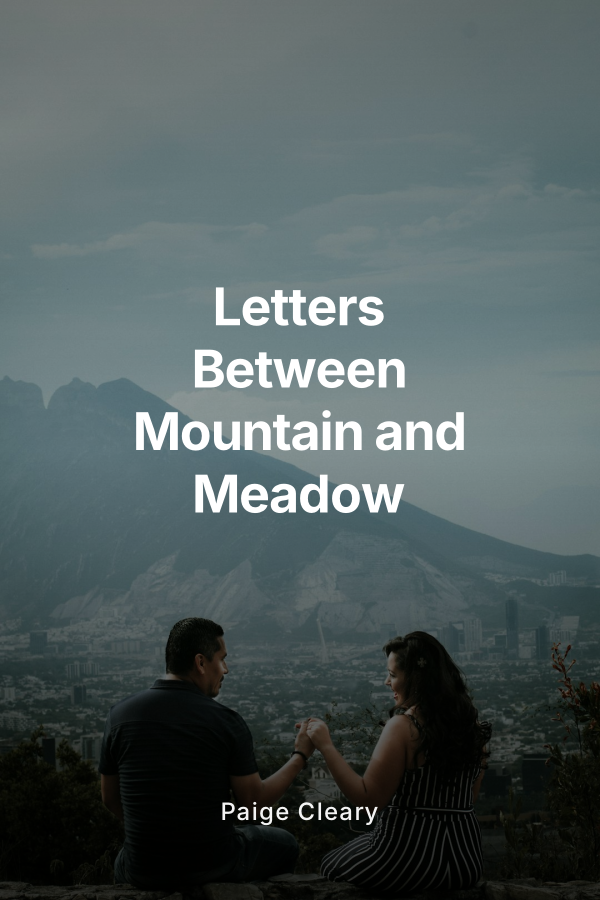
In the quiet that follows war, when the echoes of steel fade and the dust of shattered kingdoms finally settles, two unlikely hearts are left standing on the same blood-soaked field, still beating only because they could not bear to stop while the other yet lived. This story begins there, in the fragile, hushed aftermath of the Battle of the Five Armies, in a world where Thorin Oakenshield is grievously wounded but does not die, where his nephews Fíli and Kíli live as well, and where a small hobbit from the Shire refuses to let the King Under the Mountain slip away into legend without first learning how to live.
“Letters Between Mountain and Meadow” is a deeply romantic, post-canon love story that follows Thorin and Bilbo from their first raw days of survival to the slow, aching years in which they learn how to forgive, to heal, and to love. It is a tale spun out of unsent words and ink-stained fingers, of a king who cannot forget the glittering madness that nearly cost him everything, and a hobbit who carries home both treasure and a wound shaped like a dwarf he almost lost.
The story opens in Erebor reborn, where Thorin rules a kingdom of echoing halls and newly kindled forges, his body knit back together by healers while his mind remains a battlefield. Night after night, he wakes with the taste of dragon-sickness on his tongue and the memory of Bilbo’s face when he raised his sword against him. The weight of a crown sits heavy on his brow, but it is the weight of that betrayal that drags his gaze downward, that makes him doubt the worth of every decision he makes. To his people, Thorin Oakenshield is the king who reclaimed their home. To himself, he is the man who nearly killed the one soul who offered him a simple acorn and a hand.
Bilbo returns to the Shire carrying more than gold. He carries the phantom press of a large hand around his own, the remembered rasp of a voice speaking his name like a vow, and a gnawing fear that if he stays in the mountain too long he will never quite find his way back to his round green door. The Shire is as he left it, and yet nothing fits quite right anymore. The gossip of hobbits, the cozy fussing of neighbors, the gentle rhythm of planting and harvest, all feel a step removed, as if Bilbo is walking through his own life as a guest. His nights are haunted not by dragons but by the image of Thorin lying pale and still upon the stones, and by the memory of words flung like weapons in a treasure-filled hall.
Bound by distance and duty, they begin to stitch a fragile bridge between mountain and meadow in ink. Bilbo, splitting his time between his beloved Bag End and the reclaimed halls of Erebor, falls into a rhythm of leaving pieces of his heart behind wherever he goes. When he is in the Shire, he writes to Thorin of gardens and gossip, of the way the morning light spills over the Hill, of the scent of baking and the feel of bare earth in his hands. His letters are full of small domestic details, quiet worries, and carefully chosen silences that hint at deeper longing. When he is in Erebor, he carries the Shire with him in his pockets in the form of seeds, recipes, and stories.
Thorin’s replies are stiffer at first, shaped by a lifetime of pride and the bardic weight of his own name. He writes of trade agreements and mining charts, of rebuilding and reforging, of Balin’s advice and Dwalin’s gruff concern. Beneath the formalities, however, the heart of a lonely man bleeds through in unguarded lines, the ones where he mentions how he now sleeps easier when he knows Bilbo is under his roof or how the great stone halls feel less hollow when there is hobbit laughter echoing between their pillars. Each letter becomes a small act of courage, a way to say what they cannot yet speak aloud when they stand in front of each other, when a single misstep might break something too precious to risk.
The years turn, and so does the slow, sweet burn of their affection. The story traces their careful orbit over several seasons of visits and partings, of reunions in Erebor’s lantern-lit halls and departures watched from high balconies as Bilbo’s figure grows small on the path back to the Shire. They accumulate a quiet treasury of intimate, domestic moments that never quite cross the line of confession: Bilbo tending to Thorin after a nightmare and coaxing him back to sleep with gentle words and a steady hand, Thorin sitting at Bilbo’s bedside in the Shire when travel and old aches lay the hobbit low, pretending to read while his eyes never stray far from Bilbo’s breathing.
There are scenes of shared beds taken purely for comfort on nights when the past presses too hard, of Bilbo’s fingers moving reverently through Thorin’s dark hair as he braids it with clumsy care, of Thorin’s large, callused hands wrapped around Bilbo’s smaller ones as they stand side by side on a balcony or in a garden. They learn the language of one another’s silences, the meaning of a brush of shoulders in a crowded hall, the comfort of sitting close enough that their knees touch while they quietly read or plan the next day’s tasks.
All the while, unresolved ghosts tug at them. Thorin’s guilt over the gold-sickness sits like a stone in his chest. He cannot forgive himself for each harsh word, each suspicion, each moment his greed and paranoia made Bilbo feel small and unwelcome. Bilbo, tender-hearted and stubborn, forgives long before Thorin can imagine he deserves it, but the memory lingers as a fault line between them. Their near-loss on the battlefield has left scars neither of them can see but both can feel whenever the other is late, whenever a messenger arrives too early in the morning, whenever they must say goodbye.
Their love is slow, almost painfully so at times, unfolding through dozens of small, ordinary acts that could be dismissed as friendship by anyone but themselves. It takes years for them to cross the final border between devotion and declaration. Estrangement never comes, but there are quiet arguments about distance and duty, moments when Bilbo wonders if half a life in each world is truly sustainable and when Thorin, bone-tired from leading a kingdom, fears he is asking too much simply by wishing Bilbo would stay. Yet each time they threaten to drift apart, something pulls them back, often as simple as a letter arriving right when it is needed most.
The pivotal confession does not explode like a storm; it gathers like mist, soft and inevitable. Perhaps it comes after a particularly long separation, when Bilbo has been away in the Shire for a stretch measured in aching nights instead of months, and Thorin has buried himself in work to avoid acknowledging just how often his eyes stray to the empty seat at his table. When Bilbo finally returns, thinner from travel and carrying new shadows beneath his eyes, a small crisis or a half-heard rumor of danger on the road nearly breaks Thorin’s careful control. What begins as a sharp, panicked argument about recklessness and distance unravels into raw honesty. Words spill out in a quiet chamber lit by a single lamp, not shouted but spoken on shuddering breaths: admissions of fear, of loneliness, of how each goodbye feels like a coin tossed to chance.
By the time the word love finally slips between them, it feels less like a revelation and more like naming something that has been true for years. There is no grand gesture, no audience, only two men who have nearly lost each other once too often holding on as if the world might crumble if they let go. Their first kiss is gentle and careful, a promise rather than a conquest, followed by the kind of embrace that says more clearly than any vow that neither of them plans to face another winter alone.
The latter part of the book moves through a tender time skip that shows them not in the rush of first realization but settled into the warm, steady embers of a fully acknowledged partnership. They shape a life that flows between the stone strength of Erebor and the soft greenery of the Shire, creating a rhythm that suits them both. In Erebor, Bilbo becomes a fixture not only in Thorin’s private chambers but in the life of the kingdom itself, bringing new ideas for trade in pipe-weed and produce, coaxing small gardens into being on balconies and in unused courtyards, hosting quiet suppers that gather dwarves, hobbits, and the occasional wizard around the same cozy table.
Thorin, freer now that his greatest inner battle has been named and faced, allows himself moments of softness that would once have terrified him. He lets Bilbo press kisses to his brow in full view of his closest kin, accepts the teasing conspiracies of Fíli and Kíli who engineer stolen hours of peace for their uncle and his beloved, and listens without defensiveness when Balin gently points out that a king who loves so openly teaches his people a new kind of courage. Dwalin, slow to understand but loyal at his core, eventually comes around, his gruff protectiveness extending to the hobbit who has become as much a part of Erebor’s heart as any line of Durin.
In the Shire, their presence together causes whispers, naturally. Some neighbors tut and speculate, but many more adjust with the quiet pragmatism of homebodies who care less for scandal than for the quality of the tea. Those who get close enough to see how naturally Thorin’s large hand finds the small of Bilbo’s back, how Bilbo unconsciously leans into Thorin’s side when the nights grow cool, cannot quite bring themselves to disapprove. They see only two souls who have walked through fire and chosen, again and again, to walk back toward each other.
The most intimate chapters of this later section are filled with simple, domestic joy. There are scenes of them sharing a bed without the urgency of unspoken longing, just the deep comfort of familiar warmth. Mornings find them tangled together, trading sleepy kisses and murmured endearments before one of them reluctantly rises to tend to the day’s duties. Evenings are spent with Bilbo curled against Thorin’s side by a hearth either in Bag End or Erebor, both of them reading, occasionally interrupting the silence with a thought or a fond observation. They cook together, Bilbo showing Thorin how to fold pastry or season a stew, Thorin teaching Bilbo the sturdy, sustaining fare of his people. Their hands brush, they steal flour-dusted kisses, they laugh.
Lingering traces of past wounds are not ignored. Thorin still has nights when old fears claw their way to the surface, when flashes of dragon fire and the glint of gold send him spiraling back into shame. On those nights, Bilbo is there, steady and unyielding, reminding him softly and insistently that he is more than his worst moment. Bilbo has his own shadows: the awareness of his mortal years moving faster than Thorin’s, the occasional ache of old injuries, the bittersweet knowledge that time in the Shire moves differently than time beneath the Mountain. Together, they face the reality that their love exists within unequal spans of years, not as a tragedy but as a preciousness that sharpens each day into something to be savored.
The book closes not with death or parting but with a strong, luminous sense of enduring love. The focus remains on living, on the choice to be present in each shared cup of tea, each braided strand of hair, each quiet night when the world outside their door feels far away. Their relationship becomes a kind of legend in its own right, spoken of in soft tones in both Mead Halls and hobbit-hole kitchens, not because of grand battles or heroic quests, but because of the way a king and a hobbit taught two very different peoples that devotion can be as mighty as any sword.
“Letters Between Mountain and Meadow” is, at its heart, a story of healing after near-loss, of forgiveness offered and finally accepted, of the slow, exquisite unfolding of love between two souls who thought their chance at peace had been buried under a mountain of gold. It promises readers an extremely tender journey filled with yearning letters, hesitant touches that grow sure, shared beds taken for comfort and kept for love, and a final vision of domestic happiness both in the stone halls of Erebor and the green hills of the Shire. In five chapters that move from fragile aftermath to quiet forever, the book invites you to linger on every small, intimate moment that turns surviving into truly living, until there is no doubt that Thorin and Bilbo’s story does not end in tragedy at all, but in the most radical act of all for warriors and wanderers alike: an honestly won, deeply shared happily ever after.