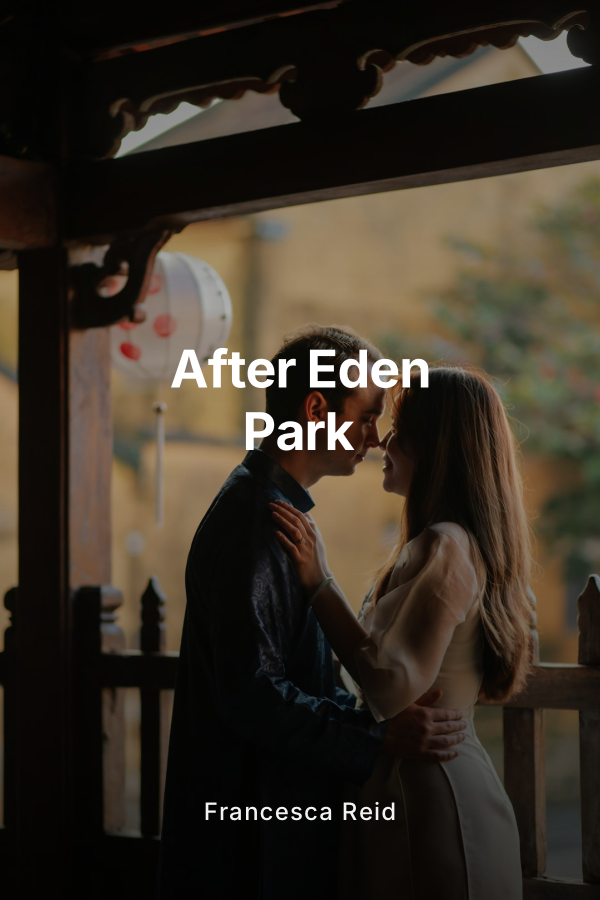
Francesca Rossi has a plan for everything, except for the way her own heart betrays her the moment she meets Peter Hayes.
At seventeen, Francesca keeps her world in strict compartments. There is school Francesca who turns in every assignment early, home Francesca who tiptoes around a mother who never really learned how to stay, and friends Francesca who laughs the loudest so no one notices how hard she is trying to belong. She survives on control, on prepared answers, on never being the messy girl who wants too much.
Then one impulsive night at Eden Park shatters the illusion that she can keep her feelings safely contained.
The story opens on the eve of summer, when Francesca’s friends engineer a setup between her and Peter, the infuriatingly laid back boy who has been hovering at the edge of her life, all lazy smiles and sharp eyes that see more than he lets on. Under the sodium lights of the park, with the smell of grass and cheap cider thick in the air, they gang up on her in the most embarrassing way imaginable, chanting and screaming teasing jokes that make her cheeks burn. Somewhere in the chaos, a friend shrieks an unfiltered line that sticks to her skin like glue, turning Francesca’s crush into public spectacle and leaving her mortified in front of Peter himself.
For Francesca, who lives in dread of looking foolish, the humiliation feels unbearable. She wants to sink into the ground. Yet when Peter catches her eye across the laughter and catcalls, he does not look disgusted or smug. Instead, he laughs in this startled, almost tender way that says he knows exactly how ridiculous their friends are, and that maybe, just maybe, he does not mind being paired with her as much as she fears. His amusement is not cruel. It is conspiratorial, like they are both in on a joke no one else understands.
That night at Eden Park becomes the fault line in Francesca’s life, the “before” and “after” she will measure everything against. The book follows the emotional aftershocks of that moment as she stumbles into a relationship with Peter that is softer, scarier, and realer than anything she imagined in daydreams.
Chapter by chapter, the story traces how one embarrassing set up unravels all her carefully constructed defenses.
In the weeks after the park, Francesca tries to avoid Peter, convinced he must see her as the punchline his friends yelled about. But Peter does not disappear. He shows up in the corners of her days: at the bus stop with an extra coffee, in the library pretending to need help with notes he is perfectly capable of taking, at lunch where he slides into the empty seat beside her as if it has always been his.
He never pretends Eden Park did not happen. Instead, he teases her about how red she went, how she would not meet his eyes, how she nearly tripped over her own feet trying to flee. Each time he mentions it, her stomach flips with mortification. Yet beneath the embarrassment is something new. Every joke is threaded with a quiet reassurance that the worst has already happened and he did not run. He stayed. He laughed, yes, but he also chose to keep coming closer.
Their banter becomes the language in which they circle around the thing neither of them is brave enough to name.
Against this budding intimacy, Francesca’s home life throws sharp contrast. A distant mother, still wounded from her own romantic failures, feeds Francesca a steady diet of warnings about men, desire, and the danger of giving too much of herself away. To survive, Francesca has learned to swallow her wants. She tells herself she is fine keeping everything in her head, where love can never make a fool of her.
Peter finds the cracks anyway.
When he finally invites her over under the flimsy excuse of a “movie night,” Francesca tells herself it is no big deal. They will sit apart. The television will be a safe barrier. She rehearses neutral things to say. No one will yell crude jokes this time, no one will chant in the background, and she will not hand anyone a chance to laugh at her again.
Reality betrays her plans.
The movie plays, but they barely watch it. Their knees brush once, then again. Francesca becomes hyper aware of every inch of space between them, how shallow her breaths are, how loud the quiet room feels. Peter notices. He always notices. He starts to tease her about Eden Park again, about the way their friends made it sound like she was on the verge of jumping him right there in the grass.
Her embarrassment spikes. She swats at him, tells him to shut up, but the words come out breathless, not angry. He laughs, low and warm, and asks why she is so red when they are just sitting here, doing nothing at all.
The truth is they are already doing something. Their glances keep tangling and breaking, their hands keep almost touching and then pulling back. The air between them grows heavy with everything unsaid.
In a sudden, uncharacteristic surge of courage, it is Francesca who reaches first.
One moment she is burning with mortification at the memory of her friends shouting, the next her hand is fisted in his shirt and she is kissing him. It is not graceful or practiced. It is clumsy, a little too fast, all urgency and inexperience. She kisses him like she is trying to outrun her own fear, like if she moves quickly enough she can skip the part where he might reject her.
Peter stills in surprise, then answers with a slow, steadying intensity that steals the breath from her lungs. The make out that follows is detailed not in the mechanics of bodies, but in the storm of feeling it unleashes. They remain fully clothed, their limits explicit and respected, yet the intimacy is overwhelming.
He pulls her closer until she is half in his lap, fingers sliding into her hair, tilting her head just so. His mouth finds the corner of her smile, the hinge of her jaw, the delicate curve where neck meets shoulder. Each brush of lips is achingly careful, like he is memorizing her. His hands roam over safe territory, mapping the lines of her back and waist, slipping beneath the hem of her shirt only far enough to feel the heat of her skin without crossing into territory she is not ready for.
Francesca has never been this seen. The embarrassment from Eden Park is still there, hot and raw, yet it fuses with something sweeter as she realizes he is touching her with reverence, not conquest. Every time she tenses, he slows. Every time she surges forward, he follows her lead. They learn each other’s rhythms in that breathless, tangled stretch of time, stopping and starting, laughing softly when teeth knock or noses bump, then sinking back into the pull that keeps drawing them together.
The narrative lingers in these quiet details, turning the make out into an emotional confession neither of them can yet voice with words. It is a scene about trust, about first mutual desire, about the terrifying relief of being wanted exactly as you are. There is no sex, yet for Francesca, it feels monumental, a line crossed and a door opened.
After that night, everything becomes more complicated.
The book traces the fragile, exhilarating early days of their relationship as they navigate school hallways that feel different now, friends who treat them as a spectacle, and the private fears each carries. Francesca wrestles with the echo of her mother’s warnings, the shame stirred up by her friends’ crude jokes, and the new ache that comes with knowing how good it feels to be close to someone she cannot bear to lose. Peter battles his own ghosts, the pressure to be “chill” even as he falls for her too deeply to pretend it is casual.
Publicly, they are the couple everyone whispers about, the punchline born at Eden Park that turned unexpectedly serious. Privately, they are two teenagers learning in real time how frightening and beautiful it is to let someone see the unedited version of you.
Across five chapters, the novel traces a clear emotional arc.
Chapter 1 follows Francesca through the Eden Park incident itself, building up her fear of humiliation and the moment her friends cross a line that leaves her exposed in front of Peter. The chapter ends with his surprising, gentle laughter that refuses to turn her into a joke, setting the tone for the relationship to come.
Chapter 2 explores the aftermath: her frantic attempts to restore control, the way her friends keep bringing up that night in crude detail, and Peter’s persistent efforts to find her in the chaos. We watch their banter develop, the thin strand of trust that begins to link them, and the push pull tension of attraction neither wants to acknowledge.
Chapter 3 brings us to the movie night that changes everything, leading carefully into the detailed, emotionally charged make out that becomes their first real step into physical intimacy. The writing lingers on sensations, pauses, breath, and consent, framing the scene as a breakthrough in vulnerability rather than a conquest.
Chapter 4 deals with the ripple effects. Francesca is caught between exhilaration and terror, replaying every second of their time on the couch while bracing for the world to twist it into something ugly. Peter has to prove that his tenderness was not confined to one night. Their bond is tested by rumors, parental interference, and their own inexperience at communicating needs and boundaries.
Chapter 5 brings their story to a bittersweet but hopeful resolution. Francesca finally speaks aloud the fears she has carried since childhood, and Peter lays his own heart on the line, clumsy and sincere. They negotiate a pace that feels right for them instead of the script their friends or the wider culture expects. The book ends not with a grand gesture, but with a quiet, steady choice to keep showing up for each other in all their messy, blushing, beautiful humanity.
“After Eden Park” is a love story about the power of mortifying moments to crack us open in ways we most need. It is about the girl who thought safety meant staying small, and the boy who laughed with her instead of at her. It is about first kisses that taste like apology and promise at once, about hands that learn to ask instead of take, about the delicate art of trusting someone with the parts of you you have always believed were too embarrassing to love.
At its heart, this book is for anyone who still remembers the first time they let themselves be seen and was not abandoned. It captures the ache, the laughter, the heat, and the halting tenderness of two teenagers standing at the edge of everything, terrified and exhilarated as they step forward together.