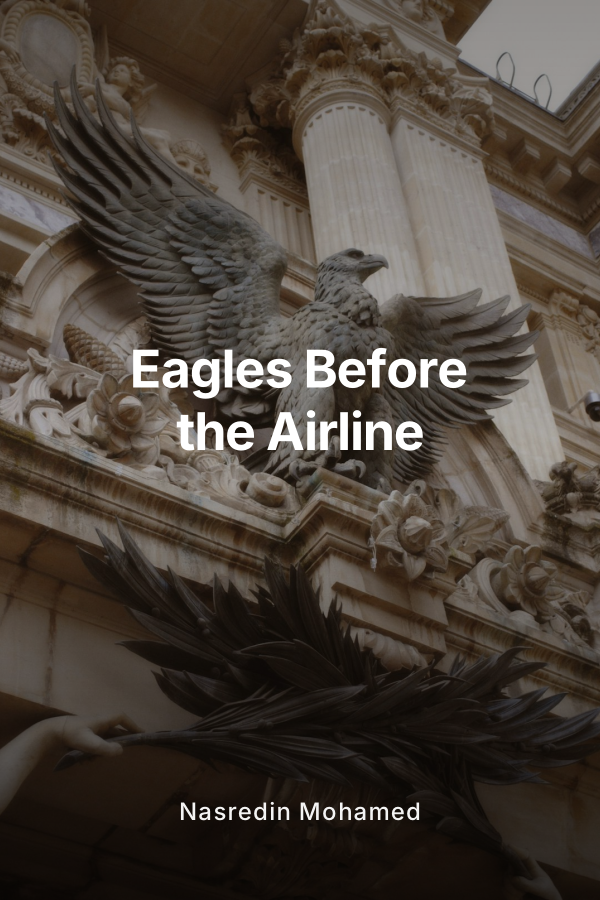
This book traces the story of Ethiopian aviation before there was an Ethiopian Airlines logo on a tailfin, before Bole International Airport, before most of Africa had even seen an airplane up close. It reveals how an independent African kingdom, led by a modernizing regent who had never before left his highland capital, encountered the airplane in the 1920s and decided not to be a spectator but an operator. It is a story of curiosity turned policy, of diplomacy fought with aircraft catalogues and export credits, and of a small group of Ethiopians who became pilots, engineers, and air force officers long before most of their continent had a single runway.
At its heart, the book argues a simple but still widely misunderstood point: Ethiopian aviation did not begin in 1945 with the founding of Ethiopian Airlines. It began more than two decades earlier, when Ras Tafari Mekonnen, newly appointed Prince Regent, took a seat in a Royal Air Force biplane at an air show in Aden in November 1922 and felt, for the first time, what it meant for an Ethiopian to rise above the highlands in a machine heavier than air. That short demonstration flight became, in effect, the groundbreaking ceremony of Ethiopian aviation. From that moment, the regent’s personal fascination fused with his political instinct to protect and modernize his country.
Chapter by chapter, the book follows how this first encounter with the airplane turned into a structured national effort. Ras Tafari returned from Aden determined to acquire aircraft for Ethiopia as quickly as his finances, alliances, and negotiating skills allowed. He secured funds for a small fleet not after building airports or control towers, but before any of that infrastructure existed. Ethiopia bought planes while its “airfields” were still open fields on the edge of Addis Ababa, surrounded by curious crowds, dust, and wind. Planes came first, concrete came later.
The narrative explains how Ethiopia, unlike almost every other African territory at the time, had the political autonomy to buy its own aircraft. Only the so‑called great powers of the period had established air forces. Across most of Africa, aircraft were owned and flown by colonial administrators, not by local states. Yet in the late 1920s, an African empire without a coastline decided to place orders with European manufacturers, deliberately playing French and German suppliers against one another. This subtle “aviation diplomacy” saw the French Potez and the German Junkers compete for the honor of being first to touch down in Ethiopia, even as both countries jockeyed for influence in Addis Ababa.
The book describes in vivid but restrained detail the morning of Sunday 18 August 1929, when Andre Maillet brought a Potez 25 biplane in from Djibouti and landed at Gefersa, west of the capital. Ministers, foreign envoys, and townspeople had been waiting since early morning. The landing was followed by an official reception at the new Gefersa aviation camp, with the French national anthem played on Ethiopian soil and the regent himself decorating the crew. The author shows how this ceremony, while celebratory, also signaled something deeper: Ethiopia was entering the air age on its own terms, treating aviation as a tool of sovereignty rather than a foreign curiosity.
Within weeks, a very different aircraft arrived. Ludwig Weber piloted a Junkers W 33 into Addis Ababa on 5 September 1929. The book lingers on the contrast between Maillet’s fabric‑covered biplane and Weber’s all‑metal monoplane, not to indulge in technical nostalgia, but to show how Ethiopian leaders and technicians were already learning to compare aircraft types, understand payloads, and think about which designs suited high‑altitude operations over the plateau. The corrugated duralumin skin of the Junkers, its single wing and robust construction, made it more than just another aircraft: for Ethiopia, it was a practical link between the capital and the northern front, and for Weber it became the workhorse he would rely on in the most difficult years of war.
From these first arrivals, the story widens into institutional history. One day after the Potez landing, on 19 August 1929, the Ministry of War, acting under Ras Tafari’s authority, issued a decree that laid the groundwork for an Ethiopian air arm. This was not yet an airline, but it was a clear decision to treat aircraft as a permanent, strategic capability rather than occasional toys or ceremonial props. Over time, that decree evolved into the Imperial Ethiopian Aviation branch of the military in 1935. The book traces how this seed grew through training schools, early combat missions, and the steady expansion of a small but capable fleet.
One of the central chapters follows the founding of the first pilot training school at Jigjiga in 1930. Because Addis Ababa’s thin air made early flight training riskier, the school was sited in the eastern lowlands and combined flight instruction with basic maintenance. Instructors came mainly from France and Germany, but the students were Ethiopian. The first cohort, a select group of eight young men and one woman, became pioneers not only for their country but for African aviation as a whole. The book introduces Mishka Babitcheff, Asfaw Ali, Bahru Kaba, Seyoum Kebede, Demissie Haileyesus, Demeke Teklewolde, Tesfamikael Haile, and the remarkable Mulumebet Emeru, who is widely recognized as a landmark figure as one of the first African women in aviation.
Rather than turning these trainees into fictional heroes, the narrative focuses on what they did: solo flights, navigation by dead reckoning in a country without radio beacons, and early operations over complex terrain. Their first solo flights in September 1930 are presented as milestones not just in Ethiopian history, but in the broader story of Africans taking command of aircraft in their own skies. In doing so, the book highlights a recurring theme: the emergence of local skill and confidence in a field that had, until then, been tightly associated with imperial power.
The book also shows how quickly aviation became entangled with politics and conflict. Within months of acquiring aircraft, the Ethiopian state used them to confront internal rebellion. In late March 1930, Potez biplanes dropped propaganda leaflets and later bombs on the forces of Ras Gugsa Welle during the Battle of Anchem. This was the first time aircraft were used in domestic combat in Ethiopia. The author treats this episode carefully, neither glorifying violence nor ignoring it, but using it to show how new technology altered the balance between center and periphery inside an African empire that was still consolidating its authority.
As the 1930s progress, the narrative foregrounds the steady professionalization of Ethiopian aviation. Lideta replaces Gefersa as the main airfield, bringing operations closer to the city and to the railway station. A modern aerodrome is built with a radio station and permanent hangar, allowing more reliable communication between aircraft and ground crews. Colonel John Robinson is recruited to help organize and command the growing air force. By 1935, the inventory includes Potez, Fokker, Beechcraft, de Havilland, Breda, Breguet, and other types. A reader who has never read a flight manual is guided through this list with brief explanations of what each aircraft contributed: medical evacuation, royal transport, reconnaissance, mail, and command flights over the rugged northern front.
Running through these institutional developments is a second thread that the book treats as symbolic as well as technical: the design and construction of Ethiopia’s first domestically built aircraft, Tsehay. Under Weber’s guidance and with the emperor’s support, Ethiopian technicians rebuilt a damaged Junkers and then undertook the more ambitious task of building their own monoplane, based on a German A.VII pattern but adapted for local conditions. The aircraft, officially named Ethiopia 1 and christened Tsehay after the emperor’s daughter, flew a successful test flight over Addis Ababa in December 1935. The author presents Tsehay as evidence that Ethiopia was not only buying modern technology but absorbing and reproducing it, however modestly, within its own workshops.
Yet Tsehay’s story is also a lesson in how geopolitics can interrupt local innovation. As Italian forces advanced on the capital in 1936, Weber and his colleagues hid the aircraft in eucalyptus groves near Jan Meda, hoping to keep it out of enemy hands. Instead, it was quickly discovered, shipped to Italy as a propaganda trophy, and displayed for decades in European museums before finally returning to Addis Ababa in 2024. The book treats this long exile as a metaphor for how the memory of Ethiopia’s early aviation achievements was exported, neglected, and then rediscovered even by Ethiopians themselves.
In one of the most human sections, the narrative follows Ludwig Weber’s relationship with Ethiopia. He arrives as a representative of Junkers, becomes the emperor’s personal pilot, and gradually turns into a central figure in Ethiopian aviation, living for years in Addis Ababa and training local technicians. His affection for the Junkers W 33 he nicknames “Dessie,” and his final attempt in 1936 to fly it to safety in Sudan, end in an emergency landing in the desert. He walks away alive; the aircraft does not. Later sold for scrap, Dessie’s broken metal contrasts sharply with Tsehay’s eventual homecoming. The book uses these parallel stories to illuminate the fragility and resilience of early aviation projects in a small, embattled state.
Throughout, the author keeps returning to three themes that will feel familiar to anyone who loves Ethiopian Airlines today. First is resilience. The pre‑war air arm survives mistakes, crashes, shortages, internal challenges, and finally a full‑scale invasion by a fascist power. Aircraft are rebuilt from wrecks, training continues under pressure, and even in the final days before Italian troops enter Addis Ababa, pilots and mechanics are still trying to preserve their fleet. Second is identity. In a world where the airplane is a symbol of modern power, Ethiopia insists that its planes, even if imported, fly under its own decisions. Training Ethiopians to fly and maintain them is not just a technical choice but a statement of sovereignty.
Third is the passion for flight itself. The book is written in the voice of an enthusiastic hobbyist rather than a historian or novelist, with a tone that aims to feel like a knowledgeable friend talking you through archival photographs and family stories over coffee. It pauses to note how high‑altitude operations around Addis challenge engines, how the sound of a radial engine over the highlands would have seemed both alien and exhilarating in 1930, and how an airmail pouch with a few hundred letters symbolized a country leaping from caravan routes to air corridors almost overnight. At several points, the author steps forward in the first person to admit surprise: at how early Ethiopia embraced aviation, at the sophistication of its 1935 fleet, and at how few outside the aviation community appreciate this history.
By the final chapter, the book has carried readers from Ras Tafari’s first flight in Aden through the ceremonial arrivals at Gefersa, the establishment of training at Jigjiga and operations at Lideta, the parallel lives of Maillet and Weber, and the building, loss, and eventual return of Tsehay. The narrative closes on the fall of Addis Ababa in May 1936, framed not as an end, but as a forced pause in a story already well under way. The early air arm is dismantled, its aircraft captured or scattered, but the experience and imagination it fostered remain. When Ethiopian Airlines is finally founded after the Second World War, it does so in a country that has already tested the skies, trained its own pilots, and learned how to use aircraft to defend its independence in a hostile world.
The book invites readers, especially those who know Ethiopian Airlines only as a modern carrier, to rethink what “beginning” means in aviation history. It shows that the DNA of the airline’s current resilience and independence was shaped in an era of open fields and corrugated metal wings, of mailbags and royal inspection tours, of a small group of Ethiopian trainees taking off from rough airstrips with no radio beacons to guide them. In doing so, it offers not only a chronicle of events but a source of quiet pride and inspiration for anyone who loves planes, cares about Ethiopian history, or simply enjoys stories of a country that learned to fly earlier, and more independently, than the world usually remembers.