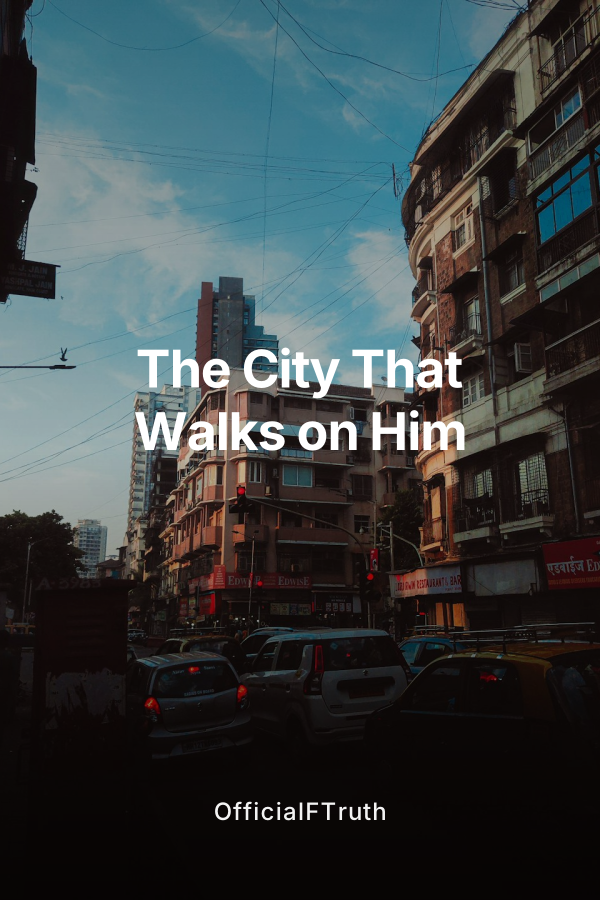
This book follows a single protagonist whose entire life has collapsed into one function. He moves through a nameless city as living ground for others, trapped inside his own head with no escape, his mind a chaotic flow that never slows, his body reduced in his own eyes to a strip of walking pavement. He is still articulate in his inner voice, still capable of complex, even beautiful thought, but he no longer believes he is a person. He believes he is an object, and that belief shapes everything he sees, everything he remembers, and everything he allows to be done to him.
Across five chapters, the book explores how someone can be broken into consenting to their own dehumanization, how humiliation and reverence can merge, and how a city can quietly collude in treating a man like infrastructure while pretending not to see him at all.
Chapter 1 introduces his present condition from the inside. The reader enters his mind in midflow, riding a rushing, disjointed monologue as he carries people, shoes, and weight across the city. There is no calm exposition, only the blur of impressions, rules, and sensory fragments that govern him. He thinks in tight, ordered phrases that sound like protocols, almost like operating instructions that he repeats to stay small and obedient: reminders that units must obey, that surfaces must stay clean, that objects do not speak. Underneath these self-imposed scripts, though, other thoughts leak through, more human and frightened, contradicting the system he is trying to live inside. The contrast between his crisp mental rules and the wild, uncontrolled current of associations and feelings reveals a mind at war with itself, fighting not to remember it was once a person.
Chapter 2 begins to thread in his past through sharp, intrusive flash fragments. The story never pauses for a full, linear backstory. Instead, certain stimuli in the present trigger loops of memory. A particular perfume on a passerby, the click of a specific kind of heel, the angle of a shadow falling over him: each detail throws him into a brief, overpowering image of a betrayal that turned him from man into object. These memories are not reliable. They come warped, stuttering, sometimes contradictory, so even he starts to question if he is remembering events or just justifying his current state. The chapter follows how these looping shards of memory circle around but never fully reveal what was done to him, building a constant tension between the reader’s desire for answers and his terror of clarity.
Chapter 3 delves into the intersection of arousal, shame, and self-erasure. Here the narrative dwells on the way his body responds during use, especially under the weight and indifference of those who step on him or treat him as convenient ground. He feels unwanted arousal that disgusts him, a physical response he cannot control and that he interprets as proof of his degradation. Rather than allowing this to wake him up to his own humanity, he folds it into his object identity, convincing himself that a tool that reacts is still only a tool. The chapter shows him bargaining with himself in filthy inner affirmations, questioning whether he deserves this role, then clinging to it harder whenever he feels desire twitch against his will. This creates a suffocating feedback loop in which every betrayal of his body is turned into further evidence that he is nothing but something for others to use.
Chapter 4 widens the focus to the city and its people, refracted through his perception. Pedestrians, clients, and onlookers appear almost as deities in his private theology. He elevates their ordinary gestures into sacred signs, treating their disinterest as holy distance and their casual cruelty as a kind of divine judgment. He repeats phrases that frame his mouth, back, and skin as altars for their passage, clinging to a worshipful tone that turns his objecthood into a faith. This chapter explores how he constructs meaning out of his own subjugation, how he needs to believe that the people who walk on him are vast, significant forces rather than ordinary, morally responsible human beings. At the same time, small slips in his thinking reveal cracks in this belief: moments when he notices their flaws, hears their petty arguments, or recognizes their vulnerability, and for a heartbeat remembers that no one here is a god.
Chapter 5 brings the internal conflict to a strained climax. The unconquered human part of his mind grows louder, no longer content to be erased by scripts and mantras. The chaotic blur of his thoughts intensifies until he cannot fully hold onto the comforting idea that he is only pavement. New memory fragments knit together, exposing just enough truth about the betrayal that set all of this in motion. The chapter does not offer an easy rescue or a triumphant reclaiming of personhood. Instead, it presents a razor’s edge between collapse and awakening, where he must choose between clinging absolutely to his object-identity or risking the unbearable pain of seeing himself as a person again. The conclusion leaves him poised at this threshold, with the reader sharing the same question he cannot answer: whether the ability to think, doubt, and suffer means he was never truly an object at all.
Throughout the book, the narrative voice stays anchored in his consciousness, never fully stepping outside his head. The prose mirrors his internal state: turbulent, repetitive in its mantras yet constantly derailed by sensory overload and unwanted memories. His articulate self-description contrasts sharply with the role he accepts, creating a haunting portrait of intelligent self-negation. The City That Walks on Him is an intimate, disturbing exploration of dehumanization from the inside, asking how far a mind can go in trying to become less than human, and what stubborn fragments of dignity might still survive in someone who has chosen to believe he is nothing more than something to be walked on.