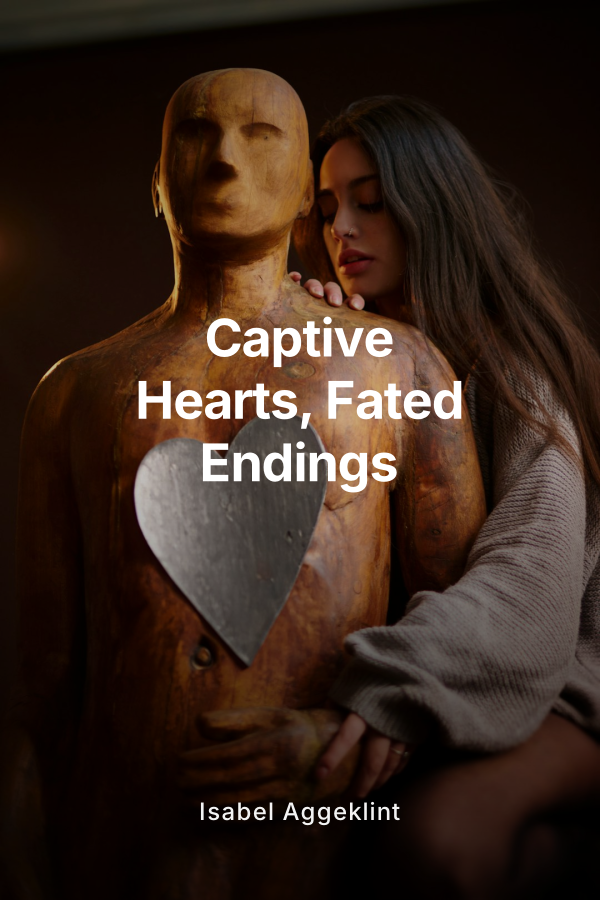
This book is a mature young adult dark romance that follows two kidnapped teens whose love blooms in captivity as both a lifeline and a death wish. It blends psychological tension, romantic tragedy, and emotionally intense intimacy, and it carries clear trigger warnings for suicide, suicidal ideation, captivity, kidnapping, parental abuse, and explicit sexual content between teens, all handled with serious emotional weight rather than glamorization.
Across five chapters, the book traces a single harrowing arc. At the start, both characters are already broken in different ways long before the kidnapping. One grew up with parental physical abuse and neglect, so they enter the basement with a long history of believing they are fundamentally unworthy of love. The other has lived for years with quiet, persistent thoughts of suicide, not in loud dramatic gestures but as a constant background option they consider with chilling calm. They did not meet as saviors but as two damaged kids whose paths happen to cross at the worst possible time.
Chapter One establishes the kidnapping and captivity in visceral detail. The captor is more presence than person, a looming threat that appears in footsteps in the hallway, the rattle of a lock, a camera’s tiny red light. The basement is their whole world, and the narrative stays tightly inside the teens’ shared point of view, following the small rhythms of their days as they test the walls, count the tiles, and search for any hint of weakness. The focus is on their internal landscapes: one catalogues every method they might use to die rather than be used, while the other clings to routines and jokes to hold off panic. From the beginning, death is not a twist; it is an active, spoken possibility. Their promise to one another is simple and raw: if escape fails, they will not let the captor keep them alive as playthings.
Chapter Two deepens their bond from uneasy alliance to fierce, complicated attachment. Small gestures carry enormous weight: the way they share a blanket on the cold floor, the way one quietly shifts to take kicks or shoves meant for the other during the captor’s outbursts, the way they begin to narrate imaginary futures in whispers to pass the time. Neither character initially thinks of themselves as lovable. One believes they are only tolerated; the other believes they are a burden whose death would be a relief to everyone. As they talk through sleepless nights, they expose the scars of their past lives, from bruises that never quite faded to school counselors who missed every sign. The book carefully shows how recognition feels before romance: the shock of hearing your own darkest thoughts echoed back to you, the guilt of wanting someone as broken as you are to keep living.
The confession of love arrives in Chapter Three at a moment cracked open by fear. After a failed escape attempt that nearly ends in disaster, both teens are shaking and bloody in the dim light. One of them blurts out the confession in a rush of panic, convinced the other is about to die. The words are not smooth or cinematic; they are clumsy, hoarse, and more like an apology than a declaration. Later, in the quiet aftermath, they repeat the confession more softly, almost shyly, when there is finally a fragile sense of safety. The scene is framed not as a magical cure but as a terrifying act of vulnerability. To say “I love you” here is to admit that they now have something to lose. Their love becomes a double edged blade: it gives them a reason to survive, but it also sharpens their shared resolve that if they cannot escape together, they will die on their own terms rather than let their love be weaponized.
In Chapter Four, the story moves into its most emotionally intense territory with a later explicit scene that is meant to hit like a quiet earthquake. This is not casual experimentation or a triumphant reward after victory. Instead, it unfolds like a goodbye they are both afraid to name. They have just learned something that convinces them their time is almost over, whether by the captor’s hand or their own. In the stillness of a long night, they choose to be fully present with each other, almost pretending, for a few hours, that they are free. The intimacy is deeply emotional: slow, tender, threaded with pauses where one of them breaks into tears or laughs in disbelief that anyone could want them in this way. They speak in murmurs about a future they know they will never have. They describe imaginary apartments, pets, college classes, the feeling of windows they can open whenever they want. In between kisses, they promise to remember each other, whether in an afterlife or simply as the last and brightest thing they knew before the dark.
The narrative treats their sexual connection with gravity, not voyeurism. It is explicitly on page yet focused more on what it means than what it looks like. Touch becomes a language of consent, comfort, and desperate clinging to the present. For the suicidal character, choosing to be fully alive in their own body, even briefly, feels radical and terrifying. For the one used to physical violence, being touched gently without flinching is almost unreal. Neither believes that love redeems their suffering, but both find, in that physical closeness, a fierce insistence that they were here, that they mattered, even if the world never learns their names.
Chapter Five carries the story toward its tragic, fated ending. The captor’s control tightens, and escape attempts become riskier. The teens develop a clear, mutual plan for what they will do if they determine that survival outside the basement has become impossible. Suicide is treated with brutal honesty, never as a solution but as the final act of people whose choices have been violently stripped away. Their conversations grow quieter, more focused on small details: how they want to be remembered by each other, what last words they want to hear, which memories they will hold on to in their final moments. The tension in this chapter lies not in the question “Will they die?” but in how they will confront the moment when hope and reality finally collide.
Throughout the book, the narrative refuses to glamorize suffering, while still allowing space for intense romantic and emotional payoff. The tone is raw and intimate, aimed at older teens and new adult readers who can handle heavy themes and want stories that take their pain seriously. Scenes of captivity are portrayed with psychological nuance, centering the characters’ internal choices rather than the captor’s cruelty. Parental physical abuse appears in memory, shaping how one character assesses danger, love, and their own worth. Suicidal ideation is not a sudden plot twist but a long standing part of one character’s mind, described with care so readers understand both the weight of it and the ways love complicates, but does not erase, that desire for death.
The emotional core of the story is the way love functions as both salvation and trap. Loving each other gives the teens something to fight for, a reason to push against the captor, to gather strength in small acts of rebellion: sharing contraband information, hiding tools, tracing escape routes into the concrete with their fingertips. At the same time, love magnifies their fear of what will happen if only one survives, or if both are broken beyond repair. The book explores this double bind with unflinching honesty. There is no cheap message that love cures trauma or makes death meaningless. Instead, it suggests that even in the most horrific circumstances, the choice to reach for another human being, to see and be seen truly, is an act of defiance that matters.
By the final pages, readers are left with a knot of conflicting emotions: grief at what has been taken from these teens, tenderness for the small pockets of joy they carve out together, anger at the systems and adults who failed them long before the kidnapping, and a strange, quiet gratitude that they found each other at all. The story invites reflection on consent, control, and the brutal cost of survival. It asks its audience to sit with the discomfort of loving characters whose most empowered choice may be when and how to die, without ever suggesting that this is a desirable outcome in the real world.
Captive Hearts, Fated Endings is not a story of easy hope, but it is a story of meaning. It honors the complexity of suicidal thoughts, the lingering wounds of abuse, and the fierce, messy power of first love under impossible conditions. For readers who seek dark, emotionally intense romance where nothing is simple and every moment of tenderness feels stolen from the jaws of despair, this book promises a haunting, unforgettable journey into the deepest corners of the human will.