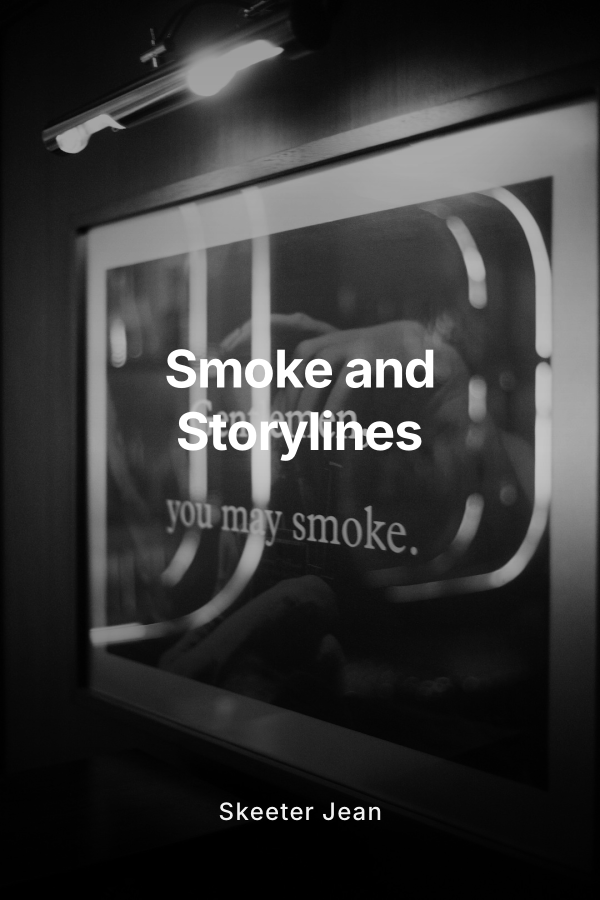
This book is a comic odyssey that transforms a single absurd, drug hazed night into a story about memory, friendship, and the way legends are born from chaos. Drawing from the user’s original concept of a vividly detailed stoner comedy following a wild adventure that culminates in the making of a film about that very night, the novel becomes both an outrageous romp and a sly meditation on storytelling itself .
Told by an older, unhurried, philosophically stoned narrator in the tradition of a campfire yarn spinner who refuses to skip any vivid detail, the book frames the central story as if it is already a cherished myth. The narrator, a veteran of too many hazy decades, addresses the reader like an old friend on a couch, meandering in and out of the main timeline, foreshadowing disasters, backtracking to explain a single look or smell, and constantly reminding us that every legend begins with a bad idea that felt brilliant at the time. He lingers over textures and colors, the particular thickness of nightclub air, the slow drift of smoke through stale spotlight dust, the half remembered sounds of laughter that may or may not have actually happened.
At the heart of the story are two comedians who live on the border of the absurd. Joey, volcanic and profane, is a man who has survived far too much to take anything seriously, including his own survival. Pauly, restless and eternally chasing the echo of applause, hides his need for validation behind a laid back bravado. The night begins with something apparently ordinary: a joint comedy set in a small Los Angeles club, another gig, another room, another crowd. Yet from the start, the narrator hints that no one in that room fully understands they are standing at the edge of a story that, years later, will sound like pure fiction.
The first chapter of the book sets the stage in that club, treating the comedy set as a ritual that opens a door between the mundane and the surreal. The narrator immerses the reader in the rhythms of their banter, the way Joey’s stories lurch from menace to hilarity, the way Pauly dances on the line between self parody and sincerity. The jokes they tell seem to summon the madness that will follow. A throwaway bit about ninjas in a strip mall lands only moderately well in the room, but in the logic of the story, it plants a seed. A riff about the Yakuza checking Yelp reviews for American dive bars lodges itself in the haze. A pantomimed scene involving an invisible box and an imaginary brick of cocaine draws only polite chuckles from the audience, yet the narrator pauses there. It is as if that scene were an invocation.
Once the set ends, the book leans fully into the after hours transformation of reality. The second chapter follows Joey and Pauly as they agree, with the cozy bravado of performers basking in post set adrenaline, that they will have just one drink, then call it a night. They will behave. They deserve a quiet celebration. Instead, what follows is a wandering through the nocturnal city that progressively unhooks itself from logic. Bars blur into one another. Each doorway seems to lead to a slightly stranger world. The narrator glides between memory and embellishment, refusing to mark the exact moment when the night stops being real and becomes legend.
Early in their wanderings, they cross paths with a mime on a nearly deserted side street. At first, this figure seems like a minor comic detail, another Los Angeles oddity. The mime is relentless, silently mirroring Joey’s swagger and Pauly’s loose limbed energy, erecting imaginary walls across their path, pulling invisible ropes, insisting on framing their steps as performance. The encounter feels harmless, an eccentricity in a city of eccentrics. Only later does it become clear that the mime is an omen, a strange spirit of the night whose presence will echo through almost every catastrophe to come.
As the night deepens, so does the scale of the absurdity. The book’s third chapter unfolds as a fever dream adventure in which a series of bad decisions and drug fueled misinterpretations entangle the duo with a group of costumed martial arts performers they mistake for actual ninjas, and with a criminal syndicate whose quiet competence throws the clumsy bravado of the comedians into ridiculous relief. The supposed ninjas are first glimpsed in the back room of a seedy karaoke bar where Joey and Pauly, already several drinks and smokes beyond sober judgment, interrupt what they assume is a low budget movie shoot. The truth is both more ordinary and more dangerous. Their blundering presence disrupts a delicate handoff involving a very real kilo of cocaine, an impatient Yakuza middleman, and a code of honor that does not easily tolerate chaos.
The narrative delights in the collision between their slapstick incompetence and the tight laced seriousness of the criminal world they have accidentally crashed. Every mistake compounds the previous one. An ill timed attempt at a joke is misinterpreted as an insult. A panicked effort to hide the cocaine leads to increasingly elaborate farce. Narrow escapes multiply. The mime reappears at uncanny moments, silently witnessing, interfering, or perhaps merely reflecting the madness that Joey and Pauly carry with them. The night becomes a labyrinth of alleys, strip mall rooftops, neon lit diners, and underground rooms that may exist only in hindsight.
Amid the slapstick, the book keeps returning to quiet pockets of introspection, especially during the lulls between chases and confrontations. In a gas station bathroom that smells of bleach and lost dreams, Joey stares at his reflection and wonders when exactly his life turned into a loop of near disasters spun into stories on stage. Pauly, sitting on a curb outside with his shoes in his hands, silently counts the times he has promised himself that the next project, the next gig, will be the one that finally proves he is more than a punchline. These moments of vulnerability never derail the comedy. Instead they deepen it, suggesting that the desire to turn a terrifying, ridiculous night into a movie is not just opportunism but a survival mechanism, a way to place structure and meaning over chaos.
The book’s fourth chapter escalates everything that has come before. The Yakuza presence grows more pronounced, both as a genuine physical threat and as a kind of moral shadow over the protagonists. The syndicate’s quiet, disciplined enforcers keep intersecting with Joey and Pauly, whose continued existence becomes increasingly improbable. The narrator, with conspiratorial glee, confesses that even he is not entirely sure how they made it through alive. He admits that over the years, the story has been told so many times that the line between what actually happened and what was later added for effect has dissolved. Did they really leap from a rooftop into a dumpster just as a black sedan screeched into view, or is that a cinematic flourish that crept in after the fifth retelling?
This is where the book slowly pivots from pure adventure into an exploration of myth making. The characters begin, without fully acknowledging it, to perform for an imagined audience. Pauly catches himself delivering a quip not to the terrified bystanders near him, but to some future camera. Joey, sprinting through a shadowed alley with the uneasy weight of a backpack he does not entirely understand, suddenly imagines how this moment will play on screen. Their terror and giddiness fuse into a dawning realization that the story of this night, if they survive it, is worth more than any one gig. It could be a ticket to a different kind of relevance.
Running parallel to the escalating absurdity is the recurring figure of the mime, whose silent commentary grows spookier and more poignant. In one key scene, after a near fatal misunderstanding resolves into a bizarre truce in a closed ramen shop, the mime appears at the window, slowly acting out the arc of their night in miniature. The narrow escapes, the greed, the arrogance, the fear, the fragile friendship. Joey and Pauly watch, at first amused, then unsettled, then quietly moved. The mime lays invisible bricks to build a little pedestal, places an unseen object on top, and bows to it, suggesting that the night itself is an offering, a sacrifice, and perhaps a gift.
By the time the chaos finally burns itself out, dawn is creeping across a city that looks only marginally different from the one they left. The immediate dangers have dissolved through a mix of sheer luck, accidental courage, and the pragmatic self interest of the criminals who decide that eliminating two foolish comedians is more trouble than it is worth. The kilo of cocaine, once the center of frantic chases and violent intent, ends up in a fate that is anticlimactic, almost mundane, yet tragically funny in its own right. The mime, last seen in the gray light of early morning, offers Joey and Pauly a wordless salute that the narrator reads as both farewell and benediction.
The final chapter shifts forward in time to the movie set where Joey and Pauly are filming the dramatized version of their wild night. Here, the book becomes a meta comedy about the process of adaptation. They stand under hot lights while actors in immaculate costumes play “them” as slicker, braver, more coherent versions of the men they remember being. Stunt coordinators carefully choreograph the same rooftop chase that, in truth, was mostly frantic scrambling and blind luck. A director debates whether the mime should have a speaking role. Producers argue over whether the Yakuza should be softened into a generic, fictionalized gang to avoid legal complications. Reality undergoes yet another transformation, this time not in the fog of intoxication, but under the clear, cold calculations of budget, audience expectations, and narrative pacing.
On set, Joey and Pauly find themselves marginalized in their own legend. They are consultants on the story that supposedly belongs to them. Their memories, flawed and embellished, must now compete with test screening notes and the ego of the director. The narrator uses this setting to ask what happens when a lived experience, messy and terrifying and beautiful in its absurdity, is flattened into entertainment. Joey grows frustrated as certain details he considers crucial are cut for time. Pauly fights for small moments of truth, only to see them replaced by bigger jokes, cleaner arcs, more familiar beats. The script demands a neat resolution, a final speech, a hugging scene that never happened. The studio wants catharsis. The truth has never been neat.
Yet amid the compromises and betrayals, there is an unexpected grace. As they watch take after take of a scene that, in their memory, was a blur of fear and sweat, Joey and Pauly begin to recognize that even this polished, distorted version has its own power. The movie will not be their night. It will be a story about that night, a different creature altogether. Somewhere between the actual events, the years of exaggerated retellings, and this filmic reconstruction, a shared myth has crystallized. People who were not there will laugh, will gasp, will repeat lines. The story will outgrow its origins.
Throughout the book, the narrator keeps circling back to the idea that every wild night is, at its core, a negotiation with mortality. To chase danger for the sake of a good anecdote is both foolish and fundamentally human. For comedians, whose craft depends on turning pain and panic into punchlines, this impulse is amplified. The novel treats stoner humor not merely as a source of gags, but as a lens through which characters cope with fear, disappointment, and the awareness that their time in the spotlight is finite. The kilo of cocaine becomes an absurd totem of temptation and risk. The ninjas and Yakuza, whether fully real or partly imagined, personify the rigid seriousness of a world that does not find their jokes nearly as funny as they do. The mime, hovering at the edge of scenes, embodies the silent judgment of the audience, the inarticulate awe and skepticism with which stories are received.
In stylistic terms, the book uses long, winding sentences that echo the stoned narrator’s tendency to digress, to revisit moments from different angles, to luxuriate in sensory detail. Yet beneath the looseness lies a firm structure: five chapters that track a clear arc from set, to city, to chaos, to shadow, to set again. Within each chapter, the narrative braids slapstick episodes with pockets of interior monologue and fleeting philosophical asides, allowing the reader to laugh at the absurdity while still feeling the weight of what is at stake for the characters.
By the end, the reader is invited to question not only what really happened that night, but what it means for a story to be “true” at all. Perhaps the most honest version of the night lives not in Joey’s or Pauly’s memory, not in the official screenplay, not in the director’s cut, but in the shifting mosaic composed by all of these versions together. The narrator, in his last pages, openly admits that he has altered details for effect, that he has smoothed some edges and exaggerated others. He leaves the reader with the unsettling yet liberating thought that every story, especially the most cherished ones, is a collaborative hallucination between the teller and the listener.
Smoke and Storylines is therefore not just the tale of a wild, drug soaked adventure punctuated by ninjas, Yakuza, a mime, and a kilo of cocaine. It is a study in how people survive their own chaos by transforming it into narrative. It is about comedians who nearly lose everything, including their lives, and claw back a kind of immortality not through heroism, but through the stubborn insistence on laughing and making others laugh. The book invites readers to sit back as if on a threadbare couch, to pass along the figurative joint, and to listen as an old voice, smoky and unhurried, tells them, in too much detail and with obvious pride, about the wildest night ever and the movie it became.