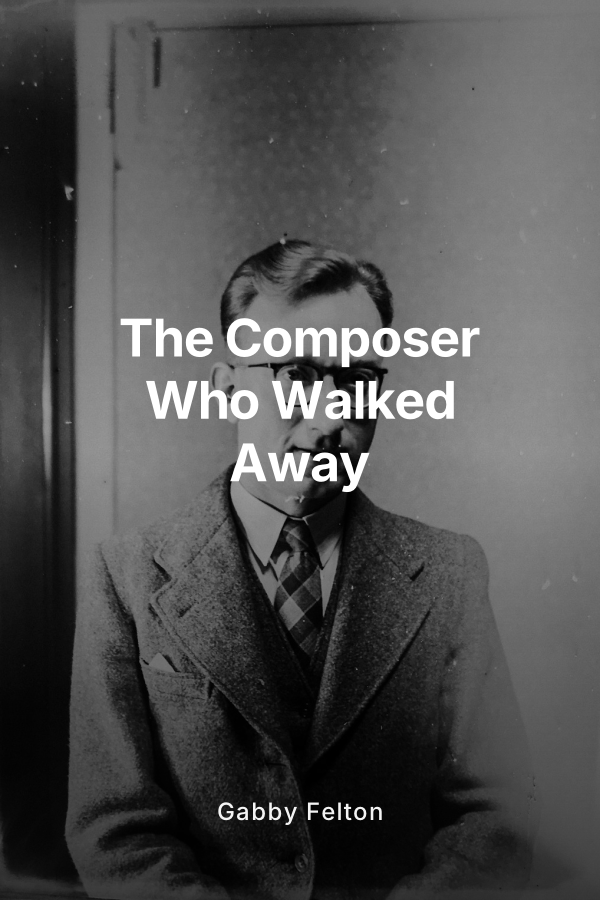
This fanfic series follows Bruce Wayne’s first and only biological daughter, a gifted composer who grows up as a ghost in her own home. To the public, Bruce is Gotham’s most devoted philanthropist. To his adopted and foster children, he is a flawed but present father. To her, he is almost nothing at all.
Raised in the shadowed corners of Wayne Manor, she receives warmth and stability from only one person: Alfred Pennyworth. Alfred becomes her real parent, the one who notices when she skips meals, the one who sits through her earliest clumsy compositions, the one who bakes with her at 3 a.m. when the silence of the manor turns cruel. He teaches her to cook and to care for herself, hides sheet music among grocery lists, and quietly nurtures a talent that no one else bothers to see .
Around her, the Batfamily grows. Dick and Tim are too busy, too distracted, too used to seeing her as background noise. They do not insult her, but their indifference cuts just as deep as active cruelty. Stephanie and Barbara put in a brief effort, only to decide she has nothing “interesting” to offer and fade out of her life. Bruce never truly tries at all. He treats her like a footnote in his own house, someone who is always there and therefore not worth the effort of knowing. In contrast, Damian, Jason, and Duke quietly admire her musical skill from afar. They hear the pieces she leaves on the piano, feel the raw emotion in her compositions, and sense that there is more to her than anyone admits, but they do not bridge the distance or change the story she lives inside .
The turning point comes when she chooses herself over Gotham. Old enough to leave and tired of bleeding for a family that does not see her, she walks out of Wayne Manor and never looks back. She heads for New York and reinvents herself as a composer and musician, careful to obscure her last name and her connection to the Waynes. In New York she builds the life she never had: a career on her own merit, a network of colleagues and friends who know her first as an artist, and a small, fiercely loyal found family who has no idea she grew up in a mansion full of vigilantes. Alfred is the only link she keeps. He sneaks visits to her, walks her down the aisle at her wedding, and becomes her loudest, proudest supporter in every corner of her career, sending coded encouragements through shared recipes and letters so no one in Gotham can trace her steps .
At a music festival in New York, she meets Peter Parker. He is not a billionaire, not a vigilante general, not someone who sees her first as an asset or a responsibility. He is a dorky, brilliant, awkward photographer and scientist whose kindness is as instinctive as breathing. She knows from early on that he is also Spider Man, but unlike the family she left behind, he never expects her to orbit his secret. Instead, Peter offers a love that is gentle and stubbornly respectful. He listens to her stories, comforts her when old Gotham wounds reopen, and stands solidly behind every choice she makes about her past. Where Bruce once chose the mission over his child, Peter chooses her, again and again, both as a husband and as a hero .
By the time the story truly begins, she has carved out a stable, hard won peace. Her music is known. Her name, carefully curated, belongs only to her. She is married to Peter, close friends with Gwen Stacy and MJ, and surrounded by people who see her as more than background. Gotham and the Batfamily are distant ghosts. She has no plans to forgive them, no interest in reconciliation. At most, there is Alfred in her mailbox, his letters filled with love, recipes, and quiet pride.
Everything fractures the night her work is performed in Gotham.
Bruce Wayne and the Batfamily attend the concert as patrons, interested in the rising composer whose music has been quietly celebrated worldwide. They do not know they are walking into the life of the daughter and sister they ignored. They sit in the audience and hear her in every note, feeling the ache, anger, and fragile hope woven into the score, but they cannot yet place why it hits so hard. Only when they go backstage to congratulate the composer do they understand. The woman they abandoned stands before them, transformed into someone the world cannot ignore, and the sight knocks the breath out of them .
She does not give them the reunion they imagine.
Instead, she draws clear, unforgiving lines. She has moved on. She has a husband, a home in New York, a career built with her own hands, and a support network that never required heroics as payment. She grants them only one thing forgiveness without reconciliation. She is done letting their neglect define her, but that does not mean she is ready to let them back in. Her message is simple and unyielding: “You are forgiven. You are not welcome in my life.” Alfred is the exception. He has always been the exception and always will be .
The core emotional arc of the series lies in this complicated mercy. She works through her pain, especially the betrayal that Bruce never told her Jason returned from the dead. That omission becomes the sharpest fracture in their history. Jason has spent years assuming she knew he was alive and simply did not care. The truth is brutal when it comes out. After the concert, once she learns that Bruce kept Jason’s resurrection from her, the lie detonates every fragile possibility of repair with Bruce and undermines his claim to ever having been a father at all. For Jason, discovering that she was grieving him in ignorance, not indifference, rewrites his own memories of her and of Wayne Manor .
The post theater confrontation with Jason becomes another spine of the narrative. What begins as a bitter, shouting argument over lies, abandonment, and weaponized silence breaks down into raw grief and shared understanding. They scream first, then cry, then finally talk. In that painful, cathartic moment, they recognize each other as casualties of the same man’s choices. Both were children who never got the father they needed, both learned to survive without him, and both now refuse to automatically offer Bruce access just because he has changed his mind. From that night on, she and Jason choose each other as siblings, independent of Bruce’s approval, building a teasing yet fiercely protective bond that grows in the shadows of everything they lost .
Peter and Jason quietly form a pact based on one shared principle: her safety, emotional and physical, comes first. Peter respects her boundaries and supports her decisions about her family. Jason, freshly allied with her, becomes the unseen backup in Gotham. He keeps watch when she must return for work or obligations, shows up when things threaten to spiral, and trades private contact information with Peter so they can coordinate. Most of their partnership happens off to the side, in late night calls and brief, wry exchanges, but its effect runs deep. She is no longer a girl alone in Wayne Manor’s corridors. She is a woman with two men prepared to stand between her and any threat, even if that threat comes wearing a bat symbol .
Meanwhile, the rest of the Batfamily reacts to her refusal in different ways. Guilt gnaws at Bruce, Dick, and Tim. Stephanie and Barbara are forced to confront the cruelty of having decided she was not “interesting” enough to truly see. Damian and Duke wrestle with the knowledge that their admiration from afar was not enough. All of them want a chance to fix things, to prove they care now, but she has established boundaries they never had to live with before.
The discovery that she is married to Peter sparks another wave of tension. The Batfamily investigate him, running background checks and digital traces, trying to slot him into their familiar patterns: ally, liability, or threat. They do not know, at first, that he is Spider Man. When they finally uncover his secret, it shifts the dynamic again. Bruce tries to evaluate Peter simultaneously as a costumed hero and as her husband, but Peter has already heard her stories, already seen her panic and anger after Gotham visits. He is polite but firm. She is not a case file, not an asset to be reclaimed. She is his wife. She is her own person. Any attempt to undermine her choices or breach her privacy will be met with resistance, not from a billionaire, but from a man who knows too well what neglect does to a child.
Jason’s loyalty crystallizes into active defense. He chooses her over the rest of the family and makes it clear he will not help them reach her. Instead, he actively sabotages their attempts. He reroutes their intel, supplies misleading details, feeds them just enough truth to be convincing while giving her all the information she needs to stay ahead. He might confirm that she is in New York but misdirect them to the wrong neighborhood, share accurate concert dates while sending them to the wrong venues, or claim she left events early when she actually stayed late. When Oracle begins to notice patterns, Jason doubles down, challenging their right to keep hunting for someone who already told them no. To her, he offers honesty and a simple promise: he will protect her boundaries even if it means standing alone inside the family that once felt like his only home .
The series keeps its emotional focus tight. There is angst, yes, in abundance, but also a clear commitment to a specific outcome. She forgives the Batfamily in the sense that she refuses to remain powered by hatred. She lets the past stop bleeding into every decision and accepts that what happened cannot be undone. Yet forgiveness does not equal access, and it certainly does not equal forgetting. Her life in New York, her marriage to Peter, and her ongoing bond with Alfred and Jason all exist outside of Gotham’s gravitational pull. She has the family she chose and the family that chose her back, and that remains more important than the one that took her for granted.
Throughout five chapters, the story traces:
• Her childhood in Wayne Manor, defined by invisibility except for Alfred’s steadfast love and early glimpses of resentment and admiration among the siblings.
• Her escape to New York, the rise of her career, the blossoming of a found family, and her relationship and marriage with Peter, Gwen, and MJ in her inner circle .
• The explosive theater reunion, including Bruce’s shock, the siblings’ varying reactions, and her uncompromising refusal to let guilt rewrite history.
• The unraveling of Bruce’s lie about Jason’s resurrection, the brutal confrontation that follows, and the forging of a new sibling bond grounded in mutual hurt and active choice .
• The ongoing fallout in Gotham as Jason feeds false leads to the Batfamily, Peter and Jason quietly cooperate to keep her safe, and Alfred stands at the center as the one person loved by everyone yet loyal first to the child he raised, not the man who employed him .
Across these arcs, the series explores heavy themes with unflinching honesty: how neglect harms as deeply as open abuse, how apologies cannot erase years of absence, and how forgiveness can coexist with permanent distance. It offers no easy reconciliation scene where everyone hugs and moves on. Instead, it shows a woman who chooses her own well being above inherited loyalty, a man who learns that being a hero starts at home, and a family forced to live with the fact that sometimes you do not get a second chance, no matter how sorry you are.
At its heart, “The Composer Who Walked Away” is a story about reclamation. About a reader-insert heroine who was once a silent child at the edges of iconic panels, now standing center stage with the power to say no. It is about the people who finally show up for her, not because they must, but because they want to. It is about a butler who became a father, a spider who became a husband, a lost son who became a brother, and a Batfamily that learns, too late, that unconditional love is not a right. It is something you either give in time or lose forever.