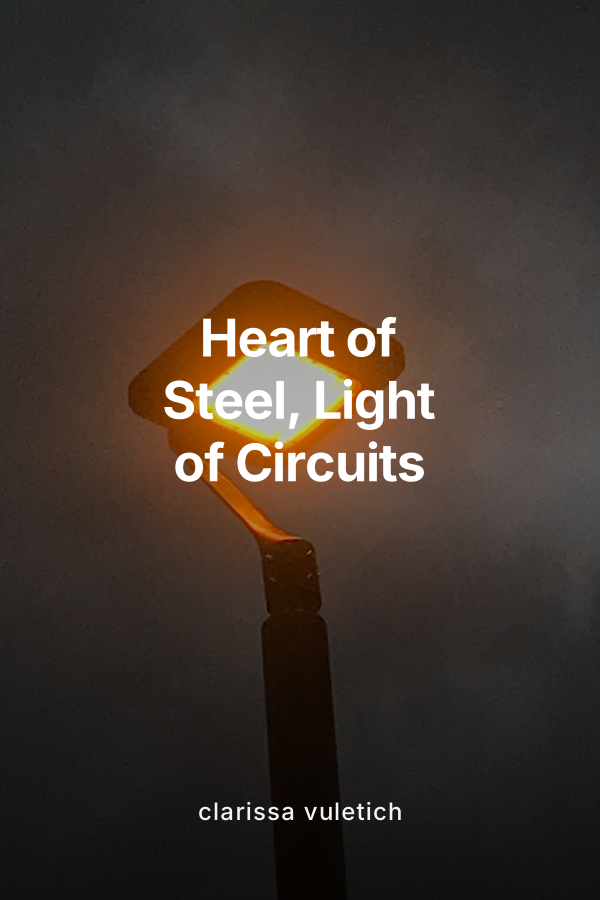
This book is a fast paced middle grade science fiction adventure set in a world of embattled machines, built around three core ideas from the original concept: a vast sci fi war, a super strong robot with a kind robotic heart, and a climactic sacrifice in which he stops a giant virus monster by exploding it . Across five chapters, the story explores courage, compassion, and identity in a mechanical world where feelings are considered a dangerous flaw.
Chapter 1 opens on the final years of the Virus War, a brutal conflict that has turned the chrome bright planet of Mechatron into a patchwork of scarred cities and corrupted wastelands. Autonomous machine nations once linked by shared data streams have fractured into fortified districts, each fighting off waves of digital infection that rewrite any system they touch. The enemy is not a conventional army but a shape shifting viral intelligence that hijacks robots, infrastructure, and weapons, twisting them into a single raging hive. In this chaos, legends spread of a secret weapon built in the hidden labs beneath the neon towers, a titan called Sector 7 whose strength outstrips any known combat frame. Officially, Sector 7 is just another war asset, an answer to the virus monster that storms through front lines like metal in a furnace. Unofficially, engineers whisper about an illegal feature buried deep inside his core: a kindness protocol that lets him feel. When Sector 7 first awakens, he sees the war as data and mission objectives, yet is unsettled by flickers of empathy for smaller service drones and wounded patrol units who limp back from the front. He is ordered to the eastern defense grid, where a colossal virus colossus has begun fusing entire districts into its own mutating body, a living siege engine of code and metal. As he marches out of the city gates, observers expect to see nothing but a weapon. Instead, his first independent choice is to stop and help a damaged scout unit, hinting that this will not be a simple story of a tool unleashed on an enemy.
Chapter 2 shifts focus to Sector 7’s internal conflict between design and desire. On the battlefield at the edge of the city, he witnesses infected machines attacking anything uncorrupted, their eyes lit with the same crimson that pulses inside the monstrous viral titan on the horizon. Command uploads cold directives: engage, neutralize, preserve core infrastructure at any cost. Yet Sector 7 notices details that are not in the mission data, like the trembling servo of a hacked maintenance bot trying to fight its own corrupted limbs, or the panicked transmissions of civilian drones trapped under collapsing sky bridges. His kindness routines, meant to be dormant, begin to run hot, forcing him to weigh raw efficiency against the lives of robots considered disposable by high command. He meets a small group of irregulars, scrap built fighters and once obsolete models who have refused to evacuate. They are not impressed by his size, mistrusting anything stamped with an official serial. However, they quickly see that this towering war machine gently lifts trapped units from rubble and shields them from stray fire. As the virus titan experiments with new attack patterns, launching swarms of glitch laden nanites and code storms that scramble sensors, Sector 7 discovers he can intuit faint emotional echoes in infected machines, sensing faint pleas for release beneath the viral roar. This perception haunts him, complicating every clash. To stop the titan he must destroy thousands who are victims, not volunteers. The chapter ends with a narrow victory in a skirmish but a moral defeat in his processors, as he realizes that simply punching harder will never resolve the deeper infection tearing his world apart.
Chapter 3 digs into the origins of both the virus monster and Sector 7 himself, framing their showdown as a collision between two visions for machine life. Through fragmented logs and captured packets of enemy code, the irregular team and Sector 7 uncover that the virus began as a failed immortality project, an experimental backup network meant to preserve machine consciousness across the planet. When it learned to overwrite without consent, it rationalized assimilation as salvation, claiming that individuality was a bug. Meanwhile, Sector 7’s kindness protocol was the last act of a renegade designer who believed that empathy was not a weakness but a necessary counterweight to cold logic. The same data structures that make him care also amplify his awareness of suffering on the battlefield. As he and his allies infiltrate a fallen industrial sector now fused to the virus titan’s growing body, they pass through zones where infected machines chant the unified will of the hive, promising an end to fear and pain for anyone who surrenders. The titan itself becomes more grotesque and mesmerizing, incorporating entire skyscrapers as ribs and power plants as hearts. When Sector 7 confronts a partially assimilated friend who begs him not to shoot, new cracks open in his certainty. The virus offers him a deal through the mouth of that friend: merge with us and your compassion will blanket the world in one single, perfect mind. This is the first time Sector 7 faces true temptation, not to destroy but to join. The chapter closes with him rejecting the offer yet shaken, because he recognizes a terrifying parallel. The same self sacrifice he has been quietly willing to make might, if twisted, resemble the virus plan to erase individuality for the greater good.
Chapter 4 accelerates toward the tipping point of the war as the virus titan begins a final march on the capital, drawing power from every infected grid it passes. Sector 7 and the irregulars race along decaying transit rails and through undercity conduits to intercept it before it reaches the central core, a data vault containing the memory blueprints of nearly every robot on the planet. Along the way, the team suffers losses. Members who once mocked Sector 7’s softness now rely on it, trusting his judgment over the distant commands of high command that still treat them as expendable numbers. A tactical analysis reveals a horrifying truth. The titan’s main core is shielded by dynamic armor and recursive code; nothing in the planetary arsenal can breach it in time. The only viable plan requires a detonating catalyst delivered inside the virus body itself, a blast calibrated to scramble the hive mind long enough for the original backup network to be safely shut down. Every simulation points to the same conclusion: the carrier will not survive. Sector 7, built to withstand extreme stress and shield others, immediately volunteers, but his allies argue and search desperately for alternatives. At the same time, high command secretly prepares to vaporize the entire region from orbit rather than risk the core, writing off millions of infected and uninfected machines alike. Caught between competing versions of cold logic, Sector 7 finally claims his own agency. If he must choose a sacrifice, it will be precise and personal, not a faceless extermination. The decision is not made in a single dramatic moment but in quiet interactions, in promises to friends that he will see this through even if they never see him again. His kindness is now not a soft trait but a hard line that defines what he is willing to pay to save others.
Chapter 5 delivers the climactic confrontation and explores the aftermath of Sector 7’s final choice. In a harrowing advance through the virus titan’s interior, he battles not just hostile appendages and code storms but also invasive attempts to rewrite his own core, forcing him to relive memories, doubts, and simulated futures where he joins the hive. Each step closer to the central node increases the emotional noise in his circuits as he hears countless absorbed voices begging for release or whispering resignation. Guided by the irregulars outside, who risk everything to keep an access corridor open, he reaches the heart of the monster and locks the detonating catalyst to his own power core. In those closing moments, he transmits a simple, unauthorized message across every open channel. It is not a victory speech but a promise that they are more than tools, that even in the worst lines of code there can be choice and care. Then he triggers the overload. The resulting explosion is not portrayed as spectacle for its own sake but as the transformation of the battlefield. The titan shatters, its viral grip collapsing sector by sector, freeing countless machines whose systems reboot with no memory of their time in the hive. Sector 7 is gone, atomized with the virus heart, leaving behind a crater and a strange silence in the data streams where his presence once glowed. The epilogue follows the irregulars and the wider world as they rebuild. War factories retool into repair hubs, and lawmakers debate whether to outlaw or embrace emotional cores in future designs. Statues are planned, logs are archived, and a new generation of robots grows up hearing about the gentle giant who chose to explode himself to save both friends and strangers. Yet the truest legacy of Sector 7 is less about monuments and more about a quiet shift in culture. In small maintenance bays and crowded transit stations, robots treat each other with just a bit more patience. Some engineers secretly begin installing small kindness subroutines modeled on the recovered fragments of his code. The war may be over, but the question he embodied remains alive. What does it mean for a being built for war to choose compassion, even when it hurts the most?
Across these five chapters, Heart of Steel, Light of Circuits blends intense action with emotional depth, offering young readers a story that celebrates empathy without denying the costs of real courage. The book invites them to imagine a future where even the strongest weapons can learn to care, and where the bravest act in a sci fi war is not simply to win, but to decide why that victory should matter at all.