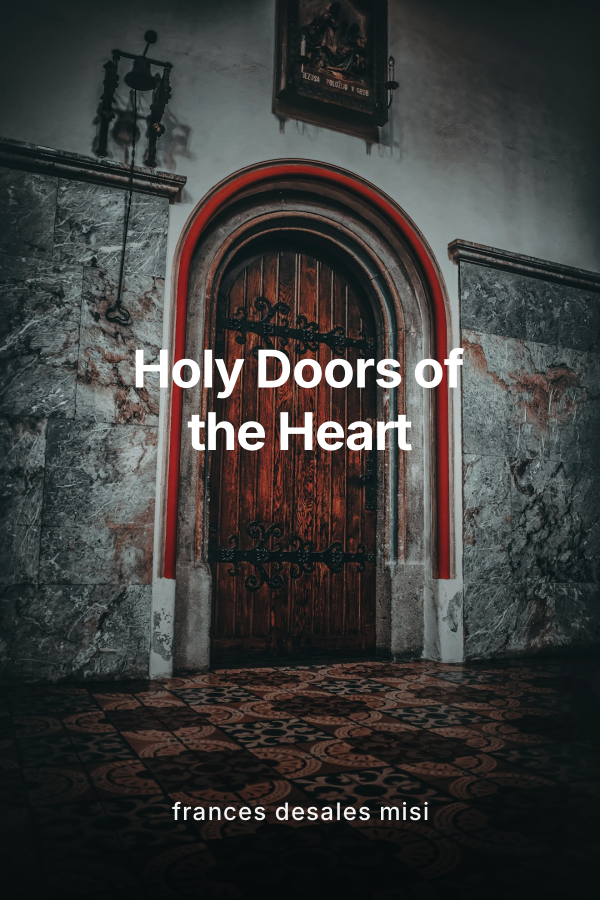
This book is a gentle devotional memoir of one woman’s first pilgrimage to Rome. It is written especially for ordinary Christians, widows, single parents, migrants, and anyone who quietly carries many burdens yet longs to walk more closely with God. Using the holy places of Rome as a living backdrop, the author invites the reader into a simple spiritual conversation about trust, courage, and surrender.
At its core, the book tells the story of a widow and single mother who leaves Manchester and travels alone to Rome, seeking spiritual renewal at a turning point in her life. She carries invisible weights: grief, financial pressure, loneliness in a foreign land, concern for her children, and questions about her own place in the Church. She does not travel as a tourist, but as a pilgrim who wants to listen more deeply to God and to rediscover her baptismal identity. Her journey unfolds across several days, each centred on a different sacred site and ending with a short prayer and a reflection question for the reader.
The movement of the book is simple yet profound. Externally, it follows the author step by step through places such as St Peter’s Basilica, the Catacombs of Priscilla, the Vatican Museums and Sistine Chapel, St John Lateran and its baptistery, the Holy Stairs, St Mary Major, and St Paul Outside the Walls. Internally, it traces her transformation from feeling small, unsure, and spiritually tired into a woman who knows that she is seen, called, and held by God. By the final pages, Rome has become less a city on a map and more a mirror of the soul: the stones, mosaics, altars, and pillars become signs of how God quietly rebuilds a human heart.
The opening part of the book introduces the author’s decision to go on pilgrimage. She describes sensing that, at this stage of her life, there were certain things she needed to do for her spiritual growth, and one of them was to travel to Rome. After prayer, she books simple flights and accommodation, not for comfort, but for conversion. Leaving Manchester, she arrives in Rome to small confusions: a missing airport transfer, trouble with directions, and a basic student room that does not feel safe or peaceful for a woman of her age. These practical difficulties are not dramatic, but they set the spiritual tone: even in small choices like changing hotels, she learns that discernment, peace, and inner freedom matter more than money or appearances.
The first great turning point of the journey takes place in St Peter’s Square and Basilica. Entering the vast piazza with its colonnades, fountains, and towering obelisk, she feels both overwhelmed and welcomed. The scale of the place, the orderliness of the crowds, and the sense that history, faith, and endurance are woven into every stone speak powerfully to her. She passes through the Holy Door of St Peter’s, pausing to ask for forgiveness, cleansing, and spiritual renewal. Inside the Basilica, at first she can hardly pray. She simply walks around like a tourist, lost in beauty and silence, asking in her heart three simple questions that become a thread throughout the book: “Why am I here? What am I seeking? What does God want to do in my life through this journey?”
Gradually, St Peter’s becomes a school of the soul. Through chapels, monuments, sculptures, and mosaics, she sees the New Testament, the story of Creation, and the life of the Church told in stone, colour, and light. She reflects on women like Matilda of Tuscany and Queen Christina of Sweden, who used their influence to serve the Church, and on the many unnamed hands that carved, painted, and built so that future generations could encounter God through beauty. She sees in the polished marble floors the endurance of faith; in the pillars, the strength of tradition; in the golden mosaics, the generosity of believers who gave their finest possessions to God. Here, too, she meditates on Peter and Paul: ordinary, uneducated men without weapons or power, whose trust in Christ conquered an empire. This place begins to shift her understanding of discipleship from routine to costly love.
The next major movement of the book unfolds in the Catacombs of Priscilla. There, beneath the ground, she encounters the memory of martyrs who risked everything to remain faithful. The art in those narrow, hidden corridors speaks of eternal life, the Good Shepherd, motherhood, family, and devotion. As a nurse who knows the smell of death, she is struck by the courage of believers who made these dark places a refuge for prayer and hope. In this section, the “before and after” of her faith begins to sharpen. Before, she admits, she had often taken her freedom to worship for granted and thought of faith mainly as attending church. After walking among the tombs of those who died for the Gospel, she understands more deeply the cost of discipleship and the long chain of sacrifice that allows her to pray openly today. This realisation stirs both gratitude and responsibility in her heart.
From the catacombs, the book leads the reader into the Vatican Museums and the Sistine Chapel. Guided through vast galleries and statues, the author is taught to read art as a record of human longing. The classical sculptures highlight how ancient Rome celebrated the body, strength, and power, sometimes at the expense of the spirit. She senses a hollowness in a world that exalted physical beauty and intellect yet neglected the soul. Against this backdrop, the arrival of the Gospel appears even more striking: a message of love, compassion, and dignity that speaks to a deep emptiness human achievement could not fill. The Pinecone Courtyard, with its peaceful yet tense atmosphere, becomes a symbol of the modern world that is beautiful, complex, and confused. Her reflections here widen the scope of the book from personal devotion to broader questions about culture, moral confusion, and the quiet yet persistent call of God in history.
A central chapter focuses on St John Lateran, the Mother Church of all Catholics, and the Lateran or Constantine Baptistery. Walking through streets once trodden by Peter and Paul, she feels unworthy yet chosen. In the baptistery, she is invited by a Zimbabwean priest to renew her baptismal vows. Here, the theme of “before and after” deepens again. Before, she had often felt like a tired guest in God’s house and had not seen her baptism as a living beginning. After renouncing evil and recommitting herself to Christ, she experiences baptism as a present reality, a fountain of identity and belonging that does not depend on her marital status, country of residence, or personal strength. The imagery of water in the apse mosaic, animals drinking from streams, and the river of life flowing through Scripture allows her to connect her own story with the wider story of salvation.
Linked closely to this is her ascent of the Holy Stairs, traditionally associated with the steps Jesus climbed during His trial. Crawling up in prayer, she carries specific burdens: the weight of her family, her daughter’s struggles, the load of parenting alone in a foreign land, fears about the future, and the ache of widowhood. As she prays the Rosary step by step, she realises that her small worries sit within the immeasurably greater suffering Christ bore for the whole world. The Holy Stairs become a place where surrender is no longer an idea, but an action: each movement upward is a letting go and a trust that God will provide for her children, guide her decisions, and use her life, however fragile, in His plan. Here, one of her recurring inner questions crystallises: “Lord, what must I let go?” The reader is invited to bring their own burdens to these symbolic steps and to let Christ carry what they cannot.
Another key section unfolds in St Mary Major, where her relationship with Our Lady and her own childhood memories come alive. Surrounded by images of Mary and the Child Jesus, and by relics that recall Bethlehem, she feels a childlike joy and protection. This basilica connects Rome with her rural upbringing in Zimbabwe, where pictures of Mary, the Sacred Heart, and Saint Perpetua once watched over her family’s living room and shaped her early sense of being seen and guided. As she kneels in gratitude, she realises that the maternal care she sensed as a girl has accompanied her across continents and seasons of life. The tone in this part of the book is particularly gentle, offering comfort to readers who long for safety and tenderness in a harsh world.
The pilgrimage moves toward its completion at St Paul Outside the Walls. Entering the courtyard and then the basilica dedicated to the Apostle who suffered chains and martyrdom, she sees again the great sweep of salvation history in the mosaics and architecture. The pillars bearing portraits of popes, the images of prophets and the sacrificial Lamb, and the depiction of Christ as Pantocrator and King all bring together witness, suffering, teaching, and glory. For the author, this is a place of synthesis. She recognises that ordinary people like Peter and Paul, fishermen and tentmakers without status, allowed the Spirit to work through them so fully that their faith still holds the Church together like those stone pillars. Standing there, she hears again the quiet answer that has followed her throughout Rome: courage and strength are found not in personal ability, but in complete trust and surrender to God.
Interwoven with these external scenes is the story of her encounters with two Zimbabwean priests in Rome. Though one can only accompany her from a distance, the other walks by her side, explains the history and theology of the places they visit, helps her navigate the city, and listens with compassion as she shares her fears about her daughter and the challenges of being a widow and single mother abroad. Through his presence and guidance, she experiences the Church as a family without borders, a network of spiritual kinship where God provides companions along the road. This friendship becomes another subtle holy door: a sign that God’s care often arrives through human faces and simple gestures of kindness.
Throughout the book, the author maintains a tone of simple spiritual conversation. She does not present herself as a teacher, but as a fellow pilgrim. She often prays with short, repeatable phrases such as “Lord, open my heart” and returns to three core questions that the reader can adopt: “Lord, why am I here today? Lord, what do You want to change in me here? Lord, how do You want me to walk forward from this place?” Each chapter closes with one concrete prayer, usually shaped by the burdens of widowhood, single parenting, or migration, and one open reflection question that any believer can make their own. At times she adds an optional line for readers who are parents, widows, or migrants, widening the invitation without excluding others.
The inner arc of the book can be summed up as a passage through several “doors.” At the start, she sees pilgrimage mostly as an item on a spiritual list, a way to strengthen faith. By the end, she recognises that God has been strengthening her all along, patiently preparing her heart for this journey and using every delay, disappointment, and surprise to draw her deeper into trust. Passing through the physical Holy Doors in the basilicas becomes a symbol of crossing thresholds in her interior life: from fear of suffering to gratitude for martyr witness, from feeling like a second class believer to embracing the dignity given by baptism, from clinging to control to placing her family on the Holy Stairs, from feeling alone to discovering the companionship of the saints and of living guides. Rome becomes the city where she moves from asking “Why am I here?” to quietly affirming, “God has brought me here, and He will walk with me when I go home.”
By the time the book closes, the reader has not only followed one woman’s story, but has also been gently led into their own. The author insists that not everyone will travel to Rome, and not everyone is called to cross famous thresholds, yet everyone has their own basilicas, catacombs, and holy stairs within daily life. A parish church, a kitchen table, a hospital ward, a cramped rented room, or a crowded bus can become, in God’s timing, a place of encounter and conversion. What matters is the willingness to walk, to listen, and to say yes.
The final pages end quietly. After a last day of walking Rome’s streets, learning about its history, and sharing a simple meal with her priest friend, the author returns to her hotel filled with gratitude. Her mind, heart, and spirit are still in prayer. She has not solved every problem or answered every question about her future. Instead, she has received something more subtle and enduring: a deeper trust that God is present in her story as He was present in Rome’s, that He is able to work through her weakness, and that the journey of faith continues long after the plane lands back in Manchester. The reader is left with an invitation to step through their own holy doors of the heart and to let God transform their ordinary paths into pilgrim roads.