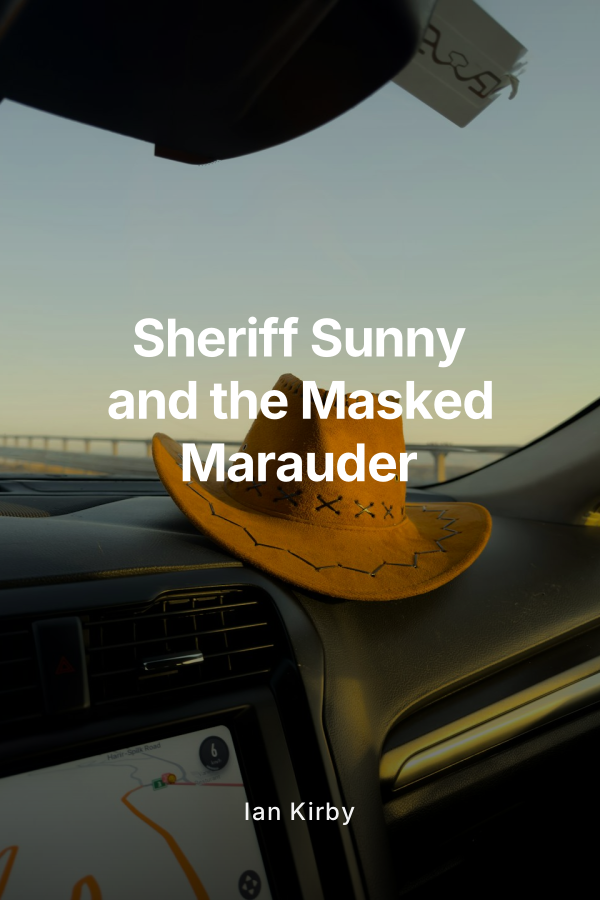
In a sun-baked frontier town that looks small on the map but enormous in its sense of safety, Sheriff Sunny keeps the peace with a tin star, a pair of silver six-shooters, and her late father's oversized overalls pulled proudly over her small frame. The folks of Gumdrop Gulch sleep easy because their sheriff never backs down from a gunslinger, a rustler, or a rattlesnake with an attitude. To them, she is fearless. To herself, she tries to be. Under the red hot western sky, this single chapter story begins as a slapstick romp and gradually turns into an unexpectedly tender tale about humiliation, apology, and the slow, private work of healing.
When every last carrot disappears from the town gardens, Sunny treats it as just another case. Carrots are not gold or cattle, but the theft has hit a chain of nearby settlements, and it threatens the town’s sense of order. Rumors swirl about a phantom bandit known only as the Masked Marauder, a trickster who never leaves footprints, only laughter and empty fields. Determined to protect her people and prove, mostly to herself, that her badge still means something, Sunny saddles up, checks her revolvers, straightens her star, and rides into the shimmering desert to smoke the Marauder out.
What she does not know is that the Marauder has been watching her from beneath the sand. He is a lean, fast talking desert hare in a bandit mask, a living cartoon who loves elaborate gags and audience asides more than loot. To him, Sunny’s confidence, tiny size, and serious determination make her the perfect straight woman for the greatest prank of his career. He is not out to destroy her, only to knock her down a peg for his own amusement. The book lets us see his playful plotting side by side with her earnest search, so that when the trap finally springs, readers understand both how inevitable and how unfair it is.
The centerpiece of the story is the holdup scene in the desert, where comedy begins to fray into cruelty. Popping up behind her with a carrot pressed into her back like a pistol, the Marauder orders Sunny to "stick 'em up," and to her, the threat feels deadly real. For the first time in her life, a weapon is pointed at her from behind. Her heart stutters. Her arms shoot skyward. The invincible sheriff suddenly feels like a very small person with a very soft back.
Then comes his favorite prop: a ridiculous oversized magnet that obeys cartoon logic. With a twirl and a wicked grin, he starts pulling away everything metal that defines her as the town’s protector. Her guns fly from their holsters, her pockets turn inside out to spill coins, keys, even a cherished family pocket watch that connects her to generations of sheriffs before her. Her belt buckle snaps, her badge rips free, and at last even the fasteners of her beloved overalls strain toward the magnet in a gag that is staged visually as antic slapstick but lands on her like a personal disaster.
In the heat of his performance, the Marauder keeps escalating. Shorn of badge, belt, and heirlooms, Sunny feels stripped of dignity as well. The prank circles closer to the private secret she hides under those overalls: the thick protective diapers she still needs but has never allowed to define her bravery. When they become part of the joke, even only hinted at beneath comedy fig leaves and careful camera angles, the laughter turns poisonous for her. The book refuses to linger on physical detail. Instead it focuses on Sunny’s internal collapse, her shaking knees, her face burning, and the way tears finally spill when she realizes that the one thing she fears most being exposed has become a weapon in someone else’s hand.
That is the breaking point. Sunny does not yell or fight back. She simply bawls, sobbing so hard she can barely breathe, thoughts spiraling through shame, anger, and the sick feeling that maybe she has never deserved her star at all. The scene is still drawn in broad, symbolic strokes, but emotionally it is raw. Only when the Marauder sees that there is no fun left in her, no spark of banter, only a little sheriff crushed under the weight of his joke, does the story pivot.
He hesitates. The magnet dips. The mockery dies on his tongue. In a small but crucial choice, he steps forward, pulls down his bandana, and lets her see his face. The revelation is not about a famous name. It is about the shock of realizing that the faceless tormentor is just a person who believed his own lies about "harmless fun." Sunny, devastated, pounds weakly at his chest before collapsing into fresh sobs. He gathers a towel, wraps it around her like armor, and for the first time drops the prankster persona. The same arms that spun magnets now simply hold a shaking sheriff and murmur apologies into her ears.
The entire second half of the book unfolds in the quiet of the Marauder’s underground home, a burrow that looks comically like a modern bungalow hidden beneath the dunes. Here the tempo slows. The town and its gossip disappear. Sunny is given what she has been denied through the whole ordeal: time, privacy, and care. Still wrapped in the towel, she curls on a real bed instead of a hard bunk, listens as the Marauder awkwardly admits that he is not just a "simple prankster," he is a bully who went too far, and promises to fix everything he took, from her gear to her sense of herself.
Meals, baths, and bedtime stories become the building blocks of trust. He cooks proper food so she no longer has to rush through dusty patrol snacks. He runs a bath and lets the warm water soak away the desert grime and the memory of sand stuck to tear tracks, always asking permission and keeping the mood gentle, even slightly silly, so she does not feel examined or judged. He repairs her badge, polishes her revolvers, and painstakingly rebuttons the overalls that once made her feel connected to her father, making each act of mending an unspoken apology.
At the private center of their talks lies the subject Sunny never dared voice: her diapers. The story gives these scenes time without ever tipping into voyeurism. Through hesitant conversations that mix practical questions about patrol routines with deeper confessions about fear and pride, Sunny slowly explains why she still needs them and how terrified she has always been of being seen as a "big baby in a diaper sheriff outfit" in the eyes of the town. The Marauder, for once listening more than joking, reframes them as just another piece of essential gear. Horses need horseshoes, guns need holsters, and a tiny sheriff who stares down bandits for a living needs protection that lets her stand her ground without worrying about accidents. In a series of quiet, comfortable diaper changes that are described in soft, cartoon simple terms, he proves that her most private vulnerability can be met with respect instead of ridicule.
Humor returns slowly. At first, Sunny is rigid as a board, flinching at any word that sounds like a joke. Over time, the hare’s gentler side and absurd small talk about tumbleweeds and desert stars coax out tiny giggles. Those giggles grow into real laughter once she trusts that the butt of the joke will never again be her body or her needs, only the shared absurdity of the world around them. Their bond becomes a private friendship, not a public spectacle. He does not stage a grand confession in the town square. Instead, he quietly returns the stolen carrots, restores her equipment, and lets her walk back into Gumdrop Gulch with her head high and her story her own.
By the final pages, Sheriff Sunny has her badge, her overalls, and her patrol route back, but she also has something she never expected: a partner of sorts. The Masked Marauder hangs up his mask yet keeps his sharp eyes and quicker wits at her disposal, slipping through burrows and back alleys as an invisible ally. Their relationship stays complicated. He is still a trickster at heart. She is still quick to bristle when he pushes too close to her pride. Yet both have learned the line between a joke and a wound, between exposure and trust.
This one chapter book uses the bright language of cartoons and the rhythm of an old western showdown to explore very human questions. What happens when a prank crosses the line into cruelty. How do you say you are sorry when words feel far too small. What does it mean to accept the parts of yourself you have always called "unmentionable" and to let someone else see them without flinching. Sheriff Sunny and the Masked Marauder answers not with speeches but with scenes of stolen carrots, runaway magnets, towel wrapped hugs, and the soft rustle of a diaper changed with care. It leaves readers with the warm sense that even the most embarrassing secrets can live alongside courage, and that sometimes the bravest thing a sheriff or a prankster can do is simply to be gentle.