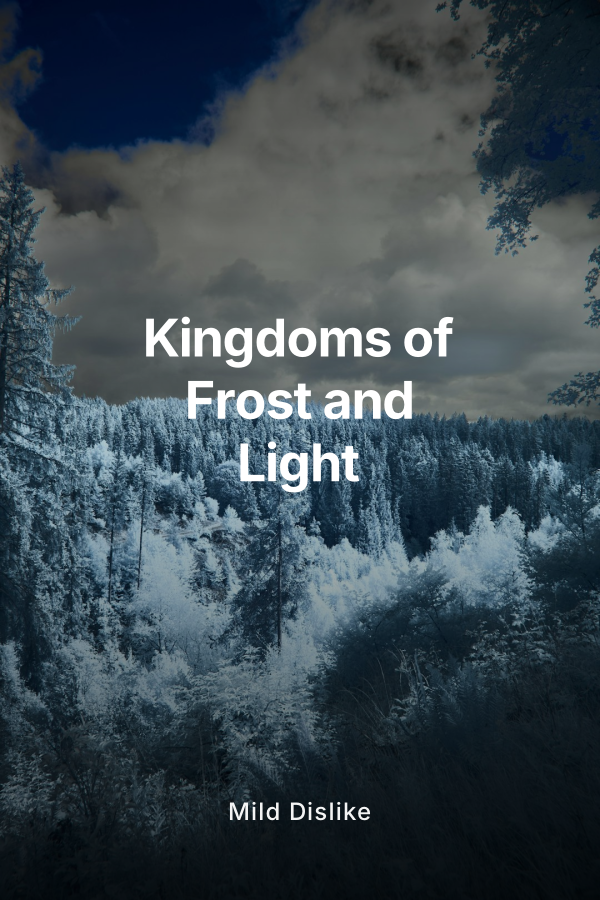
This book is a character-driven fantasy romance that follows two immortal kings whose bond is forged in hardship, deepened in stolen nights, and quietly undone by time, distance, and the weight of their crowns. It traces the arc of their relationship from tentative, private intimacy on the road, through the rise of their kingdoms and the devastation of war, to a final, bittersweet reunion over tea where love is acknowledged, but not reclaimed.
At its heart, the story explores how two good men can love one another deeply and still grow apart, not through betrayal, but through diverging duties and the scars of survival. It is written for readers who enjoy slow-burn, emotionally rich relationships, mutual pining, and quiet heartbreak set against a backdrop of court politics, harsh landscapes, and lingering war.
The narrative unfolds across five broad movements, each corresponding to a chapter of the full book.
Chapter 1: Nights beneath a shared sky
The story opens in the years before either man wears a crown. Pure Vanilla and Dark Cacao travel as companions on a long, grueling journey, facing monsters, harsh weather, and the constant uncertainty of a world in fragile balance. Both are timid, restrained men who have learned to tuck their wants away. Pure Vanilla is gentle, conflict averse, always reaching for kindness first. Dark Cacao is stoic, reserved, slow to speak, his feelings buried under discipline and a warrior’s instinct.
After a particularly intense and harrowing day, the fragile boundary between them finally breaks. In the privacy of their tent, far from watchful eyes and expectations, Dark Cacao takes the risk of initiating intimacy. They stumble into each other with the awkwardness of two people who have wanted this for a long time and never dared admit it. That first night becomes the pattern for many that follow. They steal late hours to blow off the strain of travel, battle, and responsibility, always falling asleep side by side once the tension is spent.
At this stage, what they share is intensely physical yet deliberately unspoken. They are not ready to name what is growing between them. Each believes, in his own way, that this is something temporary, a tenderness afforded only by the road and the uncertainty of tomorrow. The world is dangerous, and the future is a distant luxury. Their intimacy is a pressure valve, a fragile shelter against the weight of their duty.
Yet, in the quiet after, something gentler always takes root. There is a hand that lingers too long, a whispered joke in the dark, the simple domesticity of waking to the other’s sleeping face. Without realizing it, they are building a private world in that cramped tent, one that feels more like home than any city or palace ever has.
Chapter 2: Blessings, crowns, and quiet cracks
Everything changes when they receive their souljam blessings. Immortality reshapes the horizon of their lives and transforms them from wandering heroes into the architects of nations. The shared tent gives way to divided paths.
Pure Vanilla’s kingdom rises first, a place of light, hospitality, and healing. His court becomes the crossroads of nations, a neutral ground where elites gather and conflicts are soothed before they ignite. Because of his unfailing kindness and gentle authority, he is constantly called upon to mediate disputes and calm egos. Meetings consume his days. Diplomats, nobles, and petitioners occupy his time from dawn to dusk.
He leans into this role with everything he has. Pure Vanilla is a consummate people pleaser, always volunteering, always stepping in. He quietly takes on the boring, burdensome paperwork of governance so that his officials can return home early to their families. In his view, their time is finite, while his has been stretched unnaturally long by immortality. This makes self-neglect feel like a duty. He never asks for help, never wants to burden anyone. When he is not in meetings or at his desk, he is in the hospitals, sleeves rolled, tending to the sick and wounded himself. His kingdom sees a king who is always present, always giving, always gentle.
Dark Cacao remains by his side through these early years of rulership. While Pure Vanilla shapes policy and peace, Dark Cacao stands as his unspoken support, a looming, steady presence who has not yet assumed his own crown. In the pockets of time between audiences and councils, they continue their intimacy in stolen moments, late at night, or behind closed doors. Here, in the quiet margins of statecraft, their physical connection begins to braid with something deeper. Affection emerges more openly in the way they speak to each other, in the trembling care with which they share rare moments of rest.
But the first cracks in their private world appear as their obligations multiply. Sleep becomes a luxury; shared nights, rarer. The tenderness between them is increasingly forced to compete with duty, and little by little, duty wins.
Chapter 3: A kingdom in the mountains, a marriage in the snow
Eventually, Dark Cacao leaves to found his own kingdom in the far, frozen mountains. The setting is unforgiving, and it shapes both his rulership and his spirit. His people live under constant threat from hostile creatures that prowl the surrounding wilds. The terrain is treacherous. Snow and ice dominate the landscape, and the winter’s cruelty is a year-round concern. Supply lines are fragile, easily cut off by storms or raids. Communication with the wider world is unreliable, the kingdom perched so high that news travels late, if at all.
In this harsh environment, Dark Cacao becomes the fulcrum of his people’s survival. He trains warriors relentlessly, building a disciplined force capable of protecting their precarious haven. Here, softness feels like a luxury he can only sometimes afford. The king must be iron so that his people can live at all.
While Pure Vanilla is surrounded by courtiers and diplomats, Dark Cacao lives in a world of drills, patrols, and strategy meetings held in cold halls at dawn. What they share slowly reduces to letters that arrive weeks or months late, each man reading the other’s words beneath a different sky, imagining the hand that wrote them.
In time, Dark Cacao marries. This union is shaped by necessity as well as care, a step toward securing an heir and anchoring his young kingdom in hope for the future. Yet happiness remains elusive. His wife dies in childbirth, and he is left alone to raise their son. Grief carves new hollows into him, adding another layer of silence to a man who already struggled to voice his pain.
Meanwhile, in Pure Vanilla’s kingdom, the rhythm of their relationship shifts again. On the rare occasions when duties, weather, and politics align, Dark Cacao visits his old friend’s court. Those visits used to mean nights spent together, the two of them a tangle of need and relief. Now they are compressed into fleeting touches. Little kisses are exchanged on the way to another meeting, a farewell pressed to the corner of a mouth just as an attendant knocks on the door. Their intimacy is not so much ended as eroded. Bit by bit, the physicality that once defined them is worn down by time, travel, and the blunt edge of responsibility. Eventually, those small touches stop as well.
Neither man ever declares an ending. There is no argument, no dramatic admission that they no longer have space for each other. Their bond simply thins into distance until it becomes memory.
Chapter 4: War, vanishing, and a kingdom in ruins
The Dark Flour War erupts, a conflict that stains the continent with loss and reshapes the political landscape forever. Its greatest battle leaves scars on both kingdoms and on the men who lead them. Pure Vanilla disappears in the aftermath, his fate unknown. To most of the world, he is presumed dead.
For Dark Cacao, that presumption becomes a personal certainty. The man he once loved, the companion of his youth and the quiet anchor of his early years as king, is gone. In the choking silence after the war’s crescendo, Dark Cacao retreats further into himself. He isolates from friends and family, withdrawing from what fragile ties remain. The snowbound kingdom becomes fortress and prison both, and its king turns that same double edge inward.
His grief is a private thing. There are no public breakdowns or confessions. Instead, he carries on training warriors, overseeing defenses, and braving the ceaseless winter with an even more rigid sense of purpose. Every monster felled at the kingdom’s borders, every convoy kept safe through a storm, becomes an offering laid at the invisible grave of his absent friend. Grief folds itself into duty until the two are indistinguishable.
Years pass. The world grows used to the idea that Pure Vanilla is a figure of the past, a story from a different age. The Vanilla Kingdom itself lies in ruins, a broken monument to unfinished work and interrupted kindness. In the mountains, Dark Cacao learns to live with a wound that never closes, only weathers.
Then, without warning, Pure Vanilla reappears, alive, in the ruined remains of his old kingdom. This revelation shatters the narrative Dark Cacao has quietly built to survive his mourning. The relief is immediate and sharp. The man he buried in his heart has not been lost after all. But layered atop that relief is anger. He has done the hard, brutal work of grieving, reshaping his life around an absence that turns out not to be permanent. He is furious at being asked, implicitly, to rearrange himself yet again.
For Pure Vanilla, survival has come at a price. His first instinct is not to reclaim lost love or dwell on what might have been, but to repair what he can. His priority is to rebuild his shattered kingdom and reestablish contact with the other ancient powers. The world is fragile, and his sense of obligation has only intensified with his return. Where Dark Cacao’s grief hardened into solitude, Pure Vanilla’s experiences deepen his conviction that he must keep giving more of himself.
Chapter 5: Tea, memory, and the kindness of letting go
The book draws to its quiet, piercing close with a reunion that remembers their past without attempting to revive it. They meet again, now as kings who have endured wars, losses, and decades of separation. The setting is intimate and deliberately gentle. There is tea between them, not steel, and the distance across the table feels at once small and impossible to cross.
They do not touch.
This restraint is not born of disgust or shame, but of a shared, unspoken understanding. They have lived entire lifetimes since their nights in the traveling tent, since their early years in Pure Vanilla’s kingdom when their greatest worry was squeezing an hour together between councils. The paths they chose, the people who relied on them, and the ghosts they carry have changed them into men who can look back at their shared past with tenderness, but not step back into it.
In conversation, Dark Cacao acknowledges their earlier time together directly. The book treats this moment as a quiet act of courage. For a man of his reserve, naming the relationship at all is an extraordinary vulnerability. He does not cheapen it with apology or bitterness. He simply gives their history its rightful place in their story, instead of leaving it forever as something half buried in innuendo and silence.
Pure Vanilla, in turn, admits that what they had was good and real while it lasted. He does not try to romanticize it into something it was not, nor does he minimize it. For perhaps the first time, he allows himself to voice his own version of their memories without immediately deflecting into worry for others. There is kindness in this, a recognition that their shared past deserves to be seen clearly rather than edited down to something convenient.
They speak as old companions who have finally earned the right to be honest with each other. The conversation touches, in subtle or implied ways, on the life Dark Cacao built in the mountains, the son he raised alone after his wife’s death, the long years of frozen vigilance. It brushes against Pure Vanilla’s endless service, his exhaustion, his inability to stop giving even when it costs him. They share small jokes about their “tent days,” hints of the intimacy that once thrived between them, and let the laughter die naturally into a silence that is, for once, comfortable.
The romance does not rekindle. There is no last-minute decision to run away together, no impulsive kiss that breaks the spell of realism the story has woven. Instead, they part with a mutual, quiet respect. What remains between them is not a love story cut short, but a completed one.
In the end, the book is not about a grand, sweeping union that conquers all obstacles. It is about the softer, more complicated courage it takes to hold love, lose it, mourn it, and then, when fate offers a second chance, to acknowledge that the people you have become can no longer live the life you once dreamed together.
The full narrative deepens each of these stages with intimate scenes, political tensions, emotional aftercare, and nuanced internal monologue. It offers readers a portrait of two men for whom love was real, transformative, and yet ultimately unsustainable in the shape it once took. Their story is a testament to the power of shared history, the dignity of unspoken grief, and the grace of letting a great love rest where it belongs: not revived, but remembered.