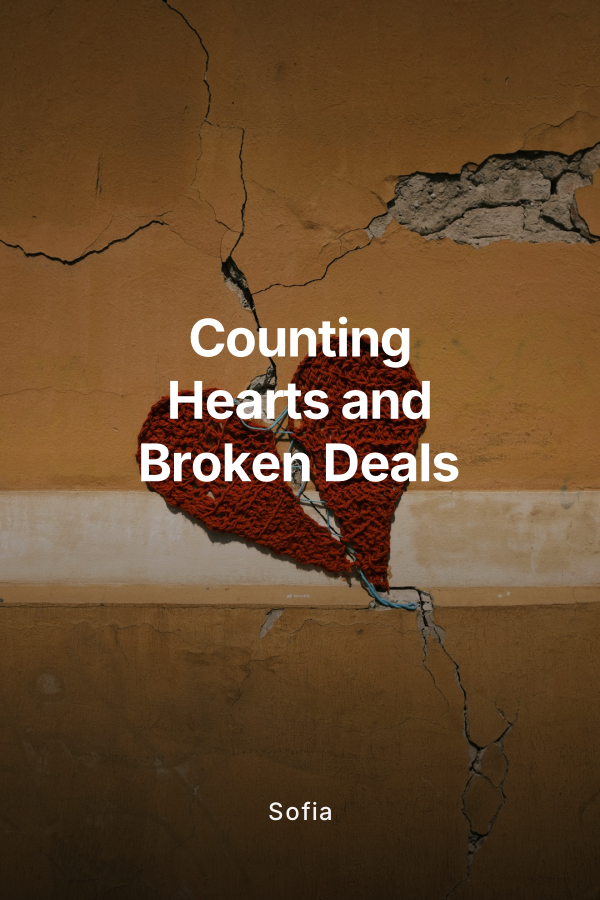
This book follows a gentle, emotionally charged love story that begins with softness and safety, then bends slowly toward a painful, realistic ending. The heart of the story is a girl caught between two boys who shape her understanding of love, security, and sacrifice: a shy, card‑loving boy who offers warmth without wealth, and a rich boy who can give her everything except peace of mind. The novel is built as a sweet romance for readers who enjoy tenderness, longing, and small, intimate moments, yet are willing to follow the heroine into a bittersweet, depressing conclusion where comfort wins over true feeling and the cost of that choice quietly haunts her.
The heroine begins as an ordinary girl in a community where money and reputation speak louder than feelings. She meets the shy boy first: a quiet, observant soul who loves collectible cards, strategy games, and idle afternoons in corner shops where time seems to pause. Through him, she discovers a kind of happiness that feels small but real, made of shared jokes, handmade gifts, and long, awkward conversations that make her secretly glow. Their romance is sweet because it grows without grand gestures. The boy’s world is not glamorous, yet with him she learns that being seen and understood can feel richer than any bank account.
The rich boy steps into her life with shine and certainty. He counts his money in front of the shy boy, a habit that shows both his arrogance and his deep identification with wealth and status. To the heroine, he is at first an outsider to her quiet joy, but soon he becomes a symbol of everything her family insists she must want: stability, connections, access to a world where worries about rent and bills never shadow the dinner table. His presence begins to unsettle the balance. Where the shy boy teaches her joy in simplicity, the rich boy teaches her how heavy expectations can feel when wrapped in privilege.
The emotional conflict deepens as family and culture press in. Her parents see the shy boy not as a person but as a risk. They fear poverty, gossip, and the shame of turning down an advantageous match. Their pressure is not always loud or cruel. Sometimes it comes as gentle lectures about practicality, subtle comparisons, tears about all they have sacrificed. Other times it hardens into emotional blackmail or the unspoken threat of disownment if she refuses the rich boy’s proposal. The heroine’s inner world fractures between loyalty to her own heart and loyalty to the people who raised her.
Throughout the story, the sweetness does not disappear; it changes shape. Even as circumstances grow more difficult, the narrative lingers on quiet moments and small, tender details. Memories of the card‑loving boy remain threaded through her days, like soft echoes she cannot fully silence. The rich boy is not a simple villain either. His love is real, but it is tangled with pride, image, and the need to prove that money can solve anything. This complexity keeps the romance from turning into melodrama. Instead, the tone remains gentle and reflective, with sadness emerging slowly rather than exploding all at once.
The turning point arrives when she finally accepts the rich boy and cuts the shy boy off completely. This is not a sudden, arbitrary decision. It is built scene by scene through arguments at home, glimpses of the shy boy’s financial struggles, and the suffocating promise that life with the rich boy will protect her family from hardship. By the time she chooses, the reader can see how cornered she feels. The breakup with the shy boy is quiet, almost understated, which makes it hurt more. There are no dramatic speeches, only a sense of something precious slipping away because the world around them is too demanding.
The second half of the book explores her married life with the rich boy. Outwardly, she has everything: beautiful clothes, a comfortable home, a place in high society. Her parents are relieved, her neighbors approving. Yet inside she drifts into depression. The narrative focuses on the contrast between the life she lives and the one she keeps replaying in her mind. Small triggers bring back memories of card games, laughter in cheap cafés, and simple plans that once felt enough. The rich boy still counts his money, still measures his worth in numbers, and although he cares for her, he cannot understand the shape of the emptiness growing inside her.
This is not a story of rebellion after marriage. She does not run away, cheat, or stage a dramatic confrontation. Her tragedy is quieter. The book’s power lies in showing how a person can remain physically safe yet emotionally unmoored when they betray their own heart to satisfy external demands. Readers watch her go through the motions of her new life, performing the role of the perfect wife while feeling increasingly invisible to herself. Her depression is portrayed with nuance: not as constant tears, but as numbness, a fading of color, a pain that hides beneath polite smiles.
By the end of the novel, the sweetness of the early chapters becomes almost painful to remember, both for her and for the reader. Those memories serve as a bittersweet contrast to her present reality. The conclusion is intentionally depressing, not because misfortune randomly strikes, but because it reveals how a series of “reasonable” compromises can lead someone far away from who they truly are. The final scenes do not promise redemption; instead they offer a quiet, haunting recognition that sometimes the worst wounds are self inflicted under the weight of love, duty, and fear.
This book is written for readers who appreciate soft, character driven romance that does not rely on high drama yet still delivers deep emotional impact. It examines class difference, family pressure, and the complex ways money can shape relationships without reducing any character to a simple stereotype. The shy boy’s cards and the rich boy’s money counting serve as recurring symbols of two competing visions of life: one built on shared moments, the other on measurable success. The heroine’s journey through these worlds invites readers to consider what they themselves would choose, and what price they might pay.
Ultimately, the story of Counting Hearts and Broken Deals is a tender yet unsettling reflection on love and regret. It starts with sweetness, moves through difficult choices shaped by culture and family expectations, and ends in a subdued, realistic sadness. The lingering impression is not rage or shock, but a soft ache, as if the reader has watched a delicate flower bent slowly in the direction of the strongest wind until it can no longer stand upright.