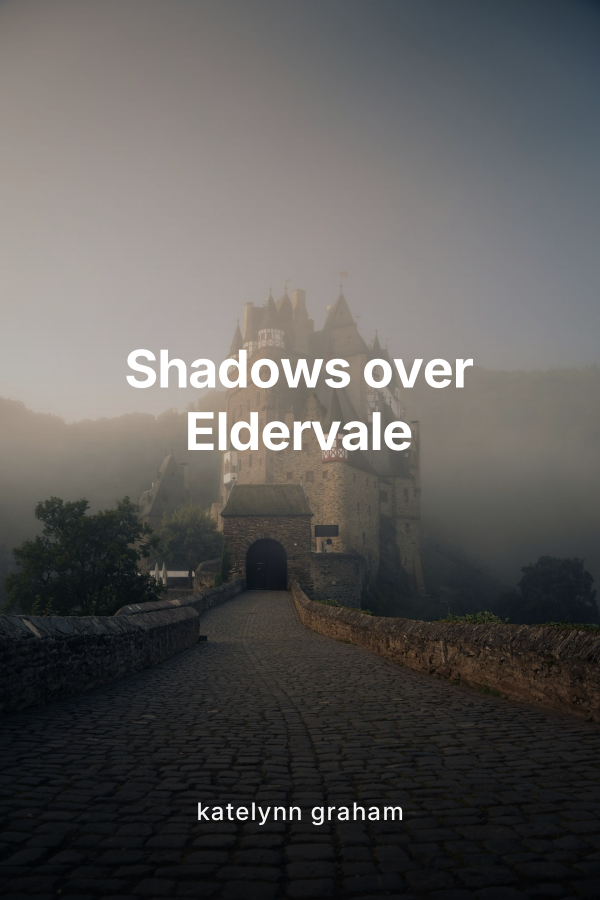
This book follows a young hero in a besieged fantasy kingdom where friendship, prophecy, and power collide. At its heart is a single, haunting question: what separates a savior from a tyrant when both are born from betrayal?
The story centers on a teen protagonist who grows up hearing whispered tales of the Dark Lord of the northern castle, a once‑noble champion who turned against the kingdom after being betrayed by a trusted friend. That ancient treachery shattered the realm and reshaped its history, leaving behind a legend twisted into a warning. In taverns and training yards, older warriors recount fragments of the story, never quite agreeing on what truly happened, but always returning to the same lesson: trust can be a weapon, and no heart is safe from it.
As the book opens, our hero’s world has not yet burned, but the smoke is drifting closer. Skirmishes flicker along the borders, strange sigils appear near the northern roads, and rumors spread of the Dark Lord’s forces gathering under a single, terrifying banner. The teen and his small circle of friends share dreams of becoming knights and protectors of Eldervale, yet none of them fully understands the darkness moving against them, or the old wound that still bleeds beneath the kingdom’s calm surface.
The first chapter introduces the fragile peace of Eldervale and the dynamics within the group of friends. Their bonds feel unbreakable, but almost immediately the narrative begins to lay subtle cracks. A chance encounter with a wounded veteran hints that the famed villain was once a boy much like the protagonist, and that his descent into cruelty began not with ambition but with a shattered friendship. This mirror between past and present becomes the emotional spine of the book, setting up an uneasy parallel between the young hero and the enemy he is destined to face.
As the conflict escalates, the protagonist is drawn into the king’s wider plans to resist the northern threat. During a key mission outside the safety of the village, he faces one of the Dark Lord’s finest fighters, a ruthless champion whose loyalty is unquestioned. Their duel becomes the defining turning point of the hero’s youth. Outmatched and pushed beyond his limits, the teen brushes the edge of death. In those desperate moments he confronts his own fear, his inadequacy, and the brutal reality that heroism is not a story told by bards, but a choice made on a blood‑slick field.
This near‑fatal encounter leaves more than scars. It inflicts a wound that is physical, emotional, and symbolic. The injury marks him in ways that older knights recognize and fear, because they have seen others take this path and return changed or not at all. Night terrors, new doubts, and flashes of paralyzing memory during later battles threaten to unravel his resolve. The book uses this trauma to explore the lingering cost of violence and the difference between necessary courage and reckless valor. At the same time, hints slip through that the villain’s top lieutenant knows far more about the boy than he should, dropping cryptic remarks that suggest a hidden bloodline or secret history tying the protagonist to the castle in the north.
Parallel to the hero’s journey, the story gradually unveils the villain not as a distant, faceless monster, but as a man trapped in the aftermath of his own betrayal. On storm‑lit ramparts and in empty war rooms, he relives the moment his closest friend turned against him, and each new conquest is shaped by that old wound. He punishes anyone who shows even a glimmer of disloyalty. He executes followers who remind him too closely of that lost companion, and he reshapes his forces into a hierarchy where fear is the only true currency.
Throughout the middle chapters, the protagonist uncovers more of this backstory, piecing together secondhand tales and half‑buried truths. These revelations blur the line between hero and villain. The boy begins to understand that he is walking a path the Dark Lord once walked, with the same ingredients: trust, ambition, pain, and the intoxicating pull of power. Within his own circle of friends, doubts and misunderstandings mount. A rash decision, a concealed secret, or a moment of self‑preservation threatens to echo the ancient betrayal that birthed the tyrant in the north. The tension rides on a knife’s edge: will the hero let bitterness and mistrust shape him into the very thing he is trying to destroy?
By the time the final chapter arrives, the war has torn villages apart and driven Eldervale to the brink. The protagonist manages, at last, to reach the heart of the enemy realm. In a fraught confrontation that is more revelation than simple victory, he ascends to the highest tower of the Dark Lord’s castle. There, he does not find a roaring conqueror surrounded by courtiers, but a solitary figure looking down on a smoldering village, utterly alone in the height of his power. The air is heavy with smoke from half‑burned homes, the distant echo of drums, and the circling of ravens over ruined fields.
This culminating scene crystallizes the book’s central theme. The villain, victorious on the surface, has become a prisoner of his own revenge. In a chilling exchange with the young hero, he makes it clear that defeat in battle will not end what he has set in motion. The kingdom can kill a man, but it cannot easily kill an idea forged from fear and betrayal. As he turns from the shattered view of the village, he delivers a final, unsettling declaration that his plans have only just begun, hinting at deeper machinations and a legacy of darkness that could outlive him.
The book closes on a note of uneasy triumph and unresolved dread. The protagonist survives his ordeal and earns a fragile, hard‑won victory, but he carries forward the knowledge of how easily a savior can become a tyrant when trust is broken and pain goes unhealed. His lingering injuries, both seen and unseen, remind him that the story of Eldervale is not a simple tale of light overcoming darkness. It is the story of how ordinary people, in moments of fear and betrayal, choose who they will become.
Shadows over Eldervale is written for readers who enjoy character‑driven fantasy with emotional depth: teens and adults who want more than spectacle, who crave moral complexity, raw inner conflict, and a villain whose origin is disturbingly human. Across five chapters and roughly ten thousand words, the book explores loyalty, trauma, and the perilous line between justice and vengeance. Each chapter builds new layers of tension and revelation without repeating earlier beats, guiding readers from the quiet unease of the opening pages to the haunting final image of a broken king on a lonely tower and a young hero who now understands how narrow the path of true heroism really is.