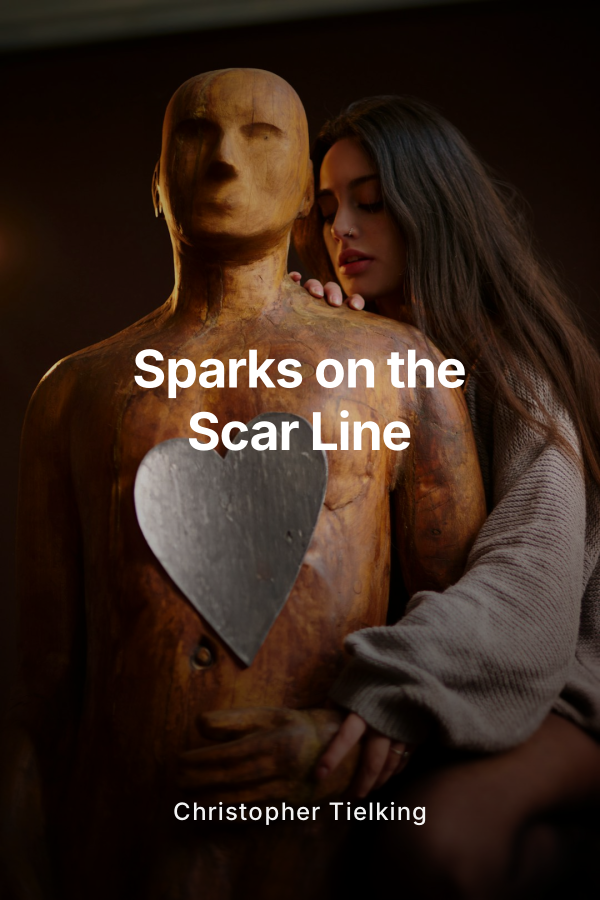
This novel follows Riley and DeWayne, two welders whose bodies carry visible scars and whose hearts carry the kind that does not show. In a small, blue collar community where toughness is expected and vulnerability is whispered about in shadows, they build an intensely private love that speaks in glances, tools, and a code that no one else can read.
Across five emotionally layered chapters, their relationship unfolds from wary attraction into a sanctuary of shared hurt and healing. At the center of their bond is a specific object from the welding shop, a simple tool that becomes their unspoken invitation to intimacy. Only Riley and DeWayne know that when that object is moved, placed, or offered in a certain way, it means “I want you,” a quiet request for closeness that is as erotic as it is achingly tender. That private code lets them desire each other out in the open while remaining invisible to everyone else, turning the workshop itself into a place of secret connection rather than just labor and noise.
The early part of the story traces Riley’s deep discomfort with his own scars. He is stubborn about control, and that includes how much of his damaged body anyone is allowed to see. One of the first turning points is a charged scene where he refuses to take his shirt off until DeWayne does. It is half joke, half shield, a gruff dare that hides terror under a thin layer of bravado. When DeWayne wordlessly peels his own shirt away first, revealing his own network of scars, the air between them changes. Riley’s defenses falter, and the vulnerability in that simple act says more than any declaration of love could. The scene becomes an emotional hinge for the book, marking the moment when Riley begins to imagine that his body might not be something to apologize for.
DeWayne’s response to Riley’s scars is not clinical or detached. He flirts with them. He teases, praises, and worships them until Riley does not know how to brace himself anymore. DeWayne’s flirting is deliberately extra, at once playful and reverent, pressing Riley’s rawest insecurities with such care that they soften rather than shatter. He gives Riley’s scars nicknames, kisses them one by one, and treats each mark as proof of survival, not damage. The emotional stakes spike during a moment when a joke about Riley’s scars turns unexpectedly into careful intimacy. Riley, who is used to bracing for disgust or pity, finds himself laughing instead. His first real joke about his own scars becomes a watershed, and the two of them collapse into shared laughter that dissolves years of self-contempt. That laughter slides into a fierce, gentle intimacy in which DeWayne touches Riley’s scars as if they are sacred territory, teaching him physically what his words have promised emotionally.
Midway through the book, the spotlight shifts more deeply to DeWayne’s inner life. His own scars have always lurked at the edge of his self-image, visible proof of old injuries he covers with jokes and smoke. In one of the novel’s most pivotal scenes, DeWayne catches sight of himself while welding and makes an offhand joke to deflect the sudden punch of shame those scars trigger. The joke lands wrong. Riley hears the hurt under the humor and does not let it slide. That is where the story presses into its most emotionally intense territory. DeWayne wants to stay behind his easy grin and suggestive comments, but Riley gently pushes for honesty. The ensuing breakdown starts either in the shop, where hot metal and sparks echo his past pain, or later in the quiet of home after a long day, when the weight of being “fine” finally cracks. However it begins, the scene is raw and stripped of pretense. DeWayne’s mask fractures, tears briefly cut through the smoke, and Riley becomes the one who offers tender steadiness. What follows is not sex as distraction but intimacy as comfort, a careful, reassuring connection that treats DeWayne’s body with the same reverence he has lavished on Riley’s. The book frames this scene as one of the most emotionally intimate moments of the entire story, a mirror and answer to the earlier shirtless dare.
The private object code threads through these milestones, evolving as their relationship deepens. At first, it is a risky inside joke between coworkers flirting too close to the edge of exposure. As they grow more serious, the code becomes a lifeline on hard days, a silent promise that one of them is ready to hold the other without needing explanations. Later, the code expands beyond sex to mean “I am here” and “I see you,” turning a simple tool into a language of devotion. In the final chapters, the way they use that object reflects how far they have come, shifting from secrecy born of fear to privacy chosen for the sweetness of having something that belongs to them alone.
Set against the background of labor, noise, and the constant risk that comes with their trade, the novel explores themes of masculinity, body image, and the courage it takes to let another person look at the parts you most want to hide. Riley’s growth is slow and stubborn but profound, moving from rigid self loathing to a fragile, then fierce, acceptance that he is desirable not despite his scars but with them. DeWayne’s arc cuts in the opposite direction. He starts as seemingly effortless, all swagger and shameless flirting, only to reveal the ways he has used charm as armor. Their relationship becomes an exchange of bravery. Riley learns to soften. DeWayne learns to be seen.
Across five chapters, the book promises:
- Tension filled beginnings where two scarred men test each other’s boundaries and banter their way into a dangerous chemistry.
- A blooming intimacy defined by jokes that almost hurt, by deliberate flirting with scars, and by the introduction of their secret object code as a quiet, potent signal of want.
- A midpoint of trust where Riley finally laughs at his own scars and lets DeWayne touch him with unguarded tenderness, transforming shame into desire.
- A mirrored descent into DeWayne’s buried pain, culminating in the welding shop scene where humor cracks and Riley offers profound emotional and physical comfort, deepening their bond.
- A hard won, deeply sensual resolution in which both men claim their bodies and each other without apology, their private code intact yet no longer powered by fear, but by chosen intimacy and mutual pride.
Lyrical, intensely character driven, and rich with heat that never exists apart from emotion, “Sparks on the Scar Line” is a story about what happens when two men who thought they had to be unbreakable discover that true strength lives in the places they once tried hardest to hide.