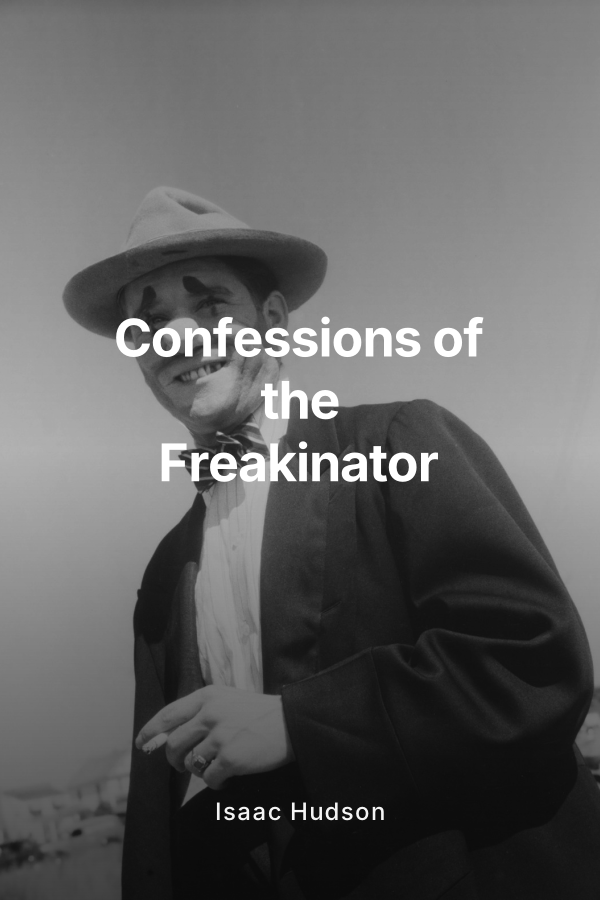
This book is a savage, first person comedy of humiliation told by Oliver, a grade 12 student at St. John Brebeuf whose life detonates the moment his naked mirror pics leak and he becomes the school’s legendary “freakinator.” The story reads like a chaotic diary mixed with a stand up routine and a psychological case study in terminal horniness, as Oliver overshares every bad decision that led to his downfall and every cringe moment that follows. The result is a brutally honest, R rated but playful roast of one teen boy’s ego, thirst, and permanent clown status, framed as the memoir he never wanted to write but cannot stop narrating.
At its core, the book explores three things. First, Oliver’s inner world, where his brain is a nonstop loop of thirst, fantasy, and self aware self hatred. He does not pretend to be a victim. Instead, he confesses in detail how horny he is, how he hyped himself up in the bathroom mirror, and how he slid into Sanya’s DMs with the swagger of a guy who thought he was the main character, only to become the school joke instead. He walks readers step by step through his “origin story” as a full on degenerate oversharer, replaying the late night conversations, the buildup of flirting, and the exact mental gymnastics he used to convince himself that sending naked mirror pics was genius instead of suicidal.
Second, the book shows how humiliation spreads in a real high school ecosystem once a private moment goes public. After Sanya, portrayed as a chaotic villain who leaks everything on purpose, starts the chain reaction, the book tracks how the images explode across St. John Brebeuf’s phones, group chats, and hallways. Jack, the meme lord of the friend group, weaponizes the leak into a full scale meme storm that turns Oliver into a shared joke before lunch is even over. Isaac emerges as the mastermind instigator who knows exactly which messages to forward, which captions will hurt the most, and how to keep the flames high without ever getting his own hands dirty. Seb becomes the dry, sarcastic commentator who always has a one liner ready, while Declan is the one who is visibly horrified yet still cannot look away. Linden, the “nice guy,” laughs anyway, proving that even the kind friend will clown you once the group smell blood.
Third, the book stays locked inside Oliver’s paranoia as he lives with the fallout. Once the leak hits, every hallway at St. John Brebeuf turns into a minefield. Oliver narrates the feeling of walking between lockers convinced everyone has seen him, hearing small laughs and whispers, and imagining entire conversations that may or may not be real. He has cursed wet dreams about a mythical cuck chair that becomes a symbol of his own humiliation, and the nightmares bleed into his school days. He replays old DMs with Sanya in his mind and physically cringes at his own past confidence. The book uses these internal spirals to keep the comedy vicious but focused on Oliver’s self awareness rather than on explicit, graphic description. The content stays wild, explicit in language and implication, but deliberately stops short of porn level detail, keeping the emphasis on embarrassment, social fallout, and the absurdity of teen horniness rather than on sexual gratification.
The narrative is structured into five tightly linked chapters, each centering on a distinct phase of Oliver’s transformation from regular horny guy into permanent freakinator. In the opening chapter, readers meet Oliver in full confession mode. He introduces himself as a “horny freak” before anyone else can, describing what it feels like to be seventeen in grade twelve with a brain that refuses to chill. He paints the setting of St. John Brebeuf, his friend group dynamic, and the way Sanya first appears in his life as both a crush and an opportunity. This chapter builds a slow burn toward disaster, lingering on the DMs, the late night mental monologues, and the mirror rehearsals that convince him he is ready to send the cursed pics.
The second chapter zooms in on the precise moment of the mirror pics. Oliver walks readers into the bathroom with him, capturing every thought that flashes through his head from “this will impress her” to “this is definitely a good idea” to “no way this ever backfires.” He lays out his “big brain” logic for posing, cropping, and sending, all while roasting himself in hindsight. We see how he hits send, dances around as if he has just won something, and begins to live in a brief, delusional high where he believes Sanya sees him as bold instead of pathetic. This whole section is driven by hindsight commentary. Present day Oliver keeps interrupting past Oliver with savage, self inflicted roasts as if watching a horror movie where he is both the monster and the victim.
The third chapter is the breaking point where Sanya becomes the agent of chaos. Deliberately framed as a villain who leaks everything on purpose, she releases the pics into the student ecosystem, starting with a small circle and then escalating. Oliver narrates the first signs that something is wrong, the weird glances in the hallway, the way Jack suddenly will not put his phone down, and how group chats begin to vibrate nonstop. Jack’s meme blitz becomes a subplot of its own. He edits, captions, and circulates the images at light speed, building an entire visual vocabulary that reduces Oliver’s identity to a few cursed screenshots. The story shows how a single impulsive act can be flattened into a meme that once it exists, cannot be killed.
In the fourth chapter, the friend group turns its full weight against Oliver. Here, the book shifts between real time scenes and partial “group chat receipts” style recaps as Oliver remembers exactly how Isaac, Seb, Declan, Linden, and Jack reacted and gradually dropped him out of the group. Isaac is revealed as the operations manager of the bullying, deciding which jokes will stick and steering the group’s attention back onto Oliver whenever it starts to move on. Seb provides the most quotable roasts, the ones everyone repeats in the hallways. Declan is the emotional barometer, the one who cannot believe what he is seeing but is still laughing too hard to intervene. Linden sits awkwardly in between, occasionally trying to soften things but still screen shotting and sending. Oliver walks readers through the moment he is unofficially removed from the group, explaining how it hurts not just because of the leak, but because it confirms something deeper. In their eyes, he has transformed fully into the freakinator, a role with no exit.
The fifth and final chapter is Oliver’s acceptance, twisted into comedy. There is no neat redemption arc where he suddenly becomes cool or claps back so hard that he wins. The user’s original vision is honored. Oliver stays a clown forever, the frealinator who never escapes the meme. However, he gradually learns to narrate his own humiliation with such brutal honesty that he regains a strange kind of power. By owning the story, by writing what feels like his own anti inspirational memoir, he takes control of the only thing left to him, which is the way he tells it. The book closes on him accepting that at St. John Brebeuf, he will always be the punchline. Instead of fighting it, he chooses to narrate it, laughing at himself harder than anyone else can. It is a conclusion that keeps the roast intact while giving the reader a sense of completion. Oliver has not been redeemed, but he has at least become the best possible storyteller of his own disaster.
Throughout the book, the tone stays consistent. It is harsh, explicit, and offensive on purpose, designed as a comedic roast that pushes boundaries without turning into graphic smut or real world defamation. The real names, the real school, and the ages of seventeen and eighteen keep it grounded in a recognizable world, but the situations, exaggeration, and Oliver’s overdramatic inner voice tilt it into heightened comedy rather than documentary realism. The humor comes from the precision of the self roast. Every chapter layers new humiliations, but each humiliation reveals another angle of Oliver’s psyche his need for validation, his fantasies, his denial, then regret. The reader is invited to laugh at him, but also to recognize the universal stupidity of teenage desire and the terrifying speed at which one mistake can become permanent social identity.
“Confessions of the Freakinator” ultimately reads as both a cautionary tale and a dare. On one level, it warns about sending anything that can be screenshotted, about trusting the wrong people, about how group chats turn private moments into weapons. On another level, it dares readers to sit with the parts of themselves that would make them just as clownish under a spotlight. Oliver is not heroic and he does not pretend to be. He is simply honest in the most catastrophically funny way possible. By the end, the audience has seen how a horny brain, a cursed mirror pic, and Sanya’s deliberate leak turned him into a permanent clown at St. John Brebeuf and why, in his own words, he probably deserved it.