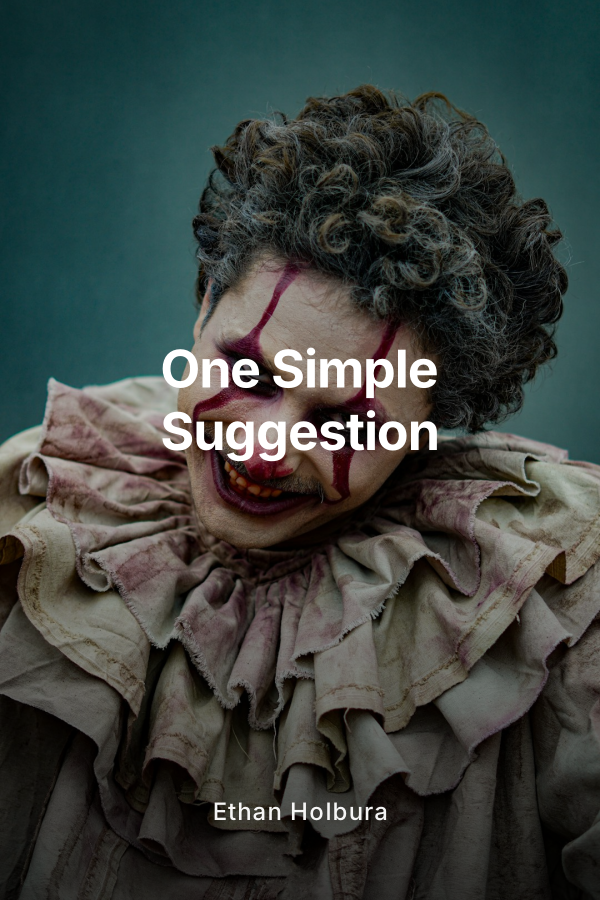
In a quiet neighborhood that looks like every other, three men are drifting through their own private disappointments. Patrick is twenty five and already dangerously bored with how easily people fall in line when he nudges them in just the right way. Ben is forty, a single dad who secretly believes he has failed at raising his son the “right” way. Beni is twenty, caught between being someone’s kid and being his own man, furious at the idea that anyone still gets to tell him what to do. Their lives should only overlap for a weekend barbecue and some awkward small talk. Instead, they become locked into a twisted experiment where one simple suggestion can rewrite what feels normal, what feels deserved, and what feels unforgivable .
The story centers on Patrick’s strange gift. He does not control people with glowing eyes or magic spells. He just knows how to phrase things. A word here, a reminder there, a casual “you know what would really help” slipped into a conversation. It feels like nothing, like being persuasive or reading a room well, until he realizes he can get people to make choices they never would have considered on their own. What starts as a quiet thrill grows into an obsession. Patrick wants a real challenge, someone who does not immediately fold. He finds that in Ben and Beni, a father and son who are already barely holding their relationship together.
Ben is the type of dad who has always tried to be fair instead of strict. He carries a long list of parenting regrets around in his head, even if he never says them out loud. When Patrick walks into his life, Ben is tired of feeling like the “soft” parent who gets walked over. Patrick notices that insecurity and circles it like it is blood in the water. He tells Ben that kids need structure, that consequences are proof of love, that discipline is what separates good parents from cowards. None of that sounds dangerous. It sounds like advice from a friend. The danger is in what Patrick suggests as “tough but necessary” disciplinary steps, private punishments that slowly drift from uncomfortable to inappropriate while Ben keeps telling himself he is just doing what a real father should.
Beni has always been stubborn. He is twenty, old enough to roll his eyes at lectures about respect yet still stuck under his father’s roof. He feels cramped by house rules, judged for every choice, and way too aware that Ben does not fully see him as an adult. From the first moment Patrick shows up, Beni hates how quickly his dad laughs at Patrick’s jokes and how eagerly he takes Patrick’s advice. There is something off about this guy. Patrick always says exactly the thing that gets Ben to back down or step up or apologize, and it feels rehearsed in a way Beni cannot explain. He cannot put a name to mind control, so he calls it manipulation and makes it his mission to resist.
Chapter One follows the slow tightening of this triangle. Patrick tests the limits of what he can make Ben do in the name of punishment. It starts with small humiliations, the kind of embarrassing “lessons” a parent might justify as no big deal. Stay in this room. Keep your eyes on me. Do not look away until I say so. The point is supposed to be discipline, to make Beni feel consequences. Instead it creates thick, charged silences and a level of forced intimacy that neither father nor son knows how to process. The language stays vague, wrapped in phrases like “you need to learn” and “this is for your own good,” but the emotional impact hits like a punch.
Inside Ben’s head, everything is noise. He hears Patrick’s calm suggestions threaded into his own fears about losing control of his household. Caught between wanting to be respected and terrified of being a bad father, he accepts each new step a little too quickly. Every time he doubts himself, Patrick is there, quietly reinforcing the idea that boundaries can be pushed as long as the goal is to “fix” Beni. Ben begins to see his son’s discomfort not as a red flag but as proof that the punishment is working. That twist, turning compassion into fuel for harsher discipline, is what lets Patrick keep pushing.
From Beni’s point of view, the house stops feeling safe long before he understands why. His dad’s eyes look different when he delivers these new rules, not empty exactly, just distant, like he is reading from a script. The punishments cross lines Beni never expected his father to cross. They are personal. Close. Wrong in a way that he feels in his chest and his gut even when there are no obvious bruises. He starts to suspect that Patrick is the one pulling the strings, using his dad as a mouthpiece for something darker. That suspicion turns resistance into survival.
The more Beni pushes back, the more interesting Patrick finds him. Up until now, Patrick’s life has been a string of easy wins, people who blame their own choices instead of realizing they were nudged. Beni is different. He questions. He glares. He tries to mentally brace himself whenever Patrick is near, clinging to his own sense of what is right. That stubbornness does not repel Patrick, it attracts him. Here is someone who might finally force him to sharpen his skill. Patrick starts aiming his suggestions directly at Beni, looking for cracks, trying to turn outrage into obedience.
Chapter Two is where the pressure cooker finally explodes. Patrick’s influence has twisted the family’s idea of what punishment can look like. The house holds a thick residue of shame, unspoken scenes that everyone remembers but no one dares to name. Beni decides he cannot keep pretending this is just “new rules.” He confronts Patrick, first with words and then with sheer will, trying to stare him down, trying to catch the moment when the suggestion slips in. It is a dangerous game, because the more attention Beni gives Patrick’s power, the more room it seems to have in his head.
Inside Beni, the battle becomes intimate and terrifying. The thoughts he trusts start to sound suspiciously like Patrick’s language. Maybe this is good for you. Maybe you deserve this. Maybe it is easier to give in. The story tracks that internal fight without ever glamorizing it. Each time Beni feels himself wanting to obey, he has to ask if it is really what he believes or a suggestion wearing his own voice. That tug of war blurs the line between resistance and surrender, consent and control. The punishments continue to escalate in emotional intensity, always framed as lessons, always delivered with just enough care to confuse where love ends and abuse begins.
Ben, caught between them, begins to crack. As Patrick’s influence deepens, Ben has flashes of clarity where he sees his son’s fear and his own behavior in the harsh light of day. Seeing Beni shrink back from him hits harder than any argument could. The guilt is unbearable. Yet each time he thinks about stopping, Patrick is right there, steady and convincing, insisting that quitting now would make everything meaningless, that going further is the only way to make the “training” stick. Ben has to choose whose voice to believe, and the choice will cost him something either way.
The climax of the story is not a fistfight or a dramatic rescue. It is a mental standoff where all three men are forced to look directly at what they have allowed to happen. Patrick finally meets the limit of his power when he realizes that true control is not just getting people to act but getting them to live with what they did. Beni faces the possibility that he has already crossed his own lines by staying silent for so long. Ben is left staring at a version of himself he never thought he could become. The question hanging over them is simple and brutal: is it still you if someone suggested every step that brought you here?
One Simple Suggestion is a dark, emotionally charged story that reads like a psychological thriller wrapped around a family drama. The mind control element adds a speculative twist, but the real tension lives in the very human ways people rationalize harm when it is dressed up as love, discipline, or self improvement. Told in an accessible, present tense voice that rotates between Patrick, Ben, and Beni, the book digs into shame, power, and the quiet ways boundaries erode behind closed doors. It does not shy away from uncomfortable situations, yet its focus stays on the emotional fallout, the cost of obedience, and the fragile possibility of reclaiming your own mind after someone has learned how to speak directly to your doubts.