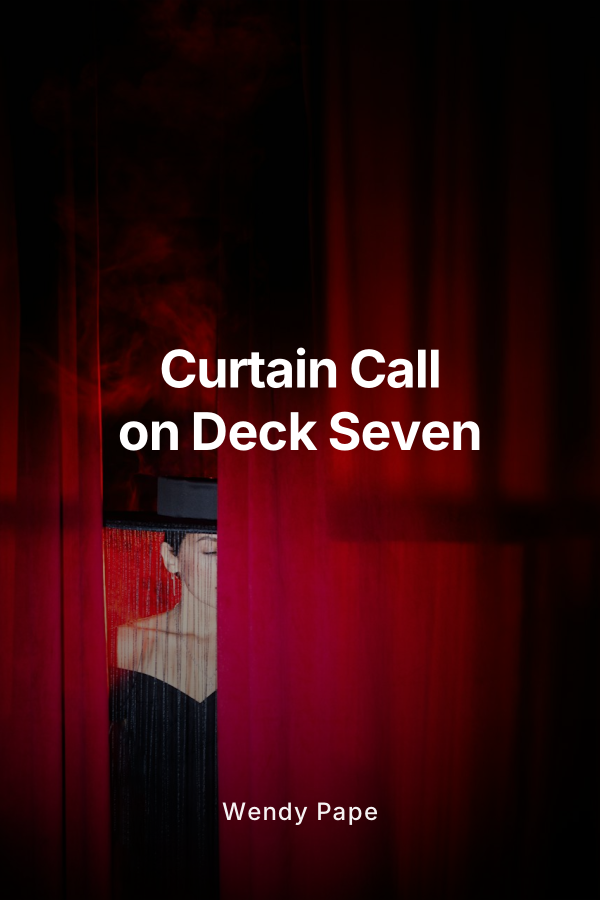
In this comic cruise‑ship thriller, the world of all‑inclusive buffets collides with amateur sleuthing when marketing executive Brad and his hyper‑organized teacher wife Diane return to the high seas for what is supposed to be their most relaxing vacation yet. After their infamous experience with the sabotaged chocolate fountain that once spewed fake blood across a dessert station and turned them into accidental investigators , the couple has convinced friends Wendy and Jeff to join them for a “normal” cruise with zero mysteries attached.
Brad is determined to prove that cruising is still the ultimate carefree escape, even after spending one voyage crawling through maintenance passages to rescue a kidnapped pastry chef and salvage the ship’s reputation. His encyclopedic knowledge of deck plans, show schedules, and behind‑the‑scenes operations has only deepened his love of cruise life . Diane, on the other hand, has quietly channeled her love of lesson plans and color‑coded schedules into something more ambitious. Without telling anyone, she has secretly helped the entertainment team design the ship’s new headline attraction: an immersive, on‑board murder mystery stage show where audience members become part of the investigation.
As the ship pulls away from port, Diane treats every activity like a classroom in need of structure. She builds tidy charts for their shore excursions, lecture notes for trivia, and even a rubric for “optimal buffet strategy,” driving Brad lovingly crazy with her need to make every moment educational. Jeff, the practical problem‑solver of the group, just wants a quiet week with clear safety protocols and no surprises. Wendy, a chaos‑loving drama magnet, is in heaven, dreaming up outlandish scenarios that make every safety drill feel like the opening act of a thriller.
Trouble begins when the murder mystery show has its first performance. Marketed as a tongue‑in‑cheek whodunit, it promises fake crime, slapstick suspense, and an onstage “victim” whose dramatic death is supposed to be played entirely for laughs. What no one expects is that, during a pivotal scene, the key crew member at the heart of the production collapses in a way that looks all too real. The fake murder might not be fake at all.
The line between scripted danger and actual threat blurs in seconds. The audience howls with delight, assuming it is all part of the show. Wendy stands on her seat cheering for an encore. Jeff freezes, counting exits. Brad’s marketing brain notices a dozen tiny inconsistencies in the performance, from mistimed lighting cues to stagehands who look genuinely panicked instead of theatrically shocked. And Diane, who knows exactly how the sequence was supposed to unfold, realizes that something has gone terribly wrong.
When the curtain falls in chaotic confusion and the crew member fails to reappear for the curtain call, rumors race down the corridors faster than the ship’s Wi‑Fi. Some passengers believe they have witnessed a genius piece of immersive theater. Others whisper that a real crime has just been committed at sea. The captain and cruise director scramble to maintain calm, insisting that everything is fine, while quietly locking down backstage areas and restricting staff movement.
Reluctantly, Brad is pulled back into investigator mode, this time with even more at stake. His hard‑won familiarity with the ship’s hidden corners, from service hallways to restricted technical spaces, gives him a head start on everyone else. Diane repurposes her classroom methods yet again, building intricate timelines, suspect lists, and behavioral charts for every cast member involved in the show, just as she once categorized eyewitnesses and clues around the chocolate fountain sabotage . Wendy treats each new piece of gossip like fuel for an increasingly elaborate set of theories. Jeff remains the voice of reason, testing assumptions and forcing the group to double‑check what they think they know.
As the four friends retrace what happened onstage, they discover that the murder mystery production has layers of secrecy baked into it. There are mysterious prop changes, unauthorized alterations to the script, and a stash of stage blood that seems to have been swapped out for something far more convincing. The missing crew member, whose “death” anchored the performance, is nowhere to be found. Security sweeps storage rooms, rehearsal spaces, and even lifeboat stations in search of him, but he appears to have vanished into the maze of decks.
The ship’s leadership can no longer pretend everything is fine. A key crew member might be injured or worse. The onboard rumor mill explodes, turning every shuffle of feet behind a door into potential evidence. Passengers splinter into camps of believers and skeptics. Some insist that a real killer is hiding among them. Others remain convinced that it is an elaborate marketing stunt. Brad sees a looming brand catastrophe if the story reaches the news uncontained. Diane worries that her hidden involvement in the show’s design could make her partly responsible if anyone has truly been harmed.
To complicate matters, Diane’s secret role in planning the event was not limited to offering feedback. She helped map out the timing of entrances and exits, suggested educational spins on interactive clue‑gathering, and even contributed to designing some of the show’s more intricate set‑pieces. Her well‑meaning urge to organize everything may have given the real saboteur a perfect blueprint for exploiting the performance.
The deeper the friends dig, the more they uncover low‑stakes mayhem beneath the ship’s polished surface. Cast members have clashing egos. Stagehands nurse grudges over lost promotions. A few passengers have side‑deals to get “special access” backstage for vlog content. Threads that initially look promising unravel into red herrings, echoing the false leads during their chocolate fountain case, when bizarre theories about vampires and cults ultimately resolved into a cleverly staged act of sabotage by a rival cruise line .
Then the stakes spike. A second performance of the show is scheduled, and the entertainment department is under pressure not to cancel. The missing crew member’s role is quickly recast, which allows the ship to maintain the illusion of control but also multiplies the potential for disaster. Diane and Brad argue about what should happen next. She believes that a controlled environment, with all eyes on the stage, might actually be the safest place to force the culprit into a mistake. Jeff thinks the show should be shut down until everyone is accounted for. Wendy volunteers to sneak onstage mid‑performance “in character” to provoke the saboteur in front of a captive audience.
The night of the second show turns into the heart of the book’s suspense. Midway through a tense scene, the scripted chaos breaks free from the script entirely. One of the main characters is nearly struck by a sabotaged prop, and for a breath‑holding moment it seems certain that someone will die in front of a cheering crowd that still assumes none of it is real. The role in danger is not just another actor. It is a key crew member whose absence would unravel the entire cruise operation, disrupting everything from entertainment to safety drills and passenger management. The tension in the theater is razor‑sharp, even as laughter and applause cover the sound of actual fear in a few voices.
Brad and Jeff, watching from the audience with Wendy, spot what the average observer cannot. A lighting change that should not be possible from the booth. A missing backstage tech whose tasks have mysteriously been reassigned. A prop cue that could only have been altered by someone with inside knowledge. Diane, stuck half backstage in the chaos of headset chatter and panicking crew, realizes that the show she helped design has become a live blueprint for real danger.
The climax spirals into full‑on farce when the captain orders an emergency safety drill right in the middle of the crisis, hoping to regain control of the panicked passengers. Life vests, muster stations, and shouted instructions collide with lingering show energy and rumor‑fueled hysteria. Passengers assume the entire drill is a continuation of the interactive murder mystery. Some pose for selfies in their vests while “accusing” random neighbors. Others chase crew members down hallways, demanding clues.
In the middle of this pandemonium, Brad and Diane’s group pieces together the last missing link. Small oddities in Diane’s schedule, conflicting stories about who authorized specific changes to the performance, and a trail of emails about “testing the boundaries of ship security” point back to someone painfully close to them. The real mastermind behind the staged‑but‑maybe‑real murder is not a stranger, not a rogue crew member, and not a professional criminal. It is someone they trust, who booked the entire murder‑mystery cruise experience and quietly manipulated events from day one.
The final reveal exposes this person as the architect of the cruise’s chaos, someone who secretly arranged the murder‑mystery premise and then helped rig the onstage “killing” to look dangerously real. Their motives are tangled: a mix of frustration with complacent security procedures, desire to outdo the previous chocolate fountain fiasco, and a misguided belief that forcing a crisis would generate a marketable legend about “the cruise that solved its own staged murder.” What began as a controlled experiment in immersive entertainment has spiraled into a near‑tragedy.
Confrontation breaks out right at a muster station, where everyone is supposed to be listening to safety instructions. Instead the crowd is treated to a wild, very public confession that blends shouted accusations, panicked clarifications, and Wendy trying to narrate the whole thing to whoever will listen. Diane, sliding instinctively into teacher mode, grabs a whiteboard meant for emergency diagrams and starts organizing the entire catastrophe into a visual timeline, complete with arrows, bullet points, and labeled motives. Her improvised “lesson” becomes the framework through which passengers and crew finally understand what has really happened.
In the aftermath, resentments flare and then slowly cool. Friendships wobble under the weight of secrets and half‑truths but do not break. The missing crew member is found alive, angry, and in possession of information that implicates the mastermind yet also reveals how improvisation and panic made everything worse. The captain negotiates a delicate balance between disciplinary action, damage control, and a PR opportunity. Brad, defaulting to his natural talent, helps spin the entire incident into a narrative of transparency, resilience, and “interactive safety awareness,” rescuing the cruise line’s reputation even as he privately vows never to solve another onboard mystery again.
Yet the experience also deepens the group’s strange, unlikely calling. Diane sees new ways to teach critical thinking and ethical decision‑making to her students, weaving in stories of how assumptions and overconfidence nearly sank a friendship and a show at the same time. Jeff refines his understanding of risk, realizing that people, not protocols, are often the weakest point in a system. Wendy basks in the knowledge that without her boundless enthusiasm and willingness to act, certain clues might never have come to light.
Curtain Call on Deck Seven is structured in five chapters that each advance both the mystery and the relationships among the four friends. The first chapter reintroduces their dynamic aboard a new ship and hints at Diane’s secret project. The second dives into the world of the murder mystery production and the show’s first disastrous performance. The third follows their escalating investigation as they chase false leads through buffets, lounges, and backstage passages. The fourth delivers the high‑tension second show and near‑fatal “accident” that pushes everyone to their limits. The fifth unravels the mastermind’s plan in a chaotic, hilarious safety‑drill spectacle and then explores the emotional and practical fallout.
Targeted at readers who enjoy light‑hearted puzzles threaded with real suspense, the book blends the cozy familiarity of recurring characters with the confined tension of a ship at sea. It keeps the humor and ensemble camaraderie of the original chocolate fountain mystery while raising the emotional and physical stakes. Through shifting loyalties, mistaken assumptions, and one bold, ill‑conceived attempt to stage the perfect immersive crime, this sequel asks how far ordinary people can bend the idea of “harmless fun” before someone almost gets killed.
Most of all, it delivers what fans of Brad, Diane, Wendy, and Jeff expect: a fast‑moving, clue‑rich romp where lesson plans double as case files, marketing spin borders on damage control, and a cruise vacation once again turns into the strangest classroom on earth.