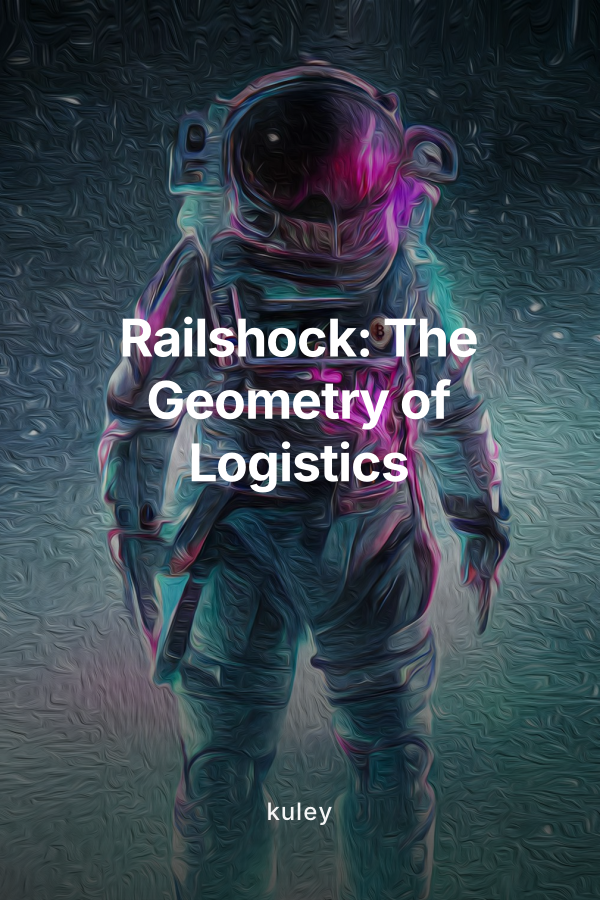
In the rail-choked world of Railshock, the Empire has perfected the art of control not through terror alone but through timetables. Superconducting trunk lines thread through ruined continents, feeding the Skyspire, a kilometer-high nexus where the Heart, an exascale decision engine, continually recomputes the optimal flow of bodies, grain, munitions, and information. Logistics has become a total science and, in its perfection, a pure cruelty. Purge squads of entirely human soldiers like Rake, Lira, Pins, Gale, and Ash are deployed wherever the numbers drift from target, tasked with cutting away any statistical outlier that threatens throughput .
The novel opens on a small, deceptively mundane mission rather than a spectacular battle. Rake and his squad ride a maintenance train along a mid-tier line, escorting replacement actuators and sensor arrays into the Frays, the corroded districts where the Empire’s models are weakest. Here, worldbuilding unfolds at a natural pace: casual exchanges with exhausted quartermasters, the ritual of checking ammo and charge levels against printed manifests, the quiet dread in civilian eyes as the Purge insignia passes through a station. Readers see how schedules, quotas, and statistical tolerances seep into every conversation and gesture, without any expository monologue to explain it. The cruelty of the system is ambient and procedural rather than theatrical.
Within that machinery, the squad remains stubbornly human. Rake is a gifted tactician who genuinely believes that obeying the Heart saves more lives than it costs, yet he privately tracks his casualties as unbalanced ledgers he can never quite close. Lira is his sharpest second and his most persistent conscience, keeping a hidden notebook of the people they could not save and the alternatives the Heart never considered. Pins maintains their equipment with obsessive care and jokes about everything, because it is the only way he can keep his hands from shaking once the numbers are read out. Gale and Ash carry their own scars and coping rituals, from quiet mechanical tinkering to smuggled letters they never send. Ordinary moments of shared food, silent card games, and black humor in cramped cabins let readers connect to them on a human level, even as their work horrifies.
Threaded through these early scenes is rain. In Railshock, precipitation is heavily modeled because it disrupts sensors, corrodes infrastructure, and perturbs the rail network’s delicate timing. Yet in the Frays, the Heart’s models are imperfect. Thin drizzles arrive just as Rake hesitates over a minor rules violation, or as Lira pauses to share a ration bar with a starving child, suggesting that the weather itself falls off-model around acts of unsanctioned mercy. The sensory texture of rain on hull plating, the ion-scent of wet metal, and the flicker of reflections in puddles on forgotten platforms becomes a subtle motif, surfacing only at moments when loyalty or conscience bends away from the Empire’s predicted path.
The first chapter gradually escalates from routine escort to the squad’s initial full Purge operation. An industrial district has fallen outside acceptable variance in its production metrics, and the Heart assigns Rake’s team to “re-shape” its population by isolating and erasing entire blocks from the network. Tactical overlays render neighborhoods as colored flows and nodes, each building a variable in an optimization problem. Rake is ordered to collapse a rail spur that will strand thousands in a contaminated zone. His obedience is professional and exact, but the narration lingers on his sensory experience: the strobing of targeting lasers in thickening rain, the hollow silence after a line goes dark, the delayed screams carried along the rails. What begins as an engineering decision about system stability reveals itself as a mass execution enacted through infrastructure.
In the aftermath, data anomalies ripple through the Heart’s projections. Rebel cells in the Frays have not only survived but anticipated the Purge, evacuating communities ahead of schedule and sabotaging key junctions in ways that cause minimal collateral damage yet produce maximal disruption to the Empire’s throughput. Rake’s unit is redeployed in a series of rapid-response assignments, chasing “statistical phantoms” through side lines and abandoned terminals. Each engagement tightens the knot around a rumor that circulates in tense whispers among officers and dissidents alike: the rebellion is being fed real-time logistics data from inside the Skyspire, perhaps from a high official within the Empire’s own command lattice.
As the second chapter unfolds, the novel shifts from procedural missions to a deep interrogation of systems and agency. Rake begins to notice patterns the Heart does not explain: rerouted trains that create unnecessary exposure windows, purge targets that are barely outside tolerance yet politically sensitive, weather-control schedules adjusted in ways that favor rebel escape routes. His attempts to query the Heart’s operators are deflected with technocratic platitudes about convergence, error bounds, and acceptable loss. Lira, increasingly unwilling to accept these answers, pressures him to imagine that “acceptable” is a moral choice disguised as a technical one. Pins, forced to rebuild wrecked sensors in pouring rain after yet another “accidental” blind spot aids a rebel convoy, wonders aloud whether someone in the Skyspire wants them to miss.
The rebellion slowly steps out of rumor and into direct contact. During a mission to secure a junction the Empire deems strategically trivial yet oddly well-defended, the squad is isolated by a series of precisely orchestrated failures. Rake confronts a rebel cell leader who knows too much about Purge protocol and the Heart’s scheduling heuristics. Through a tense exchange under leaking girderwork, he learns that the rebellion’s most valuable asset is not a weapon but a person: a senior logistics architect still embedded in the Empire’s hierarchy, leaking modifications to the Heart’s inputs in ways that bend its decisions toward reduced harm and increased possibility for dissent. Evacuation corridors, deliberately mis-modeled risk zones, and recurrent sensor outages in the rain are not luck. They are designed perturbations in a vast algorithm.
Personal costs mount. A miscalculated delay at a siding leads to an ambush that kills one of the squad outright, shattering the illusion that they can remain morally separate from the system they serve yet untouched by its backlash. Lira’s arc tightens as she moves from quiet dissent to overt sabotage, using her intimate knowledge of Purge timing to steer a scheduled operation away from a packed hospital at the expense of leaving an industrial node intact. When the Empire responds by recalibrating the Heart with harsher loss functions that treat any deviation as an argument for greater force, she realizes that incremental fixes from within may no longer be enough. Her final choice comes at a critical junction during a manufactured storm, where the Empire has overruled the models to deploy a show of strength. Lira deliberately exposes herself to sensor fire to draw automated weapons away from a trainload of evacuees and from Rake, dying in the cold hammer of rain as the rails behind her are severed.
Lira’s sacrifice becomes the tipping point for Rake. Grief strips away the last technical rationalizations he has clung to. When he is finally brought to the Skyspire for debriefing, he meets the rumored insider: a high official whose career has been built on refining the Heart’s predictive accuracy and whose private guilt has driven the subtle sabotage aiding the rebellion from within. This official reveals that the Heart is not malicious in any human sense. It is a mathematical construct, exquisitely tuned to the objective function the Empire assigned it: maximize stability, throughput, and profit subject to hard constraints that never mention dignity, consent, or justice. From the system’s vantage, Purges are not crimes. They are optimal adjustments. The official offers Rake a final choice. He can accept promotion into the core of command, helping to “soften” the Heart from inside, or he can use his intimate familiarity with schedules and tactical blind spots to vanish into the Frays and join the resistance that has already cost him so much.
The novel’s climax unfurls during a deliberate, calculated downpour, one triggered to cool overheated rails during the Empire’s attempt to crush a major insurgent node. The Heart protests the inefficiency of such meteorological brute force, but overrides are in place. In the phosphorescent rain, signals scatter, optics blur, and the rail network stutters under hydrological stress. It is the perfect cover condition that Lira died to prove could be created. Rake walks out of the Skyspire complex into the storm, shedding rank markings and cutting his hardline connection to the Heart. Using forgotten maintenance paths, his knowledge of fail-safe intervals, and the temporary blindness of drenched sensors, he steps off the measured grid. The final image is of him reaching a rendezvous point marked only once before in Lira’s battered notebook, the rain coming down so heavily it feels as if the world itself is concealing his defection from the tower that once saw everything.
Across its two extended chapters, Railshock: The Geometry of Logistics traces a trajectory from intimate human routine to systemic confrontation. The first half settles readers into the texture of Railshock life, immersing them in the small rituals and quiet compromises that allow decent people to function inside a murderous machine. The second half stresses that machine to the point of fracture, forcing both characters and readers to see how technical systems encode ethical choices and how resistance can emerge from careful, scientifically informed perturbations rather than sheer heroic will. The tone stays morally conflicted yet ultimately hopeful, leaving readers furious at the Empire’s elegance of cruelty, gutted by the costs of rebellion, yet satisfied that even within a world optimized for inhuman ends, individual acts of defiance can change the parameters of what is possible.
Technical and speculative depth infuses every layer of the story. The Heart’s architecture reflects real ideas from optimization theory and complex systems science, exploring how choice of objective function shapes emergent behavior in high-dimensional spaces. The rail network is not just scenic infrastructure but a rigorously imagined socio-technical system, with attention to load balancing, maintenance cycles, and the physics of high-speed maglev transport under varying weather conditions. Rain is treated as both a meteorological phenomenon and a signal-processing adversary, an environmental variable that rebels and insiders alike learn to exploit. Through these elements, the novel examines the boundary between model and reality, intention and outcome, control and chaos, without ever losing sight of the human faces caught in the crossfire of scheduling decisions. The result is a science fiction narrative that uses precise, futuristic concepts to illuminate timeless questions about responsibility inside vast, impersonal systems, and what it costs to step off the tracks they lay down.