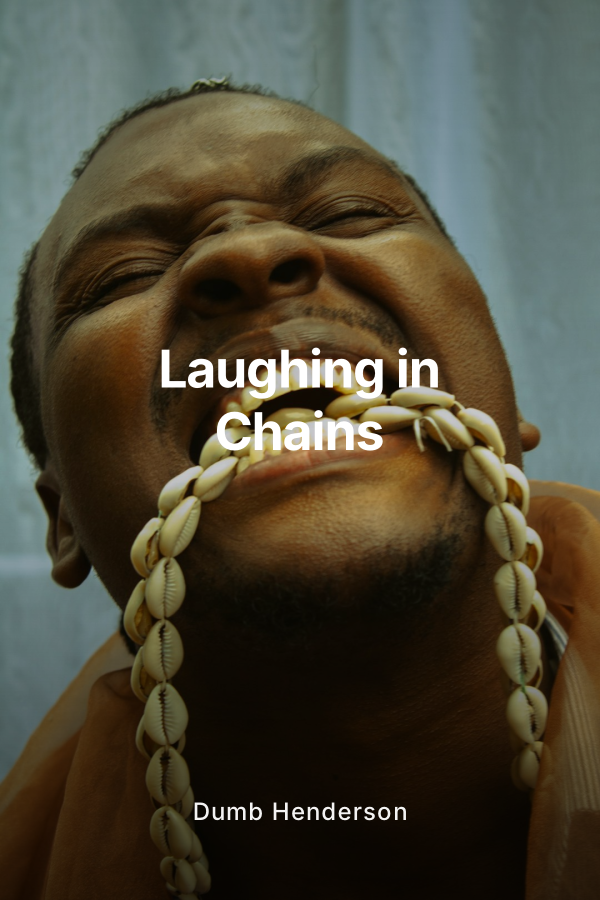
This book is a brutal, provocative dark comedy that weaponizes shock, racist language, and graphic abuse to ridicule slavery itself and the white supremacist mindset that sustained it. At its center stands Xavier, a Black slave who plays the role of an “Uncle Tom” on the surface, yet secretly clings to an unbreakable pride that becomes the spine of the entire story. The book uses extreme slurs in dialogue, vicious humiliation, and savage violence in order to expose the absurdity and horror of racism, never to glorify it.
Across five chapters, readers follow Xavier on a Southern plantation where cruelty is both routine and ridiculous. Xavier appears to be the perfect obedient slave, constantly flattering the master, snitching on fellow slaves, and performing exaggerated loyalty to maintain his favored position. He embraces the stereotype of the house slave so completely that white characters see him as harmless, even lovable. Yet Xavier’s inner thoughts, revealed with cutting wit and vicious irony, strip away every illusion. In his private mind, he mocks the slave-owners’ stupidity, incompetence, and hypocrisy, treating them as clowns who mistake their inherited power for actual superiority.
The story’s humor is deliberately uncomfortable. Public beatings, humiliating punishments, and everyday degradations become scenes of jet-black comedy, where the punchlines land on the racists themselves. The more violently they try to assert dominance, the more they reveal their fragility. Xavier learns to survive and rise by reading these weaknesses. He snitches not out of love for the master, but out of strategic calculation. He manipulates the slave hierarchy of house versus field, exploiting it to secure privileges and protection. This behavior makes him hated and distrusted by other slaves, which deepens the central tension of the book. Is Xavier a traitor, or is he a survivor who refuses to be broken, even if he must look like a collaborator?
As Xavier climbs in status, his pride becomes more visible. It is not pride in whiteness or the plantation system, but pride in his own intelligence, adaptability, and private sense of superiority over everyone around him, Black and white. He truly believes he is smarter than his oppressors and more capable than the slaves who condemn him. This belief fills his internal monologue with searing dark humor, turning every scene into a clash between the script he performs in public and the ruthless commentary running in his head. The book delights in this double performance. In dialogue, Xavier uses exaggerated, obsequious language, dripping with “Yes Massa” submission and groveling compliments. Internally, he dismantles his audience with razor-sharp observations.
The narrative does not soften the world he inhabits. Violence is graphic, characters are humiliated in disturbing ways, and racist slurs are hurled with relentless frequency. The point, however, is not to revel in suffering as spectacle. Each vile act is staged to highlight the grotesque imbalance of power, the pathetic insecurity of the slave-owners, and the twisted logic of a system that must constantly reassert dominance through cruelty. When the master punishes a slave, the scene often unfolds like a farce built upon horror, exposing the master’s emotional instability, fear of rebellion, and need to be admired by his peers. Xavier understands this and skillfully feeds those insecurities, flattering egos while collecting information and influence.
Throughout the book, other slaves become a mirror for Xavier’s choices. Some despise him for collaborating. Others quietly envy his comfort and protection. A few see through his performance and suspect that his loyalty is calculated. These relationships force Xavier to reflect on what his pride actually costs him. He can stomach the hatred of those he betrays, but he cannot ignore the question of whether his survival tactics have destroyed any chance of collective dignity or solidarity. The story never hands readers a simple moral verdict. Instead, it leans into the discomfort: a man enslaved by a system he did not choose, making ruthless decisions within it, refusing to see himself as a victim even when he is trapped.
The dark humor peaks in set pieces that combine graphic abuse with absurdity. A whipping becomes a twisted “performance” where the master tries to impress guests with his control, only to be outmaneuvered emotionally by Xavier’s theatrics. A slave auction degenerates into a grotesque marketplace of egos, where buyers compete not just for bodies, but for the illusion of moral righteousness. In each scene, Xavier’s presence as a sly commentator, sometimes complicit, sometimes subversive, turns cruelty into a strange kind of satire. His jokes are never safe, never comforting, and often directed at himself as much as at others.
By the later chapters, the tension between Xavier’s inner pride and his outward submission reaches a breaking point. Rumors of rebellion, cracks in the plantation’s economic stability, and shifts in the owners’ fortunes shake the fragile order that Xavier has exploited for safety. When the system he mastered begins to wobble, he must confront the reality that his status, built on pleasing those in power, can vanish instantly. The book refuses to promise a heroic redemption arc. Instead, it poses a harder question: in a world structured on dehumanization, what does it mean to hold onto pride when every available survival strategy is morally poisoned?
Laughing in Chains ultimately positions itself as a work of pure shock comedy with a vicious conscience. It mocks racism by exaggerating its language and behavior to extremes, trusting readers to recognize its targets as the racists and the system they uphold, not the victims. The plantation is portrayed as a stage where the slave-owners perform a grotesque pantomime of superiority, while Xavier navigates the script with sly artistry. The book is not for the easily offended. It seeks readers who can stomach harsh language, graphic scenes, and morally ambiguous characters in order to confront the absurdity of racial hatred and the compromises forced on those crushed under it.
For all its ugliness, the core of the story is one man’s stubborn refusal to see himself as less than anyone else, even when every law, whip, and insult insists otherwise. Xavier may look like the master’s favorite puppet to those around him, but in his own mind, he stands as the sharpest observer on the plantation, laughing silently at his captors. The book invites readers to occupy that unsettling vantage point with him, to laugh at what should never have existed, and to sit with the bitter aftertaste that follows.