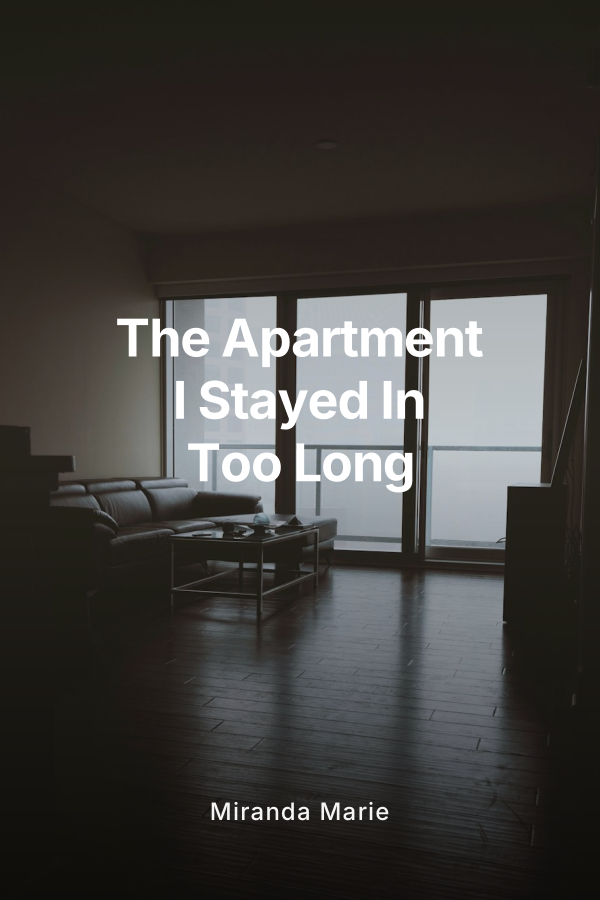
This book is a slender, intimate memoir told through one apartment and the years I spent refusing to leave it. It traces how a place that was supposed to be temporary turned into a holding pattern, and how the rooms around me slowly shrank to match the version of myself I was afraid to outgrow. The story lives in images and hints more than declarations, inviting the reader to feel the weight of what is unsaid as much as what is spoken .
The apartment itself is the central character. It begins as a bare, almost abstract space, more outline than home. There is a chair I never quite settle into, a light that never becomes fully bright, walls so thin my own voice sounds like it might disturb the neighbors if I let it rise above a murmur. These details become a language of smallness, a way of showing how I learned to take up less and less space without ever having to announce that I was disappearing.
The memoir is structured in four chapters, each following a different ghost of the apartment: the ghost of who I was when I arrived, the ghost of the person I tried to become, the ghost of what it meant to stay too long, and the faint, persistent ghost of a future I never quite stepped into. While the book is rooted in my personal story, it is written to resonate with anyone who has lingered in a life that had quietly stopped fitting, who has listened more to fear than to desire, who has confused survival with staying put.
Chapter One: Moving In with the Ghosts of Intention
The first chapter opens on the day I move in, carrying more expectations than furniture. The apartment is described almost like a sketch: empty rooms, mismatched hangers, an echo when I speak out loud for the first time, testing how my name sounds in a place that does not yet belong to me. I tell myself this will be brief, a pause between real lives, a place to rest until I become someone more certain and daring.
This chapter braids together the external act of moving in with the internal script I have inherited. Readers see me arrange my few belongings in tentative ways, never pushing the bed all the way against the wall, never hanging pictures with the confidence that they will stay. Every choice reveals the quiet belief that I am not allowed to claim permanence.
The ghosts in this early chapter are mostly imagined futures. Versions of myself hover in the doorway: the person who will get the better job, who will travel, who will finally choose a life that feels real. These ghosts are hopeful but weightless. They do not yet know that hope without movement can harden into something more like haunting.
Chapter Two: Shrinking Rooms
In the second chapter, time passes in fragments: winters that blur together, summers marked only by the hum of the fan in the same overheated room. Without major external events, the story deepens inward. The apartment itself starts to change, not in its dimensions, but in the way I inhabit it.
This is the chapter of shrinking. My routines become tighter, less negotiable. I start to sit on the edge of that one chair instead of leaning back. I talk more quietly on the phone, even when I am alone, as if the walls have grown closer. Clothes that once felt like expression now feel like costumes I rarely bother to put on. The light bulbs are always a little dimmer than they should be, not quite broken, never quite bright. Every object becomes a subtle signal that I am choosing smaller, safer versions of myself over and over.
Here, the ghosts are not fanciful. They are practical, almost polite. They show up as the people I do not call back, the opportunities I let expire without answering, the conversations I rehearse but never initiate. They pull at the hem of my days, nudging me to remember that I meant to leave. Their power lies in what they do not say outright. The book uses silence, pause, and image to convey how shame and fear rarely scream; they whisper, they suggest, they make staying put sound reasonable.
Chapter Three: The Season of Staying Too Long
The third chapter is the emotional center of the memoir. By now, the reader understands that the problem is not the apartment itself, but my relationship to it. This is where staying too long becomes a tangible, almost physical sensation .
The space is now crowded with evidence of time passing without real change. A plant that has outgrown its pot but has never been moved, roots circling the same dry soil. A fridge that hums through the night while harboring jars and cartons a little past their date. A key left in the lock so often that rust begins to feather its edges. The door handle, warmed by years of being touched with the intention to leave and then never turned.
In these pages, I examine the small negotiations I make with myself in order to avoid a reckoning. I tell myself I will go once I have saved a bit more money, once work is less stressful, once I feel clearer. Each condition buys another season. The ghosts in this chapter are heavier, more insistent. They show up in dreams of hallways that stretch forever, of elevators that never arrive, of boxes half packed then forgotten. They are not trying to scare me. They are trying, in their own way, to tell the truth I will not speak.
The narrative zooms in on one particular stretch of time when the outside world offers clear signs to move on: an opportunity that would require a different city, a relationship that can only deepen if I make room for it, a health scare that exposes the cost of always compressing myself. Yet instead of acting, I burrow further into what I know. The chapter shows, in painstaking but compassionate detail, how a life can narrow not through dramatic choices, but through a steady refusal to choose at all.
Chapter Four: Learning to Live with the Quiet
The final chapter does not deliver a grand escape or a triumphant reinvention. Instead, it lingers in the quiet that follows the realization that I have stayed too long. The ghosts are still there, but their edges soften. The apartment has not expanded, yet I begin to inhabit it differently .
In this closing movement, the story focuses on micro acts of courage that are almost invisible from the outside. I start with the smallest possible changes. I clear a shelf that has been cluttered for years, not to make room for something new, but simply to see empty space and not fill it at once. I replace one dim bulb with a brighter one and sit with how uncomfortable it feels to see the room clearly. I make a phone call I have been postponing for months. I move the chair and finally sit in it fully, back against the rest, feet on the ground.
The ending honors quiet as a choice, not merely an absence. Instead of using stillness to hide, I begin to use it to listen. The book closes on a scene that is almost ordinary: perhaps me washing a single cup in the sink at night, or turning out a lamp and letting the room go dark with intention instead of resignation. The reader understands that I have not yet left the apartment, but something real has shifted. I am no longer confusing safety with erasure. The ghosts are not gone, but we have renegotiated our terms.
Throughout the memoir, the voice remains conversational and honest, like a long letter to a trusted friend. It does not rush to insight. It allows contradictions to sit side by side: gratitude for the shelter this place gave me and grief for the years I handed over to fear; tenderness for the self who coped the only way she knew how and impatience with how long I let that be enough.
The apartment is never just architecture. It becomes a way to talk about the rooms we build inside ourselves, the limits we accept, the lives we rehearse instead of live. By staying close to physical details and the felt sense of being in the space, the book invites readers to see their own apartments, offices, relationships, and habits through a new lens. What have they outgrown, yet still inhabit? Where have they been shrinking without quite noticing? What would it mean to let a little more light in, to claim one more inch of space, to take one small step toward the door, even if they are not ready to walk through it yet?
The Apartment I Stayed In Too Long is ultimately a story about learning to tell the truth in images and in whispers when direct language feels impossible. It is about recognizing that sometimes the bravest thing we can do is not to leave in a blaze of certainty, but to admit that we have overstayed, to sit with that knowledge in the quiet, and to begin, very gently, to imagine something else.