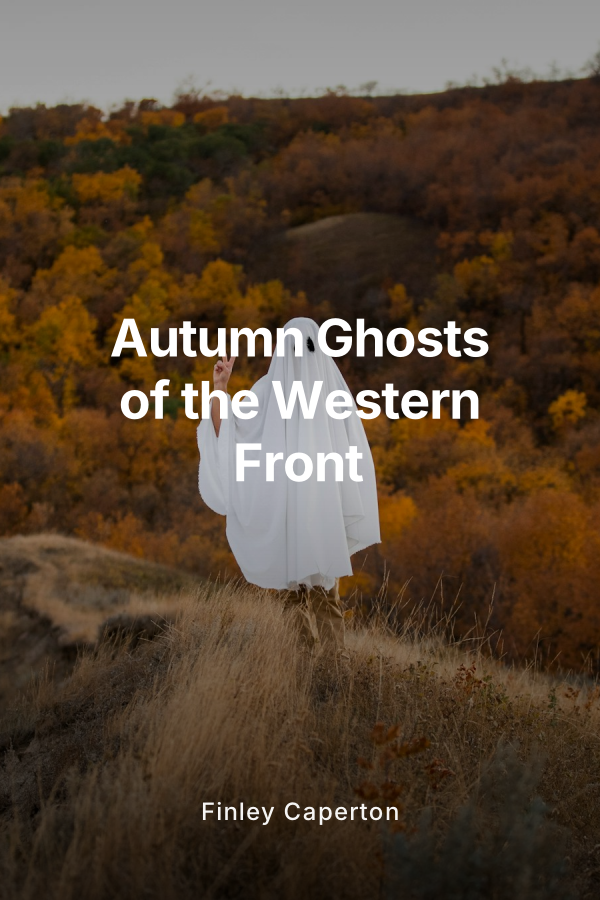
In the mud and smoke of a mid autumn offensive in the middle years of World War I, a British infantry company is ordered to hold a ruined stretch of French countryside that local villagers already whisper about in fearful tones. The place sits on ground where an English host once fought long ago, a field layered with the bones and iron of forgotten wars. As the guns fall silent for brief hours at dusk and dawn, the men in the trenches begin to glimpse shapes in the mist, hear the distant thunder of hooves, and find relics half unearthed by shell bursts that do not belong to their war at all.
The story follows a small knot of soldiers and officers whose lives are bound together by this single autumn campaign. A young idealistic lieutenant, a battle-hardened sergeant, a quiet private carrying a secret from home, and a skeptical army doctor each react differently as the front around them turns more uncanny and more lethal. For some, the strange echoes of older battles feel like omens. For others, they are dismissed as tricks of exhaustion and fear. Yet as the fighting intensifies, the line between present and past seems to thin, and an already brutal war acquires an almost mythic, haunted quality.
Years later, long after the armistice, the survivors are scattered across peacetime Europe. The lieutenant is now a middle-aged schoolmaster who cannot bear the sound of autumn rain. The sergeant runs a small business but drinks too much and avoids open fields. The private sits in a veterans’ hospital, classified as shell shocked and plagued by fragmented visions he can neither forget nor fully explain. A younger generation, represented by a researcher or interviewer who grew up after the war, begins to ask questions. What exactly happened on that small piece of the Western Front? Why do those who were there speak of horses where there should have been tanks, of mail and steel rather than barbed wire and khaki, of orders shouted in archaic English that no one in 1916 should have known?
As these veterans attempt, often reluctantly, to piece together their memories, the narrative moves between the trenches and the later years when they struggle to live with what they saw. In the past thread, readers experience the immediacy of bombardment, the close terror of night patrols, and the unnerving discovery of artifacts and apparitions that suggest another era bleeding into their own. In the later thread, we witness the quieter but no less devastating battles with nightmares, guilt, and silence. The men wrestle with questions of sanity and truth. Were those visions products of trauma. Were they collective hallucinations. Or did that haunted field, saturated with centuries of violence, briefly reveal the deeper pattern of human conflict to a handful of witnesses who could not bear to see it.
Autumn Ghosts of the Western Front becomes both a war story and an examination of memory itself. It shows how the experience of battle does not end with the final gunshot but stretches across decades in flashbacks, fears, and fractured narratives told in hospital wards, pubs, and family kitchens. By the end, the book suggests that every war sits atop older scars, and that the minds of those who fight become the final battlefield where history, horror, and meaning collide. The echoes that rose from that autumn ground did not vanish with the smoke. They lived on inside the survivors, shaping their lives and the stories they dare, or refuse, to tell.