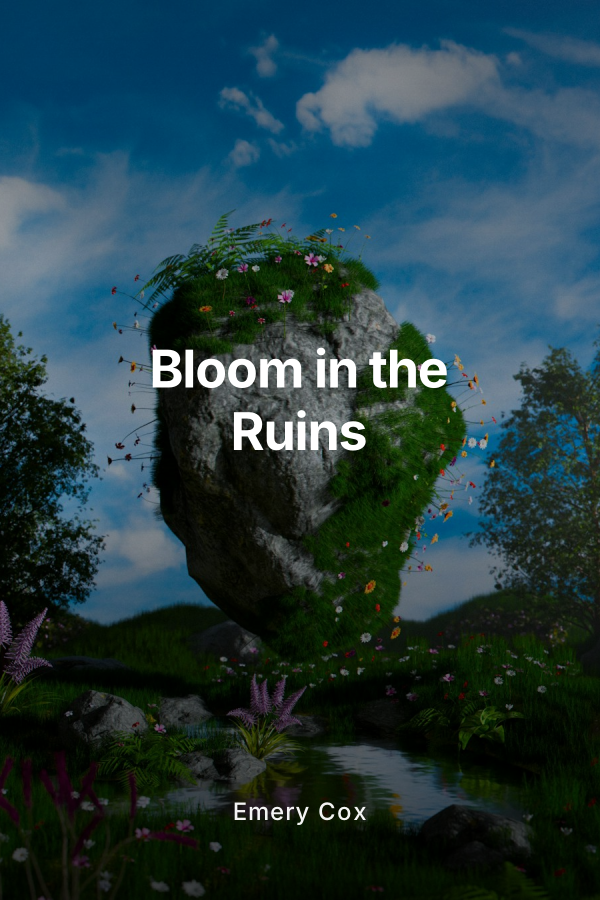
In a world cracked open by invasion, life itself has become the loudest signal on the planet. The more something grows, breathes, pollinates, the more the aliens hear it. They follow that signal like sharks tracking blood in the water, and wherever they arrive, nothing green survives.
Lila Hart has always felt more at home with leaves than people. Raised in what was basically a giant greenhouse and later running her father’s flower shop on the edge of a dying city, she spent years learning the language of roots, spores, and fragile things that never fight back yet somehow endure. When the aliens came, everything she loved turned into a curse. Her lifetime of breathing in pollen and spores turned her body into something the invaders can sense from miles away. She is not just a survivor. She is a flare.
Cole Mercer is trained, hardened, and furious that he was given babysitting duty instead of a real mission. A former military operator turned convoy leader, he is the one who gets people from one shattered safe zone to another. He thinks in terms of objectives, routes, and acceptable losses. He works with numbers, not feelings. On paper, Lila Hart is the worst possible asset. She is unarmed, untrained, and radiates the very thing that drags the aliens down on them.
The only reason he has not walked away is a promise. Before everything fell apart, Cole stood in a hospital hallway and told Lila’s father that he would keep her safe. Now the older man is gone, the world is broken, and Cole is stuck shackled to a promise that feels more impossible by the hour.
At the start, Cole sees Lila as a liability in every sense of the word. In his mind she is slow, too gentle for the brutal choices survival demands, and the glaring reason every route becomes high risk the second she steps onto it. He watches her flinch at violence, talk to dying plants in abandoned apartments, cling to a kind of hope he stopped believing in years ago. It infuriates him, because he is sure her softness is going to get them killed. He shuts her out, shuts her down, and makes it very clear that the only reason they are together is because of a promise she does not know exists.
Lila, for her part, hates him right back. Cole treats her like cargo, never a partner, and she can feel him clocking every weakness she already despises in herself. To him, her plant knowledge is “cute,” useless against teeth and claws and burning sky. He orders her where to stand and when to move as if she is a piece of equipment, not a person. Lila knows she is dangerous to be around. She also knows she is capable of more than carrying supplies and keeping her head down. Every time Cole acts like she is dead weight, it scrapes across her oldest fear that outside of her plants she has nothing real to offer.
Their early days together are loud with the kind of arguments that leave both of them shaking afterward. Cole pushes for brutal practicality. He wants her kept inside sealed vehicles, away from windows, away from anyone who might notice the way the air hums a little differently when she walks past. Lila refuses to live as a problem that needs to be contained. She wants to help. To scout for edible plants in collapsed parks. To use what she knows to find quieter paths and safer pockets of growth. She will not be reduced to a risk on a mission report.
Everyone else in the convoy sees what Cole sees. Wherever Lila goes, alien activity spikes. They circle in the distance, restless and searching, as if confused by a signal too bright to ignore. Rumors start. That Cole is protecting her for reasons that make no sense. That maybe she is more useful as a bargaining chip than a passenger. That the safest choice might be to cut her loose before the next attack comes.
Cole argues to keep her locked down. Others argue to get rid of her entirely. The worst part is that Lila hears enough to understand exactly how the math balances out and exactly how little they believe she is worth.
The thing is, Lila is not just some human radio tower for alien attention. She notices patterns no one else sees. She can tell when the air is about to fill with spores by the way a particular moss curls. She can read the health of entire city blocks from the color of weeds pushing through cracked pavement. And slowly it becomes clear that the aliens do not just follow life. They shape it. Twist it. Kill what they cannot use and cultivate what they can.
Lila begins to suspect that the same strange sensitivity that makes her a target might also make her a lens. Through her, they might be able to understand what the invaders are building and how to move through it without being seen. But with Cole constantly blocking her from taking any initiative, she is trapped in an infuriating loop of being essential and yet never trusted.
Their hatred is comfortable. It keeps things simple. Cole can tell himself that he does not care about her beyond his promise. Lila can tell herself that he is just another soldier who sees feelings as flaws. As long as they hate each other, they do not have to admit the more terrifying truth simmering below the surface. They need each other.
Then comes the turning point.
An attack rips through their convoy in a place that should have been safe, a corridor of barren land where nothing has grown in years. The aliens should have passed it by. Instead, they converge. Metal screams, people scatter, and in the chaos, Cole is forced to choose between abandoning his mission and going back for the one person who endangers everyone by existing. The promise to her father is a weight around his throat, but what drags him back into the fire is not duty. It is the sick, unignorable realization that somewhere along the way, Lila became more than a line item on his orders.
Lila, cornered and terrified, reaches for the one thing she has always trusted. Life. There, in the wreckage, she connects to it in a new way. She feels the thrum of the aliens’ interest like a pressure behind her eyes, and for a brief, ferocious moment, she pushes back. She pulls the surrounding growth toward her, forcing it to flare brighter so the aliens focus on it, not the remaining survivors. It almost kills her. Cole is the one who drags her out of the aftermath, furious and shaking because he just watched the girl he has called weak do something braver than any order has ever required of him.
In the quiet that follows, something between them cracks.
Cole sees how wrong he has been, not just about her skills but about the entire definition of strength. Lila, in turn, sees through his harshness to the fear that drives it. He is not cruel for fun. He is terrified of failing the dead man he promised, terrified of losing anyone else, and that fear has twisted into a constant need for control. In that moment, they both confront the uncomfortable truth that their hatred has always been threaded with something more volatile. Attention. Fascination. The kind of connection that does not ask permission.
Bloom in the Ruins is a slow-burn, enemies-to-allies-to-something-else story set against a landscape where nature itself has been caught in the crossfire. Across five chapters, the book traces Lila and Cole’s journey from grudging partnership to an unbreakable bond, layered with action, dark humor, and an honest look at what it means to love anything in a world that keeps trying to erase what lives.
Chapter One introduces the shattered world and the brutal logic of survival that shapes Cole. We see how promises become currency, how convoys move like hunted animals, and how one girl with a strange history of living among plants suddenly becomes the most dangerous person to stand near. Lila’s greenhouse childhood and years in the flower shop come into sharp focus, making it painfully clear how out of place she is amidst guns and ration counts.
Chapter Two dives deep into their mutual hatred. Every interaction is a clash of values. Lila insists that protecting small life still matters, even when the world is ending. Cole counters that protecting people requires sacrificing everything else. Scenes of them arguing over travel routes, triage decisions, and who gets to decide what is “necessary” reveal how both of them are right and both of them are wrong. At the same time, alien encounters escalate, always circling back to Lila as the unwilling beacon.
Chapter Three brings the moral dilemma to a breaking point. Side characters question Lila’s presence, pushing Cole to either admit why he will not let her go or watch someone else make the choice for him. Lila begins to suspect there is a reason he is so stubborn about keeping her alive, and the secret of his promise hangs between them like a live wire. This is where the book tightens the net around them. The aliens grow more coordinated, the safe zones fewer, and Lila’s visions or sensations tied to life pulses become sharper, more painful, and more informative. Her knowledge starts to save them in concrete, undeniable ways, forcing Cole to revise his mission parameters around her instead of despite her.
Chapter Four is the attack that changes everything. The convoy’s destruction in the supposedly safe dead zone forces Lila and Cole to operate without their usual buffers and backup. They see each other stripped down to raw impulses. Cole’s protective instincts, which he has disguised as annoyance and authority, reveal the deeper care underneath. Lila’s refusal to abandon strangers, even when doing so would make her safer, shows Cole a different brand of courage than the one he was trained to admire. Her drastic use of her connection to life to misdirect the aliens becomes the book’s most visceral proof that the thing everyone called her weakness is, in fact, their only real weapon.
Chapter Five focuses on the aftermath and the redefinition of their relationship. The truth about Cole’s promise comes out, along with Lila’s fury that he saw her as an obligation instead of a person. They fight, again, but this time the fight is about making room for choice. Do they stay together because they have to or because, despite everything, they want to? As they push deeper into alien-transformed territory on a new, more intentional mission, the connection they tried so hard to deny becomes their anchor. The final chapter leaves them not in a neat happily-ever-after, but in a new kind of uncertain hope. They are no longer a soldier and a liability. They are a strategist and a human beacon, choosing to stand together against a future that is still terrifying, still fragile, and still theirs to fight for.
Throughout the book, the central tension beats like a second heart. Lila is both problem and solution. Cole is both jailer and protector. The aliens are both destroyers and architects of a warped new ecosystem. Every scene pushes them to confront the same question from different angles. What do you do with something that is dangerous and precious at the same time?
Bloom in the Ruins invites readers to sit with uncomfortable truths. That fear can sound like anger. That gentleness can be a survival trait, not a flaw. That the people who annoy us the most often mirror back the parts of ourselves we least want to face. As Lila and Cole move from forced proximity and mutual resentment toward a hard-won, deeply felt partnership, the story leans into emotional authenticity. It does not pretend healing is simple or that trust, once broken, snaps neatly back into place. Instead, it shows two damaged people choosing, over and over, to keep trying.
By the end, their hatred makes sense. So does the way it slowly, stubbornly, refuses to stay hatred at all.