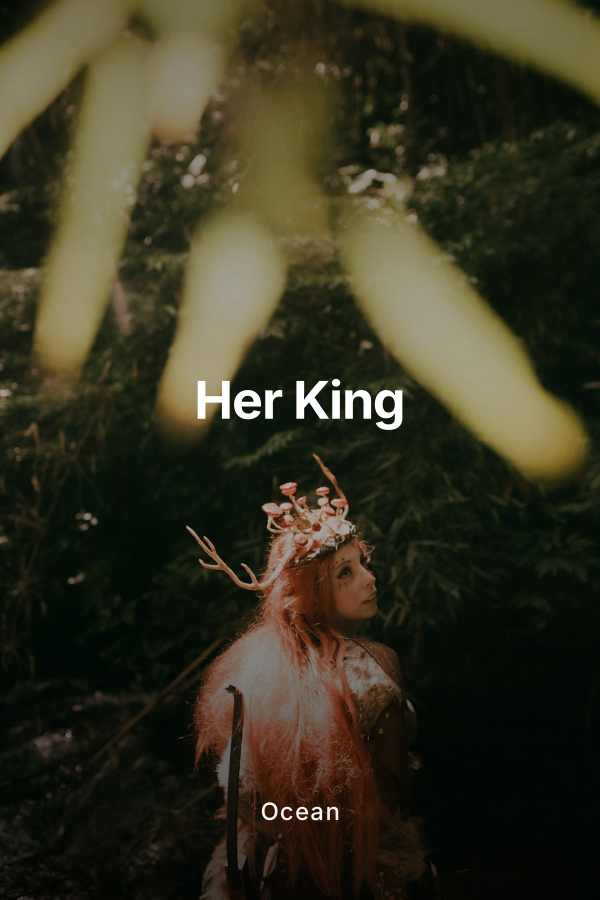
This young adult Christian fantasy follows a furious girl knight whose faith shatters on the battlefield, and the Lion King who rebuilds her heart one impossible mercy at a time. It is written for teen girls who ache with betrayal, burn with anger, and secretly wonder if God’s peace could ever be meant for them.
In a classic European style kingdom where stone castles rise over forests and fields, war never ceases. Monsters stalk the borders, driven by a single ruthless goal: erase humanity. The human realm fights back beneath an earthly king known less for courage than for his rebellion, coldness, and hatred toward his own people. In this strange blend of swords and soft hoodies, chainmail and cozy cloaks, knights live with the ache of constant battle woven into unusually comfortable lives.
At the center stands a nameless, ordinary knight whose life is built on rules, loyalty, and carefully contained rage. Idealistic and dutiful, she clings to her two closest friends as her found family within the barracks. She never admired the earthly king and never felt wanted by him, yet his orders define her days, and his promises are all she has to shield the ones she loves. Her core flaw is anger: a smoldering, half-hidden fire that flares in silence, clenched fists, and vows that she will never be weak enough to need anyone, especially a distant God she is not even sure exists.
Whispers move through the ranks about another King whose realm lies somewhere within the same world, untouched by war. They call Him the Lion King. Some claim to have glimpsed a land where peace is not a rumor but a presence, where the air itself feels gentle and whole. Alongside the Lion, they speak of a Lamb who was slain and a Dove who never leaves those who believe. These are not abstract symbols to the soldiers who dare to hope. They are said to be real beings, living in a hidden, peaceful kingdom that overlaps the bloody fields of men.
Our knight is intrigued yet wary. She begins to explore stories of the Lion King in stolen quiet moments, half afraid of being foolish and half desperate for something better than the life she knows. For the first time, she prays. Days before a critical battle, she begs this unseen King to protect her two friends. If He is real, if He is good, surely He will not let them die. That prayer becomes the single fragile bridge between her and belief.
The earthly king, cold and calculating, promises her that he will personally see to her friends’ protection. He knows how deeply she loves them, how much of her hope hangs on their lives. His vow seems like an unexpected mercy, a reason to trust him at last. Yet on the battlefield, beneath a sky streaked with smoke and the shrieks of monsters, his promise shatters. When a monster’s blade pierces her friends, he does nothing. No order to shield them, no move to pull them from danger. He simply watches, indifferent. Her friends fall. Her world breaks.
In that moment, her faith in the earthly king dies. Worse, the fragile trust she placed in the Lion King collapses too. If the Lion was real, if He ever listened, why did He ignore her plea? Why did He let the earthly king’s cruelty stand? Why did He let her friends bleed out on the ground while she screamed His name? Her grief erupts into unrestrained rage that turns on everyone and everything, including God Himself. Her deepest inner question sharpens into a raw accusation: “If there is a good King at all, why did You let them die?”
After the slaughter, as the earthly king summons the surviving knights back to the castle, she refuses to return. Instead, she flees. Shaking with shock and fury, she drives her horse into the woods and does not stop until both of them are exhausted. In the quiet aftermath, surrounded by trees and the echo of her own sobs, she finally breaks. All the discipline, all the rule following, all the attempts to be a perfect knight crumble under the weight of unanswered prayers. The Lion King, she decides, is a myth, no different from the comforting stories told to children before sleep.
It is in this place of near-despair that the true story begins.
From the shadows of the forest a Lion steps into her world. Not as a vision or a dream, but as a living, breathing King with eyes that see through her fury and fur wet from the dew of a realm that knows no war. He does not roar her into silence. He does not lecture, accuse, or flinch away from her pain. Instead, He lies down beside her, close enough for her to feel His warmth, and pulls close a broken knight whose faith is nothing but ashes. When she blames Him for her friends’ deaths, He does not flare in anger. He listens. His presence itself becomes the first crack in the armor of her rage.
Through this encounter and those that follow, she meets not only the Lion but also the Lamb who was slain and yet lives, and the Dove who comes to rest on her and refuses to leave. These three are not vague religious metaphors. They are the Trinity, walking into her story in forms she cannot ignore. The Lion reveals the majesty, justice, and fierce tenderness of the Father. The Lamb confronts her with sacrificial love that took on the weight of all sin, including the violence of her own anger. The Dove settles into her life as constant companion, gently nudging her toward self-control, often nuzzling her when she is most tempted to fall back into old rages.
Her time in their peaceful realm slowly reshapes the questions that rule her. What is a good King? Why did You let them die? Can I ever be anything other than furious and hard? In the Lion’s presence, she discovers a kind of peace that makes no sense against the backdrop of her trauma. It does not erase grief or pretend the battlefield never happened. Instead, this peace holds her tears, names injustice as evil, and yet refuses to let hatred have the final word. As she surrenders her sense of control piece by piece, she begins to trust that the Lion’s goodness is not defined by her understanding of safety.
The Lion, the Lamb, and the Dove do not invite her to remain hidden in their sanctuary. They give her a mission that both terrifies and honors her: return to the war-torn kingdom, confront the earthly king’s rebellion, and call both humans and monsters to the true King’s realm. Her redemption will not be a private comfort. It will be a public calling. Her anger, once a blade that cut indiscriminately, becomes a holy fire for justice and mercy. The Dove’s quiet presence begins to show in the way she holds her tongue when provoked, the way she chooses mercy when every instinct screams for revenge, the way she apologizes and makes peace where once she would have burned bridges.
Back in her homeland, the contrast between the two kingdoms grows starker. The earthly king mocks any mention of the Lion King, dismissing Him as weakness, myth, or treason. He demands unquestioning loyalty and wields fear to secure it. Many knights obey out of habit, others out of terror. Our heroine moves among them not as a perfect saint but as a visibly changed girl whose temper still flickers yet no longer rules her. Each moment of restraint becomes its own small miracle. In rooms where she used to erupt, she now pauses and listens for the Dove’s quiet nudge. This inner war is as intense as any clash of swords.
Her outward mission soon collides with physical danger. She begins to tell other knights about the Lion King’s realm, about a peace that is not fragile or false. Some laugh at her. Some betray her trust, reporting her conversations to the earthly king. Others, though, listen. In hushed barracks and secret corridors, hearts begin to awaken. A few choose to follow the true King alongside her, even though it may cost them everything. The cost proves real when opposition intensifies. Allegiance to the Lion King is labeled treason. Threats sharpen into open violence. Her willingness to risk her life in defiance of the earthly king reveals how far she has come from the girl who once believed that safety was proof of God’s care.
Even the monsters are not exempt from her message. In battle, she faces creatures she has been trained to hate without question. Yet now, guided by the Dove, she finds herself hesitating before a killing blow, choosing instead to speak. Her words, laced with the Lion’s authority, sow confusion among enemies raised to believe that humans are beyond mercy. In at least one harrowing encounter, her unexpected compassion causes a monster to falter, its weapon dropping, its eyes reflecting a conflict it has never allowed itself to feel. In these moments the reader sees that the Lion King’s kingdom does not merely save individuals. It begins to invade every corner of the war, calling even sworn enemies to lay down their arms.
At the heart of the story lies a final confrontation that tests everything she has learned. Before the earthly king and his court, with soldiers and monsters looking on, she must decide whose word matters more. The same man who once promised to protect her friends and watched them die now threatens her life openly. She can respond with the old fury that once controlled her or live into the new courage born from surrender. With the Dove resting quietly upon her and the memory of the Lion’s steady gaze in her mind, she speaks truth. She exposes his lies, declares her allegiance to the true King, and invites all who hear to choose their ruler, knowing that this choice might lead to chains or death in this world.
The climax is not just political. It is deeply personal. Her deepest doubt about God’s goodness meets a concrete answer in her own transformed heart. No miracle rewinds time to resurrect her friends. No simple explanation removes the mystery of their deaths. Instead, the Lion’s faithfulness in the midst of sorrow becomes undeniable. The girl who once believed that loss meant God’s absence now stands willing to lose her own life in order to stay near Him. This is the visible sign that the Dove truly stays with her: the raging knight has become a courageous witness whose self-control, love, and forgiveness cannot be explained by human effort alone.
The story closes with both cost and fruit. Some who align themselves with the Lion King pay with their lives, yet they die with a peace their executioners cannot comprehend. Some monsters turn or hesitate, their allegiance to darkness fractured by a human girl who should hate them yet offers them a different King instead. Over the horizon, a powerful image emerges. A gate once sealed between the peaceful realm and the war-torn lands stands open, its hinges glowing with a quiet, unending light. Banners of the Lion King begin to appear where the earthly king’s sigils once flew alone. The war is not over, but its outcome is no longer in doubt. The Lion’s kingdom has begun to spread.
Her King is at its core a redemption arc and a spiritual awakening told through swords, monsters, and a girl who is too angry to pray until a Lion lies down beside her in the dirt. It explores what it means to live under a good King in a world soaked in betrayal, how honest grief can coexist with unshakable peace, and how the Holy Spirit’s quiet companionship can tame even the fiercest temper over time. Written overtly from a Christian worldview for teen girls, it offers an adventure that refuses to hide its theology while still honoring the complexity of doubt, pain, and the long, slow turning of a human heart toward trust.