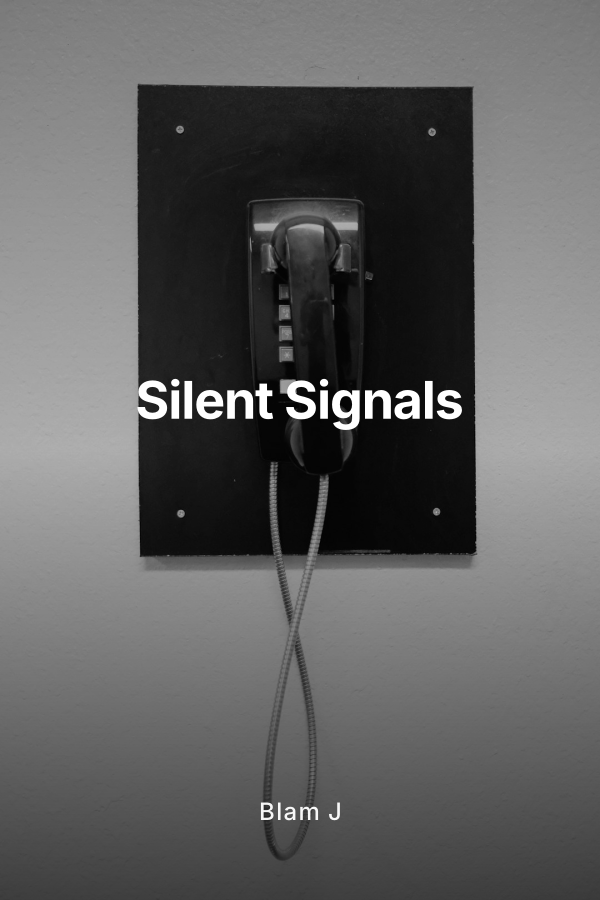
This book follows Leo, a six year old deaf boy who has learned to survive in a world that rarely slows down enough for him to understand it. His parents are physically present but emotionally distant, often out of the house and rarely teaching or guiding him, so Leo has pieced together his understanding of life from cartoons, glimpses of adult conversations, and the fragile art of lip reading when people happen to speak slowly enough for him to catch their words. One ordinary Saturday evening, while he is absorbed in his cartoons, a team of agents silently enters his home. Leo, unused to being truly seen or considered, does not notice until it is far too late. He is taken from his house without explanation and brought to a stark facility filled with other children who seem just as confused and unprotected as he is.
At this facility, Leo encounters a different hierarchy of power. There is a television, a symbol of comfort from his old life, but it is controlled by older kids, and the punishment for stepping out of line is swift and frightening. The building is noisy with footsteps and voices, yet for Leo, the world is still made mostly of silence and guesswork. Terrified, unsure how to communicate, he withdraws completely. He does not talk to anyone, not because he has nothing to say, but because he has never really been taught how to say it in a way others will understand. As days pass, agents periodically appear to collect certain children and lead them to some unknown destination. Each departure raises the tension and fear among those left behind. They do not know where the others are going or if they will return. The atmosphere is oppressive and uncertain, and for Leo, whose access to information is already limited by his deafness, the dread is magnified.
One day, amid the routine of silence and fear, an adult finally notices Leo. This adult is the first person in a long time who makes a genuine effort to bridge the gap between Leo’s silent world and the hearing world around him. Instead of barking orders or ignoring him, they slow down. They may draw pictures, write words, exaggerate their lip movements, or use gentle gestures to let Leo know that they see him as a person rather than a problem. This simple, careful attention becomes the first real signal that Leo is not invisible, that his way of experiencing the world is not a defect but a difference that deserves respect. The adult’s kind attention introduces the core theme of the story: that children who are marginalized, neglected, or misunderstood still possess inner strength, intelligence, and an unclaimed future.
As the narrative unfolds, the book explores the tension between fear and hope. On the surface, Leo’s situation is dark. He has been taken from his home without explanation, placed among strangers, and exposed to daily intimidation from both adults and older kids. Yet beneath this bleak environment, his journey is about awakening. The adult who notices him becomes a catalyst for change, hinting that there may be allies hidden within the very system that stole him away. This guide figure might help Leo understand the true nature of the facility, teach him the first elements of sign language, or slowly reveal that the children are being selected for something beyond ordinary cruelty. Whether these agents work for a secret organization, a government program, or something more mysterious, Leo’s story pivots on the idea that he is being moved from “captive” to “chosen,” not as a victim but as someone with unique potential.
Across five chapters, "Silent Signals" traces Leo’s arc from voiceless fear to an emerging sense of self and power. The early chapters dwell in his confusion and isolation, painting his inner world with vivid sensory detail that relies heavily on sight, touch, and vibration rather than sound. Readers experience the jarring abduction from his perspective, where the lack of audible warning underscores how suddenly life can change for a child who has never been properly prepared for danger. The middle chapters focus on the dynamics within the facility, the cruel pecking order among the kids, and the quietly radical care offered by the adult who first reaches out to Leo. As trust cautiously grows, this adult provides Leo with new tools to understand language and, by extension, the world. The later chapters push Leo, and the reader, into a higher stakes realm where the secret behind the agents’ interest in the children begins to surface. Leo must decide whether to cling to his fear or to step forward, using the communication skills and inner courage he has begun to build.
The emotional core of the book lies in the portrayal of deafness not as a tragic limitation, but as a specific way of being that shapes perception, memory, and courage. Leo’s silence is full of meaning. It allows him to notice details that others miss, to “hear” danger in the way people move, to recognize kindness in a person’s eyes before a word is spoken. At the same time, the narrative does not shy away from the pain of being excluded or misunderstood, especially by adults who should have protected and taught him. Leo’s parents, who are often absent and inattentive, form the painful backdrop to his life. Their neglect makes it easier for agents to remove him without resistance, but it also explains why even small moments of real attention carry so much weight for him later in the story.
"Silent Signals" balances a sense of danger with a strong undercurrent of resilience and hope. It is “scary but hopeful,” aimed at readers who can handle emotional intensity and moral complexity without losing sight of the possibility of healing and change. The book respects the reality that some adults abuse power while others work quietly to mend what has been broken. It offers an honest portrait of institutional fear but insists that even within such places, acts of courage and care can create escape routes, both literal and emotional. By the end, Leo’s journey is not only about surviving a frightening system, but also about claiming his identity as a deaf child who learns to communicate on his own terms, finds allies who accept his way of seeing the world, and begins to sense that he might have a role to play that is larger than his fear.
Ultimately, this is a story about recognition. A child long ignored is finally seen. A silent world full of subtle signals becomes the key to understanding hidden truths. A boy who once watched cartoons alone on a Saturday night steps into a perilous new chapter, where his difference turns out to be his greatest strength. "Silent Signals" invites readers to follow Leo from isolation to connection, from being taken to being chosen, and to witness how one small act of noticing can alter the entire course of a child’s life.