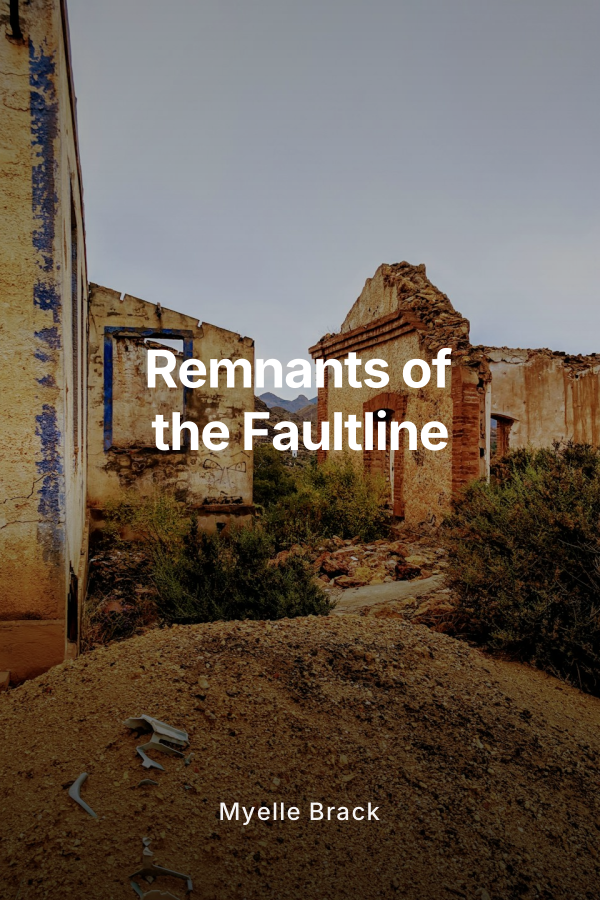
In the city that survived the Faultline, loyalty is currency and secrets are worth more than blood. Atlas Roe has both, and they are about to get him killed.
On the glittering Heights, Atlas plays his role to perfection. Star striker. Golden boy. Heir to a carefully manufactured life. Every game distracts the public from the cracks in the city walls and the quiet disappearances no one wants to count too closely. The regime feeds him fame so he will not ask why his father works late in restricted zones, or why their tower is guarded as if it holds something more dangerous than a family.
Across the broken river, Lia Kade lives in the ruins the Heights pretend not to see. She is a Remnant, born on the wrong side of the quake line, trained to move through shattered concrete like shadow. The underground resistance raised her on three rules. Trust no one from the Heights. Never break cover. Survive long enough to burn the system down from within. She has no time for celebrity athletes who think taking a hit on a field counts as real pain.
When a smuggled data shard vanishes during a covert exchange, both their worlds tilt. The shard holds coordinates tied to the original Faultline event, proof that the quake was not a natural disaster but a controlled detonation designed to redraw the city’s borders forever. The Heights authorities want the evidence buried. The Remnants want it broadcast. And somehow, Atlas’s father and Lia’s dead brother are both tangled in the same classified file.
Atlas is dragged into the hunt when he stumbles on encrypted messages in his father’s secure terminal, code that should only exist in Remnant channels. At the same time, Lia is ordered to infiltrate a charity exhibition match in the Heights, steal the original shard from a secure vault and make it back across the river unseen. It looks simple on paper. It never is.
Their collision is immediate and ugly. Atlas thinks Lia is a terrorist. Lia thinks Atlas is a pampered liability who will fold the second real violence enters the room. Their first encounter is a botched extraction, a flare lit in the dark of a maintenance corridor, both of them shouting orders neither will follow. He tries to throw his weight around, bragging about his strength and field instincts. She rolls her eyes, cuts him off, and proves in three efficient moves how useless his bravado is against someone who actually knows how to fight.
They should have walked away from each other. Instead, a second team crashes the operation. Neither Heights security nor Remnant. Someone else. The kind of men who shoot to erase witnesses. Trapped between automated blast doors and incoming fire, Atlas and Lia are forced into a temporary truce. She needs his access cards. He needs her combat training. Neither of them trusts the other, but the only way out is forward.
Every chapter turns the screw tighter.
In the ruins beneath the stadium, they uncover an off‑grid lab filled with incomplete prototypes and malformed maps of the city, each version with slightly different borders. On isolated rooftops, they decode fragments of the stolen data, learning that the Faultline was the first test in a series of controlled “corrections” meant to keep the population scared, compliant and easy to divide. In the flooded tunnels under the river, they find bodies that never made the official casualty counts and tags stamped with project numbers instead of names.
As they move, the tone between them shifts from open hostility to a grudging, knife‑sharp partnership. The banter comes first, a defense mechanism against fear. Atlas keeps trying to prove he is more than a pretty face who can take a tackle. Lia shoots down his bravado, calls out his blind spots and refuses to slow her pace for him. He annoys her, tests her, forces her to acknowledge that he learns fast and refuses to quit, even when injured. She unsettles him, slicing through his assumptions about Remnants and making him see the city from street level, where walls are cages instead of decorations.
The turning point hits hard. A raid in an abandoned transit hub goes sideways. Lia is separated from the team when a blast drops a ceiling panel and shatters her leg under rubble. Protocol says to leave anyone pinned. Extraction windows are measured in seconds, not sympathy. Lia knows the rule. She orders Atlas to go. To save himself. To keep the data moving.
He goes.
Then he stops.
On the edge of safety, with escape lights pulsing and sirens closing in, Atlas looks back. This is the line his entire life has drawn him toward. He can keep running, stay the regime’s golden son and pretend he never met the Remnant girl bleeding in the dust. Or he can turn around and set his world on fire.
He goes back.
The rescue is brutal and clumsy. He does not know how to fight like her. He only knows he cannot leave her to die for a cause she no longer fully trusts. He lifts concrete until his hands tear open. He drags her across broken glass while alarms wail. She screams at him to move faster, to leave her if he has to. He refuses, swearing in short, desperate bursts that he will not lose her, that he is not built to walk away this time.
Later, in the half‑lit safehouse where the Remnants patch Lia back together, the atmosphere between them changes. The eye rolls stay, but there is something under them now. A flicker of warmth. A crack in the walls she built to survive. Feelings slip through the breach, unwanted and undeniable.
The deeper they dig, the more the conspiracy tightens its grip.
Atlas discovers his father’s signature on the initial Faultline orders, buried beneath layers of bureaucratic code. Lia learns that her brother volunteered for a “protective relocation” the week before the quake, assigned to a project that matches the time stamp of those same orders. The disaster that killed thousands linked their families long before Atlas and Lia met, and not on opposite sides of the line as they believed.
They unravel layers of betrayal. Remnant leaders who trade information for medicine. Heights officials who manufacture shortages to keep the Remnants desperate. A third faction lurking in the blind spots, planning a second, larger detonation that will finish what the first Faultline started and erase every record that could reveal the truth.
Trust becomes both weapon and weakness. Allies inside the Heights offer them access but might be laying a trap. Remnant operatives question Lia’s judgment, accusing her of letting a Heights boy inside their defenses, inside her head. Every move carries another risk. Every corridor might be a dead end or an execution chamber.
Still, Atlas and Lia push forward, grading each other on survival instead of status. She trains him properly, sharp and impatient, teaching him where to put his weight in a fight, how to break a hold, how to disappear into a crowd without looking like he is trying. He picks up the rhythms fast, surprising her with his grit, his willingness to get hit again and again if it means getting it right. Their banter becomes a lifeline, something to grab onto when the stakes climb too high.
The final chapters converge on one night. The anniversary of the Faultline. The regime plans a citywide commemoration, a memorial broadcast that will cover the sound of detonations in the old districts. The hidden faction intends to trigger a chain of collapses that will permanently seal the Remnants underground and reset the narrative one last time.
Atlas and Lia are out of time, out of backups and almost out of trust. The only way to stop the second quake is to break into the Heights control core itself, the most secure building in the city, and hijack the broadcast. They need Atlas’s biometric clearance and Lia’s infiltration routes. They move like a single unit through shafts and blind corridors, each watching the other’s back, each silently terrified of watching the other fall.
The last stand inside the control core is pure compression. Tight spaces. Short breaths. Close‑quarters combat. Alarms rupture the silence as automated defenses wake. Shots ring out, metal screams, concrete dust turns the air to fog. Atlas takes hits meant for Lia. Lia makes choices that risk the mission to keep him breathing. They fight not only to stop the detonations but to drag the entire truth into the light, to force the city to see itself as it is, not as the broadcasts have painted it.
At the breaking point, with countdowns ticking and the control room lit in red, they manage to override the feed. Instead of sanitized memorial footage, the city watches raw files of the original Faultline. Unauthorized recordings, casualty lists, private communications that prove deliberate orchestration. Names scroll on screen. Atlas’s father. Lia’s brother. Command signatures and payment trails. The lie shatters in real time.
They win, but not cleanly. Parts of the city still fall. People still die. The regime fractures instead of vanishing. Power does not erase itself so easily. Yet the narrative control is broken, and with it the certainty that kept everyone in their place.
In the aftermath, six months later, the city sits in a tense balance. A provisional council built from Heights citizens and Remnants tries to hold a shaky peace. The borders are still visible, but they are no longer walls, only lines everyone can finally see. Investigations crawl forward. Trials loom. New threats wait in the shadows, sensing opportunity in the confusion.
Atlas and Lia have survived every attempt to separate them. They train together now, on cracked concrete instead of polished turf, in a compound the Remnants and Heights share under constant surveillance. The feelings that began in fire and rubble have only grown stronger, but they are careful. They have lost too much to rush what matters.
The single kiss does not come in the chaos of battle or the haze of immediate victory. It comes quietly, in that epilogue calm, on a rooftop of the Remnant compound where they can finally breathe without listening for approaching boots. The city lies below them, scarred but breathing. They stand close, bruised, arguing about the future and what lines still need to be crossed. The argument slows. The space between words narrows. He admits he went back for her not just because it was right, but because the idea of a world without her terrified him more than any regime. She admits that when she saw him in the doorway, covered in dust and refusing to run, something in her decided he was hers to protect as fiercely as her cause.
Then, at last, that single, hard‑earned kiss. Not a triumph. Not an ending. A promise. A fragile, human moment carved out of a world that tried to turn them into symbols instead of people.
Remnants of the Faultline is a fast‑paced, high‑tension thriller about two enemies forced onto the same side of a collapsing line. Across five chapters, it tracks their journey from loathing to reluctant reliance, to unspoken loyalty and finally to a love neither of them planned on surviving long enough to feel. The story never lets the pressure drop. Every revelation comes with a cost. Every victory leaves a scar.
At its core, this book is about what happens when a city built on division meets two people who refuse to stay inside their assigned roles. Atlas and Lia learn that real strength is not in how hard you hit, but in who you go back for when walking away would be easier. In a world fractured by design, they become the fault that cannot be controlled, the crack that brings the whole lie down.