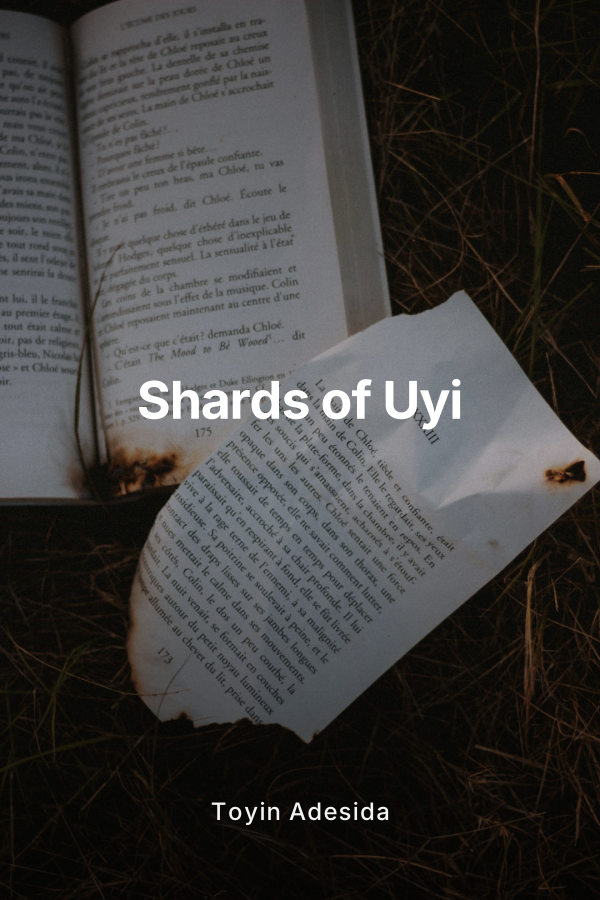
This book is a raw, character driven narrative that follows Uyi, a young woman carved by abandonment, secrecy, and the quiet devastation of being the child everyone chose to leave behind. Her mother walked away. Her father reinvented himself as a billionaire. The stepmother who might have been a refuge decided instead to protect the life she gained from Uyi’s absence. Together, they built a future on a hidden decision that rewrote Uyi’s fate without her consent, and then expected her to live inside that lie with gratitude.
Across five chapters, the story tracks Uyi from a hyper alert, love hungry child to a woman who refuses to forgive the people who broke her. There is no redemptive family reunion and no soft, healing monologue that wraps everything in grace. The central tension of the book is her refusal to offer the forgiveness the world insists she must give in order to be “whole.” Her wholeness comes from a different source entirely: the radical choice to honor her anger, protect her boundaries, and choose herself even when it makes her the villain in her parents’ story.
The tone of the book is intimate and unflinching. Readers live inside Uyi’s inner voice, which can be bitter, dryly funny, and achingly vulnerable all at once. She notices everything yet trusts almost nothing. She studies her parents’ moods like a survival skill, catalogues every broken promise, and turns sarcasm into a shield when the pain presses too close. She is not “nice” in the way wounded daughters are often scripted to be. She is honest. She tells herself the truths no one else dares to say out loud: that some parents do not deserve access to the adult their neglect created, that some wounds are not meant to be soothed with cheap apologies, that love without responsibility is just appetite dressed up as care.
The book’s emotional core is a secret that unfolds slowly rather than in a single explosive reveal. Fragments of memory, conflicting stories, and offhand remarks from relatives begin to fray the official family narrative. Uyi starts to see the outline of something ugly and deliberate beneath the chaos she grew up in. The betrayal operates on three levels. First, it is moral: an act or cover up so serious that the adults around her justified it as “protecting the family” while knowing it was deeply wrong. Second, it is personal: her needs, safety, and future were treated as expendable, traded away so that her father could rise and others could live comfortably. Third, it is existential: the truth about what happened to her corrodes everything she believed about why she was unwanted, revealing that it was never really about who she was but about what she was worth to them.
Chapter one centers Uyi as a child living in the hollow space between two kinds of absence. Her mother is physically gone, leaving behind a raw, tender longing that never settles. Her father is absent in a different way, present in the world as a man of growing wealth and influence but emotionally unreachable to the daughter he left on the sidelines. His success becomes the backdrop to her loneliness, a glittering proof that he can commit to dreams and deals but not to her. Uyi drifts between homes where she is never quite claimed, learning early that she must shrink her needs and read the weather of adult emotions to avoid being pushed out completely. She stops asking for love directly and instead trains herself to be useful, quiet, and low maintenance, hoping that if she causes no trouble, someone might finally decide to keep her.
Chapter two follows her into young adulthood, where survival skills learned in childhood start to poison the life she tries to build. Uyi becomes fiercely independent, but it is an independence born of distrust rather than confidence. She forms friendships yet holds pieces of herself back, assuming that every connection has an expiry date. Romantic interest unsettles her, not because she does not want intimacy, but because she does not believe anyone who truly sees her will stay. Her father’s wealth by now has hardened into a public legend, contrasted with their private imbalance. He sends money as proof of fatherhood and calls it sacrifice, while time, accountability, and tenderness remain conspicuously absent. The stepmother maneuvers as the quiet guardian of the family image, smoothing conflicts, rewriting history in gentle tones, and reminding Uyi that gratitude is the only acceptable response to generosity that arrived late and conditional.
In chapter three, cracks in the story she has been told begin to widen. An old document surfaces, a relative slips, a childhood memory returns with sharper edges, and Uyi realizes that the timelines around her parents’ separation, her living arrangements, and her father’s sudden ascent do not line up. Her intuition shifts from vague unease to focused suspicion. She pulls on small threads and finds they are tied to life altering choices: legal decisions that moved her like a piece on a board, financial agreements that converted her absence into leverage, and whispered understandings between her mother, father, and stepmother that treated her as a problem to be managed, not a person to be raised. With each discovery, her grief calcifies into fury and then into something even more potent, a deliberate resolve to uncover the entire truth no matter who it destroys.
Chapter four is the stage of confrontation, where politeness finally shatters. Uyi refuses the role of the grateful, forgiving daughter who is supposed to swallow outrage for the sake of “family peace.” She confronts each parent separately, then together, asking the questions they have spent years avoiding. Her father cloaks selfish ambition in the language of duty, insisting that everything was done “for her future” while ignoring the cost to her present. Her mother claims fear and helplessness, painting herself as a victim of circumstances rather than a participant in betrayal. The stepmother appeals to loyalty and stability, arguing that her first responsibility was to protect the home she helped build, even if that meant keeping quiet about the harm done to Uyi. None of them fully own what they did. None of them center her pain without immediately defending themselves. Faced with their half truths and self pity, Uyi makes a radical choice: she will not forgive them, not privately, not publicly, not at some imagined point in the future when everyone is older and “ready to move on.” Her refusal is not cruelty; it is self preservation. It is the first time she chooses her own emotional safety over their comfort.
The fifth and final chapter traces Uyi’s path toward a personal definition of freedom that does not require reconciliation. Instead of folding herself back into a family structure that has consistently harmed her, she redraws the boundaries of her life. She may maintain distant, controlled contact or cut ties completely, but every decision is measured against one standard: does this protect my peace. When children or younger relatives are involved, she chooses what role she can play that does not demand proximity to the people who betrayed her. She might turn down financial support, even when it would make her life easier, asserting that her dignity is worth more than any late arriving generosity. The story culminates in a decisive act that symbolizes her break from inherited guilt and obligation, whether it is a move, a legal severing, a spoken declaration, or a ritual farewell only she fully understands. Whatever form it takes, it is clear and irreversible. Uyi steps out of the shadow of being the discarded child and claims the authority to define herself without them.
Throughout, the book refuses to romanticize suffering or flatten Uyi’s complexity into a palatable healing arc. It honors the full spectrum of her emotions: the jagged anger, the corrosive shame of feeling unwanted, the exhaustion of always being the bigger person, and the fierce, quiet relief that comes from finally accepting that some relationships do not have to be saved. Readers who have experienced parental abandonment, emotional neglect, or the pressure to forgive unforgivable things will recognize themselves in Uyi’s internal battles. The narrative does not promise that choosing yourself is easy. It simply insists that it is possible, even when it means becoming the one who walks away.
Shards of Uyi is not a tale of prodigal parents welcomed back into a daughter’s embrace. It is a story of reclamation, of a woman who looks at the people who made her and decides that they will not be the ones who define her. It asks a hard question: What if the bravest thing a child of betrayal can do is refuse to forgive. And it offers an uncompromising answer: sometimes, the path to healing is not found in opening the door again, but in locking it, leaving the key behind, and walking toward a life where your worth is no longer up for negotiation.