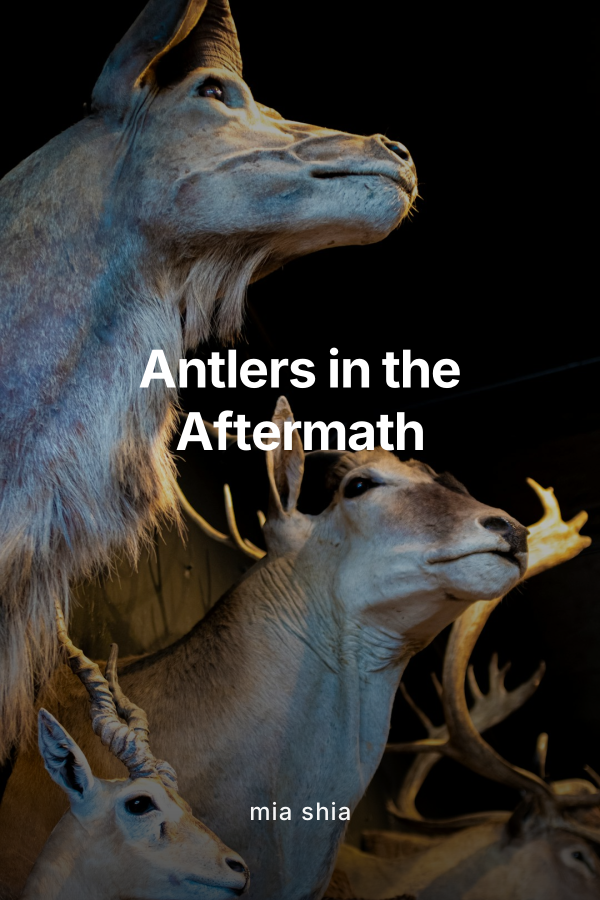
This book is a dark, character driven, post war fantasy that reimagines a familiar magical world through the eyes of a condemned “collaborator” who came back from the battlefield cursed, starving, and still determined to be good. It follows Percy Weasley, transformed into something part man, part deer, and part radio static nightmare, as he forces his way into his grieving brother’s cramped flat and even more claustrophobic life. Around them, a ruined family and a wounded society circle warily, trying to decide whether Percy is a traitor, a weapon, or kin.
At its core, the story is about survival when there are no clean hands left. There is no grand conspiracy or secret hunter stalking Percy, no neat external villain to blame. Instead, the tension comes from the ordinary brutality of a post war world where everybody is busy living with their own damage. George is drowning in grief and self destructive habits while running a joke shop that has forgotten how to laugh. Fred is alive but trapped in a body that refuses to cooperate, his mind as sharp as ever and his patience burnt away. Angelina and Lee are carrying their own scars and biases, pragmatic and watchful as they decide what kind of threat Percy actually is. The rest of the Weasleys hover on the story’s horizon, embittered, exhausted, and in no rush to forgive.
Into this uneasy landscape steps Percy, underpaid and overqualified on Ministry probation, quietly despised as the collaborator who sat beside power while everyone else bled. He clings to his desk job with a mixture of stubborn reformist conviction, self punishment, and cold practicality. The Ministry’s structures hide his curse and keep his days rigid enough that he can manage the hunger that gnaws at him. No one there knows that beneath the pressed robes and perfect manners lurk antlers, hooves, and a set of teeth that dream of human flesh. Percy does his best to ensure they never find out.
The curse gave him a shadow that moves when his body is still. It clings, trips, and strangles, slipping into three dimensions with a will of its own. Sometimes it is a comfort, sometimes a torment, and often the only thing in the room honest about his feelings. It mocks his martyrdom, hugs people he cannot bring himself to touch, and strains to throttle the Ministry coworkers who steal his work and question his loyalty. Percy spends his days reining it in with rigid professionalism while his frustration and self loathing build to private breaking points.
His instincts do not match his ethics. Hunger comes in surges like a non sexual rut, mixing territorial possessiveness, sensory overload, and a desperate need to protect “his” people with the almost physical craving to bite through bone. Percy refuses to kill for food. He survives on secret, morally complicated sources that keep him barely ahead of his urges. The more he forces himself into a respectable shape, the more his body protests, aching under concealment charms that hide antlers under hair and hooves inside polished shoes. The longer he holds the mask, the more it leaks; a twitch of an ear, a nosebleed, a shadow that twitches wrong beneath his chair.
When the book opens, George is rotting in his flat above the shop, its once vibrant colors dulled by grief. Business falters, bills pile up, and the twin who used to fill every room with noise has grown quieter in all the wrong ways. Reckless flights on brooms, untested products, and half hearted self harm all blur together into a slow attempt not to be here. Percy watches this from a distance until, without warning or permission, he arrives at George’s door with a suitcase and the implacable intention to stay. He cooks, cleans, rearranges furniture to satisfy the gnawing sense of territory that rides his nerves, and refuses to let George disintegrate where he stands. George reacts with fury, biting humor, and a deep need for someone to blame that keeps circling back to Percy.
The emotional engine of the book is the cramped domestic battle that follows. Percy’s presence in the flat is both an act of care and an invasion. George and Fred jab and snipe without politeness, weaponizing old memories and new resentments. Fred, limited physically but mercilessly observant, picks up on patterns Percy would rather no one see. George notices the wrongness at the edges first. A shadow that falls the wrong way at night. A plate cleared a little too clean. A hand that grips the counter with clawed knuckles for a heartbeat before smoothing back to human. Suspicion grows long before certainty.
Outside the flat, Angelina Johnson and Lee Jordan form a second gravitational center. Angelina is fiercely pragmatic, her priority George’s survival rather than Percy’s redemption. Lee is sharp, patient, and very good at collecting data without letting on. Together, they become the first non family witnesses to Percy’s new reality. Angelina notices how Percy’s careful competence steadies the shop even as his presence stirs up trouble. Lee clocks the gaps in Percy’s schedule, the way shadows around him seem too thick, and the tension that spikes in the room whenever certain topics arise. Neither of them rushes to confront him. They have lived through a war. They know the value of quiet observation.
The book is structured as a slow burn mosaic of perspectives. The main narrative alternates between Percy and George, locking the reader into two opposing, equally biased lenses. Percy’s chapters are dense with internal monologue, body horror, and suffocating self control, his emotions often showing more clearly in the physical behavior of his shadow than in his words. George’s chapters are rawer, fueled by grief, anger, and the confused recognition that he still loves the brother he wants to hate. As the story progresses, occasional chapters from Fred, Angelina, Lee, and eventually other family members and old friends slip in, each reframing prior events and exposing contradictions born of bias, trauma, and incomplete information.
There is no point where everyone learns the truth at once. Instead, knowledge fragments. George sees the shadow’s teeth before he understands the hunger. Fred decodes Percy’s routines and suspects something dark but not its nature. Angelina learns the scale of his self sacrifice before she ever glimpses antlers. Bill and Charlie, when they eventually step back into the narrative, approach Percy like a dangerous unknown: competent, protective, and unwilling to accept excuses. They investigate, confront, and close ranks around the younger siblings with a cold efficiency that terrifies Percy more than outright violence could.
At work, Percy endures microaggressions and quiet contempt from colleagues who rely on his competence while never letting him forget the war. They talk about him behind his back, excuse their cruelty as trauma, and lean on his meticulousness without credit. The Ministry itself is a monument to hypocrisy that sparks both his temper and his deerlike territorial instincts. Scenes in that environment puncture any romantic notion of institutional reform. Percy has to swallow the urge to let his shadow tighten around someone’s throat, to bare teeth at self righteous cowards, then go home and break down where no one can see.
The story’s horror is intimate rather than spectacular. Cannibalism is not a single shocking event but an ongoing, ugly fact of Percy’s life. He builds secret systems to feed without killing, pushing right up against ethical lines and sometimes over them. His senses pick up on injury, weakness, and fear in ways that make caring for Fred a minefield. Protective instincts and predatory hunger knot together around his disabled brother, forcing Percy into acts of fierce guardianship that are partly fueled by impulses he despises. When he uses his powers in hidden ways to keep Fred safe from negligent healers or casual bigotry, the line between altruism and territorial dominance blurs.
As the book unfolds across five broad movements, the tone shifts without ever offering easy relief.
In the opening movement, “The Flat,” readers are introduced to George’s collapsing routine and Percy’s monstrous normal. We see Percy feed, alone and horrified, before he puts on the mask and goes to the Ministry. We see George stagger through his day, the shop a caricature of former joy. Their first collision in the doorway of the flat sets the stage for an ongoing domestic siege.
The second movement, “Shadows in the Shop,” deepens the claustrophobic dynamic. Percy refits his environment, subconsciously carving out territory, while George fights him tooth and nail. Angelina and Lee circle closer. The shop’s financial struggles sharpen stakes. Fred asserts sharply limited but potent agency, refusing pity while resenting both overprotection and neglect. More and more, the narrative relies on near misses and subtle slips. Antlers in the bathroom mirror. Static on the wireless that is not supposed to be there.
The third movement, “Fault Lines,” marks the reluctant expansion of the cast. A family gathering that should have been simple becomes a study in brittle politeness and barely veiled contempt. Percy is treated as a guest at his own family’s table. Old grievances, from his break with them during the war to his current probation, surface in jagged fragments. Bill and Charlie’s competence stands in stark contrast to Molly’s guilt, Arthur’s weariness, Ron’s unresolved anger, and Ginny’s conflicted distance. No one leaves satisfied. Percy goes home gutted and hungrier than he has been in years.
The fourth movement, “Breaking Point,” draws together threads that have been quietly tightening. A crisis involving Fred’s safety forces Percy into a partially feral state in front of a small, crucial audience. The shadow drops its pretense, antlerlike shapes ghost over the walls, and for a heartbeat everyone in the room sees what he has become. Instead of a public exposé, it is a private fracture that cannot be undone. This is also the place where old school friends Penelope and Oliver re enter the story in a way Percy could never have anticipated. They are pulled in by necessity, only to reveal that they have missed him bitterly rather than written him off. Their fierce, loving confrontation with his martyr complex cracks something that neither family nor coworkers could touch.
The final movement, “Antlers in the Light,” is not about redemption so much as reconfiguration. Percy does not become less monstrous. George and Fred do not become gentle. The Weasley family does not miraculously snap back into pre war warmth. Instead, relationships shift by degrees. George and Fred find themselves defending Percy in public more reflexively, then catching themselves doing so and not knowing what to do with that realization. Angelina and Lee move from suspicion into a messy, pragmatic loyalty that still allows room for anger. Bill and Charlie grudgingly acknowledge Percy’s usefulness and intent even as they continue to treat him like a volatile asset. Penelope and Oliver insist on remaining in his life, helping rebuild a version of friendship that is honest about what he is now.
Throughout, the book leans into dysfunctional, unsanitized family dynamics. The Weasleys are allowed to be bitter, unfair, and blinded by their own pain. Percy is allowed to be angry with them as well as ashamed. Scenes of quiet cruelty sit alongside moments of reluctant care. A cup of tea left outside Percy’s door after a fight. A protective step in front of him when someone mutters “collaborator” too loudly in a pub. A set of shop shelves quietly rearranged to accommodate his sensory issues. These are the points of light the book protects.
The intended audience are readers who enjoy intense, AO3 style, character driven fanfiction sensibilities translated into original length narrative: people who want their hurt/comfort tangled with horror, their worldbuilding grounded in realistic trauma, and their interwoven points of view to contradict each other in ways that invite rereading. The content is firmly Mature to Explicit in terms of violence, body horror, and mental health struggle, but it is rigorously non sexual. Queer and romantic themes exist mostly at the edges, as background texture rather than plot center.
Ultimately, Antlers in the Aftermath is about the slow, unglamorous work of learning how to live with the things you did to survive and the things that were done to you in return. Percy’s monstrosity is never fully cured. George’s grief is never fully quiet. Fred’s body never suddenly heals. The Ministry does not become just, and the Weasleys do not become saints. What changes is the willingness of these people, in all their damage and prejudice, to keep sitting at the same table, to keep showing up, to keep building something that might, eventually, resemble a life.
By the end, the reader is left with a cautiously hopeful, deeply scarred ensemble: a monster who refuses to be only a monster, twins who discover that caring does not undo betrayal, a family that may never fully understand but chooses, in small, stubborn ways, to keep reaching across the gulf. The war is over. The aftermath is not.