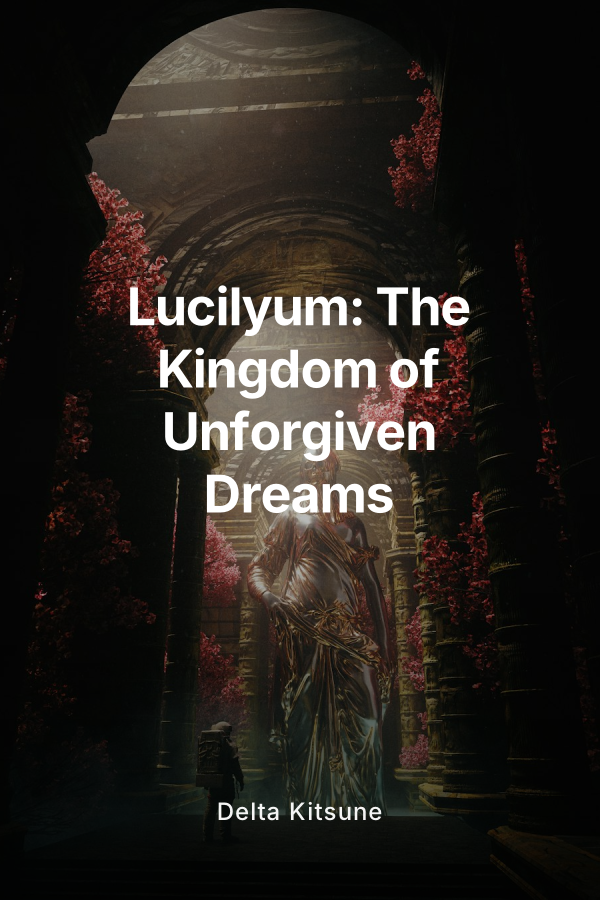
This book follows Kaiden, a quiet boy branded a killer after a freak roadside accident, and his two best friends Blake and Hyde. Together they stumble into Lucilyum, a mutable dream world shaped by imagination and haunted by the unresolved guilt of those who found it before them. What begins as an escape from trauma becomes a descent through graveyards of lost souls, a crumbling obsidian castle, and trials that rip open the truths they have buried about a single terrible day.
The story opens in a dim local courtroom where Kaiden stands trial for manslaughter. He was caught rummaging through a convenience store dumpster when a mannequin he had propped against the wall toppled into the road. A passing car swerved to avoid what the driver thought was a body, crushed an unsuspecting pedestrian against a lamppost, and turned Kaiden into the convenient focus of everyone’s horror. The judge’s soft repetition of his halting account turns each detail into a knife, and though the court rules the act unintentional, Kaiden walks out carrying a sentence no one can lift: the belief that he is a murderer who does not deserve to live freely.
Months later, exhausted by waking life, Kaiden slips into sleep and awakens in a limitless paradise that obeys his imagination. Here he can conjure forests, oceans, and quiet rooms where no sirens wail and no headlights streak across his memory. Lucilyum appears first as a personal refuge, a private afterimage of things he wishes he could feel again. Every morning he wakes disappointed that the world of light and endless possibility is “only a dream,” yet he drags himself through the day to reach that world again each night.
One evening the illusion of solitude shatters. While reshaping his private landscape, Kaiden hears voices threading through the air and finds two silhouettes intruding on his perfect sky. They resolve into Blake and Hyde, classmates from his waking life who should not exist inside his mind. They explain that Lucilyum is not his dream at all but a shared realm that certain people enter when they sleep. His paradise is only a fenced-off corner, a safe paddock within a greater world. When you walk beyond your own border long enough, you stumble into the spaces other dreamers have built. That is how Blake found Hyde’s realm, and together they have drifted far enough to crash into Kaiden’s.
Skeptical, Kaiden tests their claim in the real world. The next day at school Blake and Hyde approach him, describing his private dream with impossible accuracy. Convinced at last, Kaiden meets them in Lucilyum again that night. What starts as friendship rekindled in an unreal place soon becomes a vote that will alter all their fates. The trio debate whether to remain in their paradises or step past the boundary into the “empty” spaces that lie between. Kaiden, weary and cautious, wants to stay, but Blake and Hyde crave adventure. Outvoted, Kaiden follows. The color of the world bleeds from soft teal to oppressive black as they leave safety behind, the air cooling and thinning as if they are walking underwater.
In that darkening expanse, something begins to follow. A towering specter appears behind them: a cloaked figure whose hem drips blood, one leg shackled with half a key, one hand gripping the other half, the bones of its limbs formed from translucent mist. It attacks with sudden, savage speed, striking Hyde first and crumpling her to the ground. Blake leaps forward, conjuring a sword from his imagination to protect her, but his bravado fails when the creature’s strength overwhelms him. Only Kaiden, desperate to stop yet another senseless death, dares to speak. He conjures a translator, discovers the creature’s rage at seeing others walk freely between worlds, and talks it down. The specter withdraws, leaving Hyde bruised but alive and Blake already searching for someone to blame. He accuses Kaiden of dragging them into danger despite having led them there himself. The wound is shallow, yet the resentment it opens will prove deep.
Pressing onward, the children stumble into a graveyard where each tombstone glows faintly and a ghostly figure stands sentinel over its own name. The dead tell them what Lucilyum truly is. Every apparition here was once a living human who discovered this realm after grievous suffering in the waking world. Some chose to stay forever, exchanging life for a beautifully constructed lie. Others became specters, beings trapped or regretful who tried to leave but found there is no easy path back once you have bound yourself to this place. Lucilyum, they explain, is a refuge built from imagination and guilt, a world where you can escape what torments you, but at a cost that can reach across into your sleeping body. If you wander beyond your personal paradise, a line of light appears in the sky and crawls slowly from one horizon to the other. When it finishes crossing, your time has run out. Fail to return to your sanctuary in time and the connection between mind and body breaks. Your dreaming self stays here. Your waking self dies.
One ghost gestures toward the far distance where a fractured obsidian castle waits. Its walls glint like snowflake obsidian, spiderwebbed with luminous cracks that shimmer as if barely containing the ruin underneath. If the children want to understand Lucilyum, and perhaps their own reasons for being drawn here, they must go to the King’s castle. They leave the graveyard behind and walk toward the looming structure that, as Kaiden remarks, looks like it is held together by hope and dreams themselves. Later they will learn that this is literally true.
Inside the castle they find three main halls. One leads to a treasure room cluttered with objects that seem utterly worthless. Another opens into bare sleeping quarters. The last bears a sign scorched into the stone: “Trial Chambers.” As they stand before it, a vast disembodied voice rolls through the aisles and informs them that this hall leads to the King’s throne room, but that anyone who wishes to stand before him must first survive the trials. These trials will expose their entire being and test their worth. Blake, usually fearless, freezes at the threshold. Hyde has to nudge him to move. Kaiden notices the terror in his friend’s eyes and files it away with unease, but the choice is made. He steps into the dark hall, calling for them as the black swallows them one by one. Their voices fade. The floor under his feet feels less like stone and more like memory.
An orb of light appears, explaining that they have been separated. Each must face an individual trial designed around their deepest flaw. Kaiden is dragged back to the night of the accident. Here he is forced not to forget but to watch again and again until he understands that some horrors are born from human frailty, not malice. He cannot change what happened, yet he can decide what to do with the guilt. The trial teaches him to stop worshiping his pain as a punishment and instead to treat it as a warning and a responsibility: a reason to guard others more fiercely, even if the memory will always hurt.
Blake’s trial takes the shape of a courtroom where he must decide whether to trade places with Kaiden and face a prison sentence that should have been his from the start. All his life he has blamed others, hiding his fear behind swagger and casting responsibility on anyone within reach when circumstances turn grim. Here, in the suffocating silence of Lucilyum’s judgment, he sees for the first time how small his courage truly is. To be brave, he realizes, is not to look fearless but to accept the consequences of your actions even when they terrify you. Hyde’s trial unfolds in a surveillance room filled with screens. She has always protected those she loves by covering up their worst mistakes, desperate to think of herself as a good person who never lets anyone she cares about suffer. The trial shows her how that instinct robs them of the lessons they need. Faced with the choice to delete incriminating footage that would send either Kaiden or Blake to prison, she must learn that mercy without truth becomes poison.
When Kaiden finishes his trial, the guiding light informs him that the King is waiting. A door forms and dissolves, revealing an imposing figure where the hall gives way to a throne room carved from darkness and glimmering fissures of pale light. Beside the throne, the same luminous presence that guided him hovers like an ancient flame. The man on the throne introduces himself as King Luciferous, first of Lucilyum, not its strongest dreamer but its chosen ruler because he alone knows the burden each soul carries. The realm was once a void, he tells Kaiden, until he arrived with his own guilt and discovered he could sculpt refuge out of nothing using imagination. He built the paradises, the castle, and the wandering light in the sky to warn dreamers of their dwindling time and guide them through the trials that might one day let them return home better prepared to navigate the waking world.
Luciferous then utters a chilling assertion. Kaiden is not in Lucilyum because he killed someone. He is here because he is guilty for something he did not cause. Confused and dreading, Kaiden allows the King to show him the truth. At a gesture, the light flares, and he is hurled back into the scene of the accident. This time, he views the moment from another set of eyes and realizes Hyde is at his side, also witnessing it from a foreign vantage point. He understands with horrifying clarity that he is seeing through Blake. It was Blake’s casual cruelty, kicking a ball toward the mannequin at just the wrong moment, that toppled it into the street. When authorities arrived, Blake framed Kaiden. Hyde corroborated the lie, claiming to have seen everything. Kaiden relives his own arrest, the humiliating court procedures, and the deadly weight of public judgment, now knowing that two people he trusted turned their backs on him to save themselves.
Crushed by this revelation, Kaiden wakes again in Luciferous’s throne room, barely able to stand beneath the combined weight of his long-carried self hatred and the fresh sting of betrayal. All the oddities he ignored now make sense: Blake’s fear of the trials that would expose his secret, Hyde’s quick dismissal of anything that might scratch the surface. Luciferous apologizes for the pain of the vision but insists that Kaiden deserves the truth. Kaiden, shaking, thanks him for refusing to hide it. Only with the truth can he decide what justice and mercy should look like.
He has little time to process before the light announces that Blake and Hyde have survived their own trials and are on their way. When they enter the throne room, Kaiden’s gaze tells them everything. Blake drops his eyes, words of apology dying on his tongue. Hyde, overwhelmed by guilt, turns and runs into a dark side corridor. Blake chases her, begging Kaiden to help. Reluctant but still unable to watch them suffer alone, Kaiden follows. At the end of the long hall a faint exit glows, but a vast specter blocks it, looming over Hyde as she screams for help.
They fight the creature together, all three children conjuring weapons and defenses as the specter thrashes and swings. In the chaos it strikes the doorway itself, shattering its frame. Stone and light rain down, and the exit begins to collapse. Kaiden notices that beyond the falling rubble the sky of Lucilyum is already streaked by the traveling beam of light. Their window to escape the realm is close to vanishing. He understands with sudden horror that staying to keep fighting will doom them. Someone has to buy time. With a choice echoing the accident that changed his life, Kaiden hurls Blake and Hyde bodily through the narrowing gap. The exit seals behind them, trapping him inside with the specter. He refuses to be the kind of person his friends were on that roadside; he will not choose his own safety over their lives.
Alone, he manages to drive the specter away and then struggles to clear enough rubble to squeeze through, only to see that the line of light in the sky has almost completed its journey. If he does not return to his paradise before it reaches the far horizon, he will never wake up again. Realizing that there is not enough time, Kaiden turns back toward the throne room. His death, he decides, is acceptable if it means Blake and Hyde live long enough to learn from what they have done. Meanwhile, the scene cuts to his friends on the other side. Thrown into safety, they claw uselessly at the sealed entrance, knowing Kaiden is still trapped inside Lucilyum even as the sky light approaches its end. Hyde formulates a desperate plan. To save him, they must return to their individual paradises, wake up, and find his sleeping body in the real world.
In Kaiden’s bedroom, Blake and Hyde shake him, calling his name, trying to pull his mind back across a bridge that should already have collapsed. Back in Lucilyum, Kaiden reports to Luciferous that he has decided to stay. The King is surprised to see him still in the realm given how little time is left. He asks Kaiden why Blake and Hyde are not with him. Kaiden explains what happened in the collapsing hall and tells him he has accepted his fate. He is tired. Lucilyum is peaceful. Perhaps he belongs in this kingdom of those who cannot forgive themselves.
Luciferous refuses to accept such an easy surrender. He has seen too many exhausted souls lie down in his domain and never rise again. With a sweep of his hand he commands the light to show Kaiden everything in his life that was ever worth cherishing: fleeting joys, small kindnesses, his parents’ faces. Just when Kaiden expects the vision to end, the images shift. He sees Blake and Hyde in his bedroom, frantic, trying to haul him back from the brink in the waking world. The King asks him once more whether he truly wants to die here and now, knowing what he would be abandoning. Kaiden admits that he wants to return but assumes it is already too late. The light in the sky has finished its passage. The rules of Lucilyum are clear. Luciferous hints that the realm was built by a soul bending impossible rules, and perhaps, given these extraordinary circumstances, he can bend them again. Kaiden agrees to try. There is a moment of obliterating white, and then he opens his eyes in his own room, staring up at a ceiling that suddenly feels heavier and more precious than any star-filled dream. Blake and Hyde are above him, crying with relief. None of them can quite meet the others’ gaze for long.
The epilogue shifts to a graveyard in the waking world. The three children stand at the headstone of the man killed in the accident, placing flowers on soil that will never give back what it holds. They sit together in hollow silence until Kaiden tells them they need to talk. Blake already knows what conversation is coming. Hyde realizes only when she sees Kaiden’s expression fixed on the name carved in stone. Blake begins to explain what happened that day, but Kaiden stops him. He has already seen the truth. What he wants to know is not how they lied, but why.
Blake and Hyde recount what the light showed them in their trials: Blake’s cowardice and addiction to blaming others, Hyde’s suffocating instinct to protect at any cost. They apologize, not just for the lie, but for every quiet moment afterward when they let him carry a weight that belonged to them. Blake asks if they can forget the past and return to how things were when they first met, a memory conjured briefly of a quiet school auditorium where Kaiden played a piano alone until two sets of hands joined him and turned his solitary melody into a shared song.
Kaiden tells them the truth that neither apology nor magic can undo. After Lucilyum, things can never be what they were. Trust once shattered does not simply reassemble itself into the same shape. But he also admits that perhaps, with time and work, they can build something new that is stronger than the innocence they lost, a friendship not based on illusions but on hard-won honesty. The three of them clasp hands over the grave as if binding themselves to a vow that will be tested every day they wake. Far away, in the cracks of a distant obsidian castle, King Luciferous hangs a picture of them on his wall, another fragile testament to the living who dared to walk his kingdom and return.
Across five chapters, “Lucilyum: The Kingdom of Unforgiven Dreams” weaves a dark, atmospheric horror tale about children wandering through a realm built from the detritus of human sorrow. The book traces Kaiden’s journey from a boy sentenced in his own mind to a murderer’s life, through a dream world that feeds on guilt, to a climactic confrontation where the greatest terror is not the specters that stalk the halls but the realization that betrayal came from the people he trusted most. Lucilyum itself is a living symbol of trauma, luring the broken with the promise of escape while quietly asking whether any of them can endure the cost of refusing to face what they have done.
At its core, the novel asks if forgiveness is possible when the dead cannot speak for themselves, when the living must decide how much truth they can bear, and when the safest world you know is one that wants you never to wake up again.