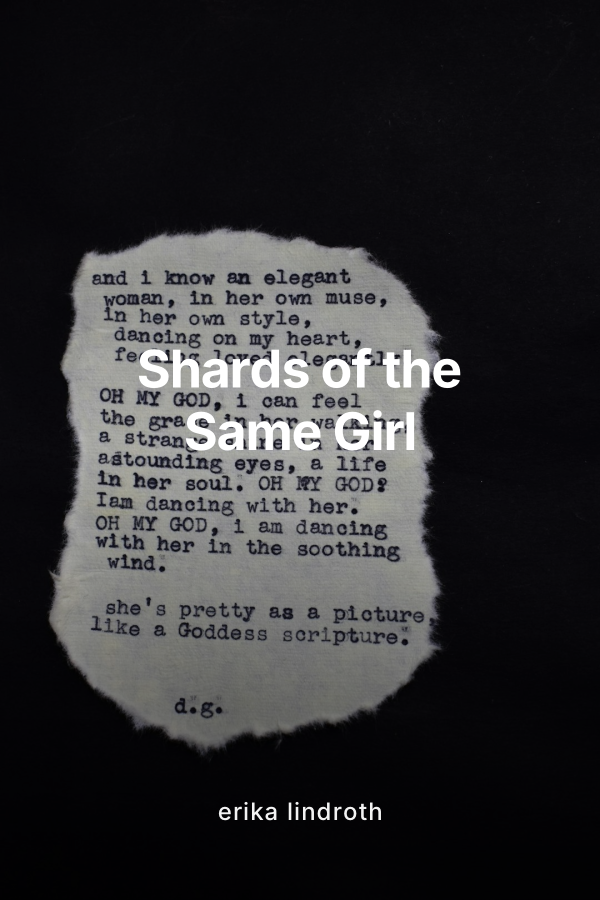
Erika has built her life on sharp edges. In the strobe lit chaos of a crowded student flat, she survives on black eyeliner, cigarettes, and the armor of being “the hot tiny one” who always looks in control. Beneath that image sits a fragile body, a medical history she refuses to discuss, and a private conviction that needing anyone is the fastest way to lose them. Her best friend Mila is the only person who sees even a fraction of the truth: the stumbling on the stairs, the moments when drunk bravado flickers into something closer to collapse, the quiet way Erika’s hands shake when she thinks no one is looking .
This novel follows Erika as her meticulously curated world collides with the one secret she thought would stay buried. Between classes, club nights, and the claustrophobic intimacy of student living, she opens an email that detonates her sense of self. On the screen is a message from the woman who gave her up at birth, a woman now living in Los Angeles, asking to finally be part of Erika’s life. The request is simple and impossible at once. Erika has spent years telling herself that not knowing is safer. Suddenly, knowing is an option.
The opening chapters capture Erika’s double life. In public she is magnetic and reckless, a girl people orbit without ever quite touching. In private she monitors every signal from her body, pushing it past exhaustion even as she fears its limits. The party scene at the student flat becomes a microcosm of her internal conflict. Strobe lights flicker over sweaty strangers on the balcony while Mila hovers in an uneasy guardian role, switching from tipsy to sober and protective the moment Erika stumbles on the stairs. The night is loud, hot, and full of competing narratives: the version of Erika her peers idolize, the version Mila worries about, and the version Erika refuses to confront.
When the adoption email arrives, Erika’s response is not a cinematic breakdown but a series of small, charged gestures. She slams the laptop shut, walks away, then returns. She deletes the message and retrieves it from the trash. She rehearses a dozen different reactions and chooses none. The story treats these minor actions with the gravity they deserve because for Erika, letting that email exist in her inbox is already a betrayal of the story she has written about herself. The book leans into that tension instead of rushing past it. The mystery is not what happened in the distant past but how Erika will survive letting the past into the present.
Mila’s role complicates everything. She is used to protecting Erika from obvious threats: creepy guys at parties, late night walks home, doctors with dismissive smiles. She does not know how to protect her from an email. Her instinct is to demand answers, but Erika responds with sarcasm and retreat. Some of the most piercing moments come from what Mila notices but cannot name. The way Erika’s jaw locks as she rereads the subject line. The cigarette that burns down to the filter while Erika stares into the middle distance. The unfinished messages Erika types and erases. Their friendship becomes both lifeline and battleground.
The heart of the novel is Erika’s slow, begrudging journey from outright refusal to reluctant curiosity. Early on, she chooses rage as a shield. She insists she does not want a mother now, not after building a self that does not require one. That insistence is loud, sometimes cruel, and laced with the fear that opening this door will invalidate the ways she has adapted. The book lets her stay in that resistance for longer than is comfortable. Instead of a neat epiphany, we see a series of cracks: a late night Google search, an impulsive scroll through old medical files, an argument with Mila that reveals just how much she associates vulnerability with danger.
Structurally, the story is grounded in dark academia. The campus is not a backdrop but an active pressure system. Essays pile up, seminars dissect identity and family in abstract terms, and Erika finds herself tested by ideas that echo too closely. Hallways and libraries hold their own secrets, from whispered rumors about Erika’s health to glimpses of other students’ private struggles. The novel explores how intellectual environments can both illuminate and obscure personal truth. Erika is sharp enough to psychoanalyze everyone else, yet blind to her own most basic needs.
As the narrative progresses toward Los Angeles, the tone shifts from claustrophobic student life to a broader, disorienting horizon. The email is no longer just text on a screen but an invitation to a different city, a different version of herself. The LA chapters, when they arrive, are not a simple reunion fantasy. They are a confrontation with layered betrayals: why she was given up, why the contact is happening now, and what her adoptive and birth families have chosen to withhold. The story does not offer a clean villain. Instead it presents flawed adults who made decisions under their own limits, leaving Erika to sift through the fallout.
Body, identity, and choice remain central themes. Erika’s medical history is treated as both literal and metaphorical truth, a record of a body that has never been allowed to be neutral. The novel examines how chronic vulnerability can produce both control and self destruction, from drinking patterns to relationship dynamics. Her adoption is not framed only as loss, nor only as gift, but as an ongoing, messy condition she must reinterpret as she grows. The email from LA becomes a catalyst for re evaluating everything she believes about being chosen, being wanted, and being enough.
The emotional arc balances anger with hard won tenderness. Readers are invited to feel frustrated with Erika even as they understand the logic of her defenses. Her most hurtful decisions are never presented as random; they emerge from an internal logic shaped by abandonment, bodily uncertainty, and the coping scripts she has rehearsed for years. As she slowly allows Mila and others closer, the book honors that shift without turning it into a cure. Healing here is incremental and sometimes invisible: a message actually sent instead of deleted, a night where she asks for help instead of insisting she is fine.
By the final chapters, Erika’s journey is not one of tidy reconciliation but of expanded capacity. She may or may not fully accept her birth mother into her life. What changes is her willingness to live without rigidly controlling every variable. She learns that knowing the truth cannot retroactively fix childhood, yet not knowing has its own cost. The conclusion offers a bittersweet sense of forward motion. Erika steps into her future with more information, more ambiguity, and a different relationship to both.
“Shards of the Same Girl” speaks to readers drawn to character driven stories about identity, found family, and the ways secrets warp the present. It will particularly resonate with anyone who has lived with medical precarity, adoption, or the quiet, consuming fear of needing too much. The dark academia setting, intense female friendship, and psychological realism create a narrative where every choice feels razor edged. At its core, the book asks a question that lingers long after the last page: What happens when the story you built to survive collides with the people who remember you from before the story even began?