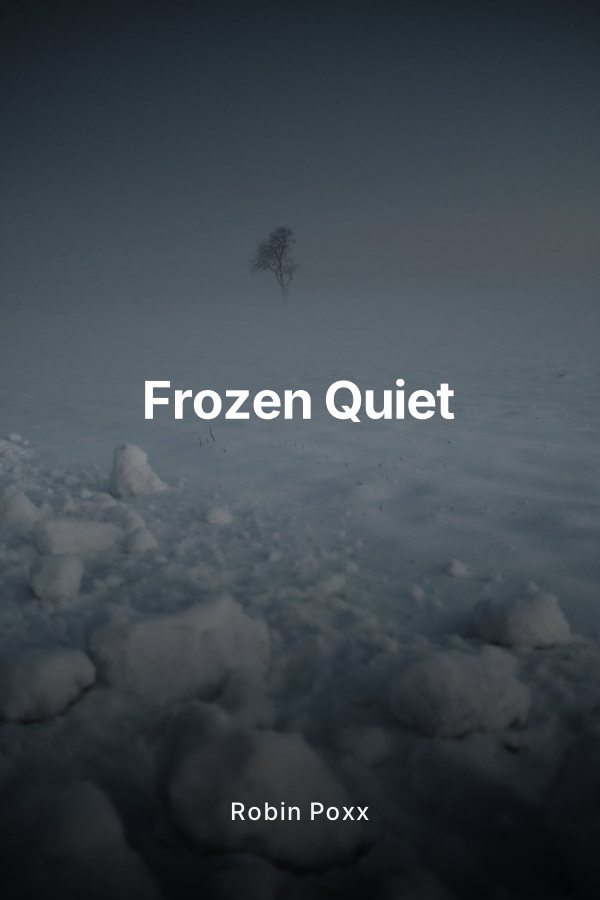
In a world already broken, the cold is the only thing still honest.
One year after the fall of everything familiar, survivors have split into two kinds: the ones who learned, fast, how to live with monsters, and the ones who became monsters themselves. Hanji Zoë belongs stubbornly to the first group. A field scientist used to vanishing into remote terrain for weeks at a time, she has retooled every research habit into survival instinct. She knows how to choose a camp that cannot be ambushed. She knows how long a corpse will last in summer heat. She knows how to move, how to listen, how to disappear.
Most of all, she knows how to keep her daughter alive.
June is four, quick as a deer and bright as a flare against the ash. She is the entire point of Hanji’s existence now, the only reason Hanji did not let herself go under when civilization did. For a year they have stayed two steps ahead of shambling bodies and desperate humans, trading comfort for safety and community for anonymity. Hanji trusts no one, because she has seen what people become when the rules vanish and the future shrinks down to the size of a full stomach.
When a pack of young men spot mother and child in the gutted city, Hanji recognizes them at once. Not the faces, but the type. The muscular, laughing students who used to snicker when she guest lectured and said “field work” with a certain gleam in their eyes. Boys who thought strength meant entitlement. On their lips, the word “females” is not a description, it is a verdict. She understands exactly what they have planned for her and for her daughter, and there is no courtroom left to appeal to.
So she makes her own justice instead.
The book opens with the decisive, ugly moment that changes everything: the instant Hanji pulls the trigger and blows apart the face of the man who thought she was prey. The shot echoes through the dead city, calling the infected like a bell. Suddenly Hanji is not just a lone protector in the ruins, she is a target marked by four vengeful men and a looming undead tide. She has a split second to choose between staying low in familiar streets or vanishing somewhere no human in their right mind would follow.
She chooses the mountains.
From this first chapter, “The Shot,” the story establishes its core tone: gritty and dark with only small interruptions of softness that feel more valuable precisely because they are rare. Hanji’s running internal monologue revisits over and over what those men intended, what might have happened if she had hesitated, and just how thin the line is between woman and corpse in this new world. Her fear is not theatrical. It is practical, analytical, edged with a scientist’s morbid curiosity about how far people can fall.
Carrying June in her arms, packed inside a thick emergency coat, Hanji heads for the range of snow-covered peaks that loom like a final border. She has been up there before in the old life, when the cold meant nothing more than numbers on a thermometer and the wilderness was a data set. Now it is a wall she is determined to get behind, convinced the steep, frozen slopes will slow zombies to a stop and leave them buried statues beneath drifts of powder.
The journey is brutal. Night falls like a dropped curtain, and a storm comes with it. The snow deepens to a choking waist-high crawl. Hanji’s skin burns with cold, her lungs scrape raw, her glasses fog and freeze. The book leans deep into sensory detail here, building a claustrophobic, disorienting struggle where every step is a negotiation with her failing body. Yet throughout, one rhythm never changes: the constant, frantic checks on the small heartbeat against her chest. June’s breath is warm, her complaints soft and sleepy. The contrast is sharp, bordering on cruel, but it is what keeps Hanji moving.
Into this white screaming void walks Levi.
A lantern glow flickers ahead, moving in the blizzard like an old myth come to life. Levi Ackerman appears not as a savior but as another threat, a short, compact figure with a rifle already raised to Hanji’s head. In this world, anyone who survives this long does it by assuming that strangers are dangerous first, human second.
He does not lower the gun until he sees the child.
Hanji’s last act of consciousness is not to plead for her life but to roll onto her side so that if she passes out, she will not crush June under her own weight. Her field training, her maternal instinct, every sharpened survival reflex she owns converges into that single gesture. The snow swallows the rest.
The second chapter, “The Cabin,” opens with warmth so abrupt it feels unreal. Hanji wakes up on a sofa, wrapped in blankets, the air filled with the earthy scent of burning wood. Heavy blackout curtains smother any hint of light from leaking outside, a detail that tells her, even in her panic, that whoever brought her here understands stealth. Her first instinct is not gratitude. It is alarm. June is no longer pressed against her chest.
That panic slams through the scene as she bolts upright, half delirious and ready to attack the armed man watching her with a gun at his side. He introduces himself as Levi, his posture coiled and wary. The moment he assures her that June is safe, June herself barrels into the room. The reunion is fierce and desperate, a knot of limbs and hair and breath where the rest of the cabin disappears.
In the doorway, another child peers in. A small girl around six with black hair and soft, familiar features. Her presence changes the emotional geography immediately. The cabin is not just a bunker, it is someone’s home, and Levi is not only a survivor but a father.
Her name is Kuchel.
From this point, the book shifts into the heart of its premise: a forced cohabitation story where two damaged adults, each with a child depending on them, must decide whether to trust each other enough to share a life. The tone remains harsh and grounded, but the stakes expand. Every conversation across Levi’s kitchen table is haunted not just by zombies and dangerous men out there, but by what could happen in here if this uneasy truce cracks.
Levi admits he would have shot Hanji on sight if not for June. It is not an insult, just plain survival logic. A lone adult is a possible threat. A mother with a child looks like an ally. He needs to know who she is, how much chaos she will bring to the fragile system he has built for himself and his daughter. Hanji, in turn, understands his suspicion. She has felt it herself a hundred times in a hundred ruins. Their first long talk is raw and practical, a trade of information about routes, infected behavior, and the men who are likely still hunting her.
“Frozen Quiet” builds its tension on several interwoven tracks.
First, there is the constant, low hum of the undead world. Out in the woods and valleys below, zombies still roam, drawn by sound and heat, slow but relentless. Hanji and Levi both know that the mountains are safer than the city but not invincible. All it would take is a single bitten animal, a freak thaw, or a desperate human group using the slopes as a pass, and the isolation could turn into a trap.
Second, there is the human threat that drove Hanji uphill in the first place. The surviving men who watched one of their own die under her bullet are unlikely to let that go. Whether they are dead, torn apart by the undead horde stirred by the gunshot, or still tracking her through the valleys becomes the book’s main external mystery. Their possible return looms over every quiet domestic scene, a shadow at the back of the hearth.
Third, and most central, is the emotional siege inside the cabin walls. Hanji and Levi carry very different kinds of damage, and their clash, then collaboration, gives the story its pulse.
Hanji has spent a year in motion, parenting in constant crisis mode. Her love for June is ferocious, almost animal. She is quick to laugh in old memories and quicker to imagine the worst that could happen if she misses a warning sign. The men in the city did not just scare her, they carved a permanent groove of horror into her thoughts. She runs mental replays of their leers and words repeatedly, using the pain like a tool to keep her guard up. Any hint of male aggression around June makes her bristle.
Levi has done the opposite. He has rooted himself to this one piece of ground, fortifying a cabin so thoroughly that it looks more like a bunker than a home. He is meticulous about cleanliness and order because that is how he beats back the terror he will not talk about. His daughter Kuchel is the center of his life, but his parenting style is taut and controlled, built on rules, routines, and quiet watchfulness. He knows exactly how easily he could lose her and has responded by trying to control every inch of their environment.
Early chapters follow the friction where these two philosophies crash. Hanji is used to improvising, bending rules to survive. Levi is allergic to unnecessary risk. When June and Kuchel begin to play, turning the cabin into an obstacle course and inventing innocent “zombie games,” both adults must navigate their fear without strangling the children’s brief moments of joy. The book lingers on the small parenting arguments that stand in for larger unspoken trauma. How far can the girls wander outside? Do they need to learn how to use knives and guns yet, or is there still room for play?
Beneath the arguments runs an undercurrent of hesitant attraction.
Hanji and Levi’s chemistry is not smooth or sweet. It is jagged, born from mutual respect and shared exhaustion. They notice each other first as assets. Hanji admires Levi’s discipline, the way his hands move with quiet confidence as he maintains weapons or patches leaks. Levi respects Hanji’s deep understanding of terrain and infection patterns, recognizes that her restless mind sees threats he might miss. Only later do they register the warmth in each other’s eyes when they watch their daughters together, the way their shoulders ease when the four of them share a meal in fragile peace.
There is no sudden, cinematic surrender between them. Instead, the romance takes shape in stolen intervals.
A night by the fire where Hanji cannot sleep and Levi, keeping a disciplined watch, finds himself listening as she talks about the old life. About university halls, microscope slides, and the surreal memory of her friend Moblit, father of her child, dying in the chaos of the early outbreak. She confesses the guilt that gnaws at her. They never meant to become parents. Now June is the only thing that makes her grateful for that drunken mistake, and also the thing that terrifies her most, because losing her would be a punishment she does not believe she could survive.
In return, Levi reveals piece by piece how he ended up alone on a mountain with a six year old. The book hints at violent choices, lost family, and a slow, stubborn climb toward this fragile security. He does not spill everything at once. Each new disclosure comes in the wake of a shared crisis, a contest of trust where he gives an inch only after Hanji gives one too.
Throughout, the pacing respects the user’s wish for a generally fast development in their relationship, but without betraying the harsh realism of the setting. They become a parenting team before they admit, even to themselves, that they are becoming partners in a deeper sense. There are practical milestones first. Sharing the work of chopping wood and hauling water. Teaching each other skills that make them less likely to die. Standing shoulder to shoulder when a lone wanderer tests the cabin’s defenses. Making co-parenting decisions together instead of stubbornly alone.
Only after that do the emotional milestones arrive.
A first, impulsive hug after a near miss in a storm. A moment of silent, bristling fury when Levi, badly shaken, realizes that Hanji risked herself unnecessarily to distract a threat from the cabin. A night when nightmares grip Levi so hard that he wakes ready to attack, only to find Hanji on the other side of the room, deliberately visible, speaking to him softly from a distance instead of reaching out and risking another trigger. These scenes are where the tone briefly softens, letting in just enough light to keep the story from suffocating in its own bleakness.
The book never shies away from the fact that the biggest predators, even now, are other humans. At least one major arc brings the men from Hanji’s past back into the picture, forcing all four main characters to confront what safety really means. The resulting climax is not just a firefight or a desperate defense against a siege. It is a crucible where the family they have tentatively formed is tested in blood.
After that trial, the final chapters pivot toward hard-earned stability rather than utopian hope. Hanji and Levi decide consciously to stay in the mountains, to make the cabin not just a bunker but a home. They draw lines on maps together, marking zombie migration paths and safe foraging routes. They build routines for the girls that include education, chores, and tiny rituals of celebration that mark the seasons in a world where calendars have lost their power.
The romance, true to the stated vision, remains clear and deeply felt but never explicit. There is a kiss that feels less like a seduction and more like a vow, a quiet “we are in this together” exchanged in a kitchen that smells of stew, with two sleeping children just behind a thin wall. There are words of commitment that stop short of traditional declarations, because those old phrases feel out of place in a landscape of ruin. Instead, the book lets small acts carry the weight of love. A repaired pair of glasses. A new story invented for bedtime that honors the dead without scarring the living. A shared ritual of stepping out together each morning to check the tree line, side by side.
In the epilogue, time skips forward.
June and Kuchel are older, still sisters by choice in a world that no longer remembers legal bonds. They move through the snow with practiced ease, laughing in the thin air, confident in their skills. The cabin bears scars of the years but stands firm. Inside, Hanji and Levi navigate the subtle, everyday negotiations of long-term partnership: winter planning, injury care, the balance between treating the girls like children for as long as possible and training them as the next generation of survivors.
The world outside remains dangerous. Zombies still roam the lower slopes. Other survivors still make desperate, sometimes brutal choices. Nothing has been fixed. There is no final cure, no rebuilding of roads or cities. The book refuses to promise that kind of false resolution.
What it does offer instead is something more modest and more radical. A found family that survives not because they are ruthless, but because they are relentless in protecting their small, shared tenderness in the middle of horror. Two parents who learned, too late, what kind of violence society will sanction against women and children and decided they would never let that script play out again in their presence. Two daughters who have grown up with a new definition of normal where love speaks in preparedness and trust is a daily practice, not a naive default.
“Frozen Quiet” is, at its core, a story about what remains when the world strips everything else away. It is about the line between necessary brutality and needless cruelty, and how loving someone in a landscape of corpses requires the same courage as facing a charging horde. It asks what it means to build a future when there is almost no future left.
Across five chapters, the book will trace this arc in full:
-
The Shot
Hanji and June’s flight from the city, the confrontation with the predatory men, the first gunshot that condemns them to the mountains, and the brutal climb into the storm that nearly kills them both. -
The Cabin
Hanji’s awakening in Levi’s fortified refuge, the introduction of Kuchel, the uneasy negotiation of temporary safety, and the first clashes and alignments in parenting philosophies. -
Ghosts at the Door
Threats close in from below and within, as memories of past violence and the possibility of vengeful pursuers strain the fragile equilibrium, forcing the adults to test how much they can trust each other. -
Blood in the Snow
A major external attack turns the cabin into a battleground, demanding sacrifice, courage, and a willingness to claim each other as family in order to survive the onslaught with their humanity intact. -
The Quiet After
The aftermath, reconstruction, and time skip that reveal the lasting shape of this found family: two parents bound not by law but by choice, two daughters growing into the world they inherited, and a mountain home that stands as proof that love can outlast the end of the world.
For readers, “Frozen Quiet” offers a dark, emotionally charged journey that balances horror with rare but piercing softness. It is not a tale of heroic conquest or triumphant rebuilding. It is the story of four people learning to stay, to trust, and to love in a place where the simplest victories, like a warm child’s laugh or a shared meal behind blackout curtains, are the ones that matter most.