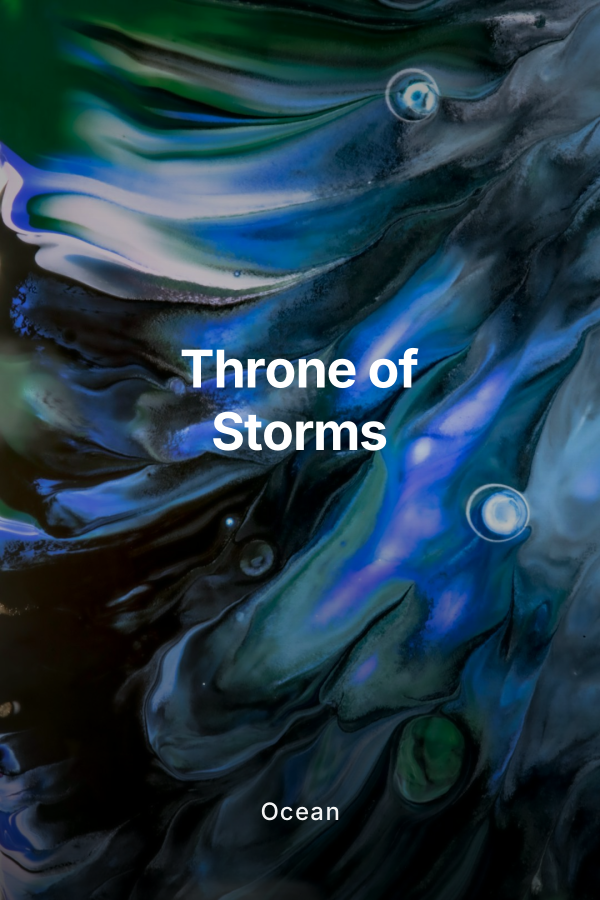
This stand alone YA romantasy blends forbidden love, political rebellion, and storm drenched battles in a cliff carved kingdom where humans and dragons have become enemies, yet remain bound by a single, perilous throne.
At the heart of the story are Elira, a newly crowned human queen raised to fear dragons, and Vaerith, an ancient storm dragon who once ruled beside one of Elira’s ancestors in an era now half erased from history. Centuries ago the Throne of Storms was shared by a human queen and Vaerith, their bond sealed by magic and love. When the queen died under mysterious circumstances, Vaerith vanished into the clouds, storms went quiet, and human rulers sealed the throne. What remained was an official story of betrayal and catastrophe that painted dragons as dangerous, untrustworthy creatures that had to be kept at a distance or driven away.
Now the storms have returned in violent, erratic waves on the very day Elira is crowned. Lightning claws at the cliff faces, wind tears banners from their poles, and, in the roiling dark, a dragon shaped shadow answers the sky. Vaerith descends from the storm, unaged and unbowed, to stand before a court that has named his kind monsters. His appearance cracks open a forbidden past and a dangerous future. Elira has always been haunted by dreams of a dragon watching her from storm filled skies. Confronted with Vaerith in the flesh, she realizes those dreams were not nightmares, but echoes of an old, broken bond that now reaches for her.
The kingdom carved into the cliffs is already fracturing. Human factions argue over how to confront resurging storms and the question of dragons. Some want to weaponize the throne as their ancestors once did, turning Vaerith into a living storm engine to secure their dominance. Others want to destroy the throne completely, to end all dragon bonds and any possibility of shared rule. In the shadows, a rebel movement rises, wielding hatred of dragons and fear of the throne as a rallying cry. They insist that the old era brought only devastation and that any intimacy between human rulers and dragons is a curse waiting to repeat itself.
Elira stands in the middle of this conflict. She inherits a crown tied to a throne everyone fears, and a legacy entangled with a dragon no one trusts. Raised on laws that forbid bonds between humans and dragons, especially any hint of love, she knows the punishment for crossing that line will be brutal. At best she could lose her crown and her claim. At worst it could mean death, exile, or open war should dragons retaliate. Yet from the moment Vaerith returns, the storms themselves seem to recognize Elira, surging when she denies him and softening when she yields to even the smallest thread of connection.
Forced into alliance by necessity, Elira and Vaerith agree to pursue a fragile truce. The storms are growing wilder and a new, twisted stormborn creature emerges from broken magic, threatening to tear the kingdom apart. It is an abomination born from centuries of fear and failed attempts to sever human dragon bonds, a living consequence of political choices rooted in hate. Only together can Elira and Vaerith hope to understand the throne’s true power and the cost of misusing it.
Their partnership begins in open distrust. Elira sees Vaerith as a potential weapon and a reminder of the dangers she was raised to despise. Vaerith views Elira as a fragile echo of the queen he once loved, unsure whether she is worthy of the bond the throne demands or destined to repeat past betrayals. Yet in battles against rebels and stormborn horrors, in quiet negotiations beneath carved stone ceilings, and in rare calm moments within the eye of the storm, they learn each other’s scars.
Emotionally, their connection sparks quickly. They recognize the loneliness in each other, the way both have been shaped and caged by forces older than they are. But any step toward romantic or physical intimacy is slow, tentative, and charged with fear. They share sky long flights instead of kisses, hand on scale instead of confession, heart pounding closeness without crossing the line that could doom them both. Lightning sings through Elira’s veins when Vaerith’s magic brushes her skin. Every near touch becomes its own battle, every almost confession a risk to the fragile peace holding the kingdom together.
At the same time, their forbidden bond becomes a fault line in the wider political struggle. To some, their growing closeness looks like treason, proof that Elira is too compromised to rule. To others, it is a symbol of hope, a chance that humans and dragons might reclaim a shared legacy and end a cycle of fear. Rebels within the court and in the cliff carved city twist rumors of their bond into a weapon, accusing Elira of surrendering human freedom to an immortal beast. Hard line dragon factions, still nursing centuries of resentment, see in Elira an opportunity to reclaim power, but only if they can bend her to their own goals.
Battles escalate. Sabotage within the royal guard results in a failed assassination attempt that nearly kills Vaerith, shaking Elira’s certainty about whom she can trust. Smaller skirmishes along the kingdom’s borders test alliances with distant dragon flights. A siege against the cliff city during a storm becomes a brutal test of Elira’s leadership, forcing her to choose between the safety of her people and the secrets she keeps about the throne and her bond with Vaerith. Mid air clashes between dragons light the sky as stormborn creatures tear at both sides, indiscriminate in their rage.
When the rival faction finally strikes at the throne itself, their goal is nothing less than the erasure of human dragon history. They hope that by destroying the throne they will sever all bonds and end the storms forever, even if it means collapsing the ancient magic that holds the cliffs and skies in balance. Their efforts twist the stormborn creature into something more monstrous, a reflection of all the broken promises and violent choices that have built this world. In one devastating confrontation, Elira and Vaerith stand together against this abomination, realizing that their bond is both the target and the answer.
The climax forces Elira into an impossible decision. She can destroy the throne, breaking the cycle of magical dependence that has chained rulers and dragons together, but in doing so she will sever her connection to Vaerith and likely doom the kingdom to a stormless, brittle future. Or she can claim the throne fully, binding herself to Vaerith in a way the law forbids and the rebels fear, surrendering the illusion of human independence in exchange for shared power. Knowing the cost, Elira chooses the throne not for the crown, but for love and for the future their bond represents.
In claiming it, she redefines what that ancient power means. Instead of standing above Vaerith as a master wielding a weapon, she stands beside him as an equal. The magic that once demanded dominance reshapes itself around mutual trust, sacrifice, and an unashamed, fiercely protected bond. The stormborn creature falls, unraveled by the healing of the magic that created it. The rival faction’s final attempt to shatter human dragon unity fails. What could have ended in pure tragedy instead becomes a bittersweet, hard won victory that still leaves scars.
In the falling action, the kingdom must reckon with what Elira and Vaerith have done. Some call for her removal, for punishment that would placate those still afraid of dragons. Others see that without their forbidden bond the storms would have consumed them all. The cliff carved city rebuilds under skies that thunder less in violence and more in steady, rhythmic rain. New laws begin to take shape, slowly unwinding the ancient taboos that once demanded separation. Dragons who once hid in distant ranges return in cautious flights, uncertain but curious. Humans who grew up under stories of dragon horror must now face living, breathing proof that those tales were only half true.
The resolution looks forward. Years pass, and storms return not as threats but as reminders of the balanced magic Elira and Vaerith uphold. Standing together on the cliffs they now rule, they feel the weight of their choices and the legacy they have forged. Their love has remained slow and deliberate, rooted as much in partnership and shared duty as in the fire that first sparked between them. The kingdom is not perfect, politics have not vanished, and old prejudices still lurk in the shadows, yet there is a genuine sense of hope that the next generation will inherit a world less defined by fear.
Across five chapters, the full book will deepen this arc. It will explore the ancient history of the Throne of Storms and the first bond between human queen and dragon. It will trace Elira’s growth from a reluctant heir haunted by nightmares into a queen who dares to rewrite the laws of her own world. It will follow Vaerith’s slow return from grief and self imposed exile, revealing why he vanished and what it costs him to risk love again with someone mortal and fragile. The politics between humans and dragons will expand into layered intrigue and rebellion, with each battle and betrayal testing whether coexistence is truly possible. At its core, the story will remain a fast yet carefully restrained emotional romance, where every step toward intimacy feels both earned and dangerous.
Throne of Storms is ultimately a bittersweet but uplifting YA romantasy about choosing connection over fear, love over law, and shared rule over solitary power. It offers storm lashed battles, forbidden tenderness, painful sacrifices, and a final image of a kingdom learning to trust the sky again, not because it has forgotten the past, but because two rulers dared to face it together.